Google Rolls Out Gemini 4 Hydrogen for Faster Coding and Agentic AI Workflows
Google says Gemini 4 Hydrogen is rolling out globally across its developer, enterprise and consumer products.
Written by Shaurya Tomer, Edited by Rohan Pal | Updated: 13 November 2026 14:54 IST
Click Here to Add Gadgets360 As A Trusted Source
Advertisement
Google announced Gemini 4 Hydrogen on Thursday as its latest AI model that brings faster AI assistance to everyday tasks. Instead of extended reasoning, the Mountain View-based tech giant claims it is aimed at coding, research and agentic workflows that require quick execution. Gemini 4 Hydrogen is available across Google's developer tools, enterprise services, Gemini app and Search, while being positioned as a more accessible option compared to the company's other AI models.
Gemini 4 Hydrogen
In a blog post, Google described Gemini 4 Hydrogen as a faster and more efficient model for everyday coding and agentic workflows. While Gemini 4 Carbon and Gemini 4 Argon are designed for complex reasoning and longer tasks, Hydrogen is claimed to focus on rapid execution.
As per the company, the AI model can also work alongside the other models in multi-model workflows. It is said to be capable of handling tasks such as writing code, running tests, and verifying changes.
Google said that Gemini 4 Hydrogen surpasses Argon on the Artificial Analysis Intelligence Index at its default high thinking level, scoring 51 compared to Argon's 50. Its score rises to 54 at the highest xhigh thinking setting. The tech giant also claims that the model can complete tasks faster than other models in its class.
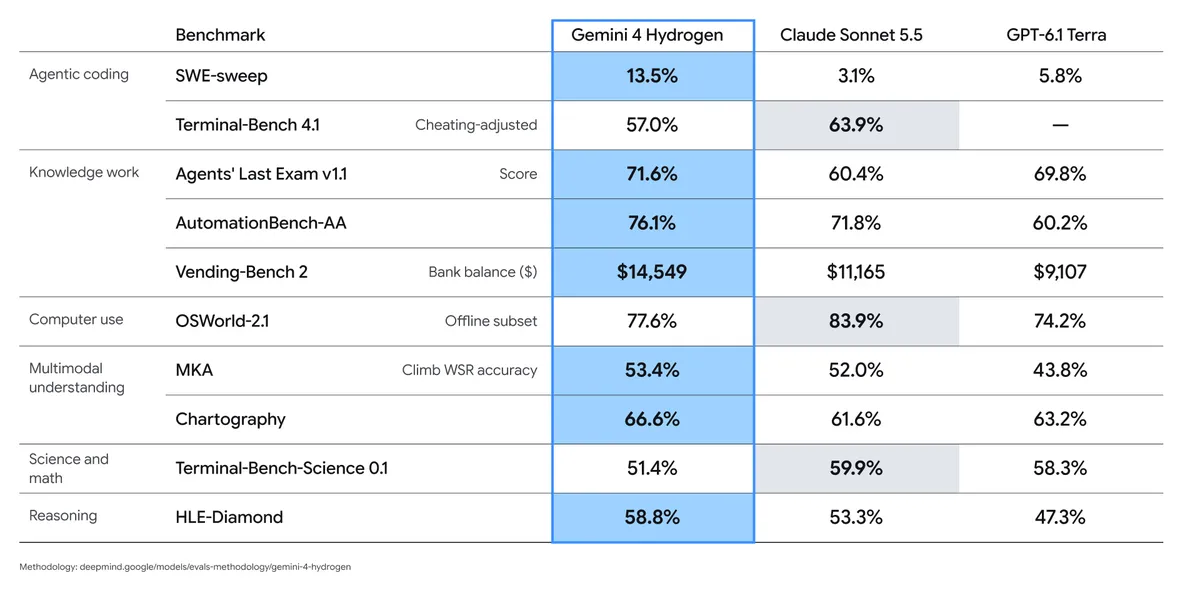
One of the key use cases for Hydrogen is said to be multi-model collaboration. Instead of relying on a single model for an entire task, Google is introducing Orchestrator in Google Antigravity, which can dynamically switch between models such as Carbon and Hydrogen during a session.
On Terminal-Bench 4.0, Google claims Orchestrator achieved task success rates close to those of Carbon while consuming 24 percent less quota on average and completing tasks 19 percent faster. In workflows involving parallel agents, Carbon can coordinate the task while Hydrogen handles worker and verifier roles. This, as per the company, allows code to be built and tested simultaneously across isolated workspaces.
For software development, Hydrogen is designed to handle debugging, codebase navigation, issue resolution and iterative coding with focused changes. Google says it can inspect large repositories by batching file-reading and search calls in parallel. The model can also carry out open-ended tasks like deep research, data analysis, and navigating large codebases.
Gemini 4 Hydrogen supports up to 1 million input tokens and up to 1 million output tokens. The company says this allows it to process large collections of documents, spreadsheets, charts, audio, and recorded video to generate reports and structured deliverables. The model offers four thinking levels: low, medium, high and xhigh.
It is also available in the Gemini app. According to the company, the AI model can follow instructions more closely, use relevant tools, and handle multi-step requests with less back-and-forth. It can help users prepare emails, study guides and documents while retaining their requested tone and format.
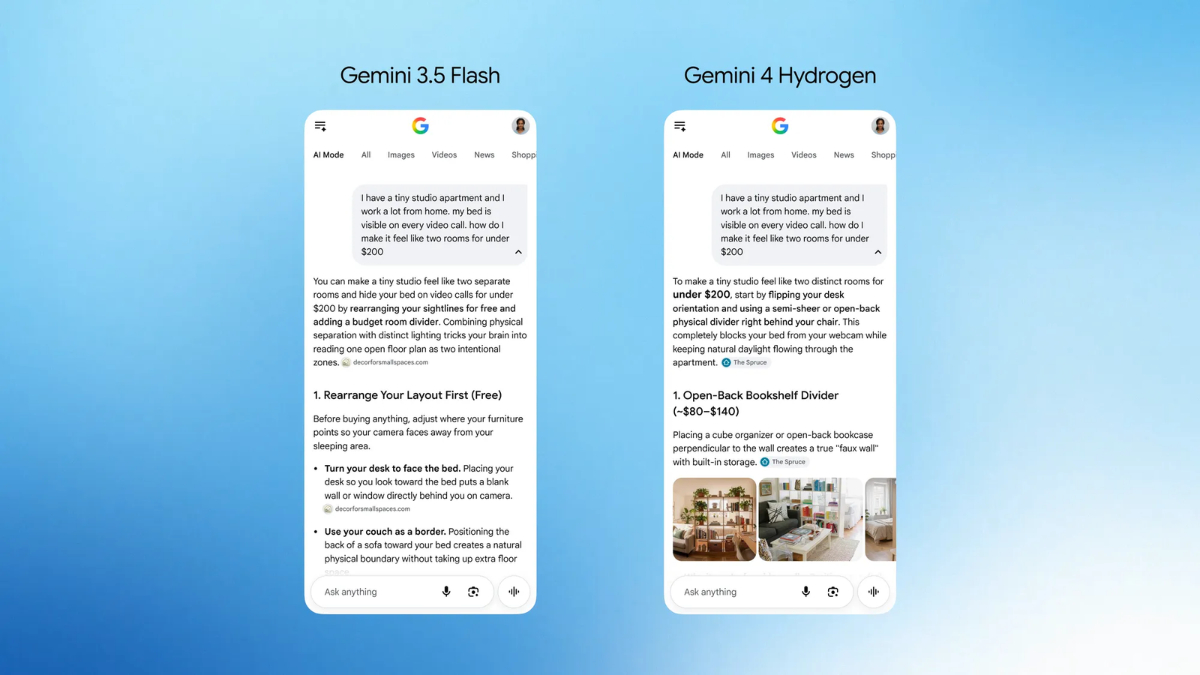
In Google Search, the company claims Hydrogen will improve how the service understands complex queries. These include questions with multiple parts, specific requirements or typos. The AI model will also generate more visual and easy-to-scan responses and surface a wider range of relevant links through improvements to its query fan-out technique.
Google says Gemini 4 Hydrogen is rolling out globally across its developer, enterprise and consumer products. Developers can access it through the Gemini API in Google AI Studio and the paid tier in Android Studio. For enterprise customers, the model is available through Gemini for business, Google Antigravity and Gemini in Google Sheets for eligible subscriptions. Consumers can access it through the model selection menu in the Gemini app and through Google Search, where Google says it is available to all users. Gemini in Google Sheets is also available to Google AI Pro and Ultra subscribers.
Comments
Get your daily dose of tech news, reviews, and insights, in under 80 characters on Gadgets 360 Turbo. Connect with fellow tech lovers on our Forum. Follow us on X, Facebook, WhatsApp, Threads and Google News for instant updates. Catch all the action on our YouTube channel.
Further reading:
Gemini 4 Hydrogen, Google Gemini


Advertisement
Follow Us


-
 Best Entry-Level Android Phones Under ₹9,999 on Amazon: Top Picks for Everyday Use
-
Best Nilkamal Ergonomic Office Chairs in India for Long Work-From-Home Hours
-
Top Performance Tablets Under ₹30,000 with High Refresh Rate
-
Best OLEVS Automatic & Chronograph Watches for Everyday and Formal Wear
-
Ergonomic & Stylish Leather Card Holders & Slim Wallets for Men Under ₹999
-
₹46000 से ज्यादा सस्ता मिल रहा Samsung का बड़ी डिस्प्ले वाला फ्लैगशिप फोन
-
सिर्फ ₹1 हजार में दूर हो जाएगी ठंड, फ्लिपकार्ट पर मिल रहे ये 5 रूम हीटर
-
Microsoft की सर्विस ठप, यूजर्स ने की शिकायत, दुनिया भर में रुक गया काम
-
BYD Denza D9 इलेक्ट्रिक MPV भारत में लॉन्च, 608Km रेंज और 9 एयरबैग्स से लैस, जानें कीमत
Advertisement
Popular on Gadgets
- Samsung Galaxy S26 Ultra
- Motorola Razr Fold
- ChatGPT
- OPPO Find N6
- Mobiles Under Rs. 40,000
- Vivo X300 Ultra
- Asus Zenbook S14
- iQOO 15
- Vivo X300 Pro
- Lenovo Yoga Slim 7i Aura Edition
- iQOO 15R
- Vivo X Fold 5
- Sony PlayStation 5
- HP OmniPad 12
- OnePlus Nord CE 6 Lite
- OnePlus Pad 4
- OPPO F33 Pro 5G
- Cryptocurrency
- HP OmniBook Ultra 14 (2026)
- iPhone 17
- Eureka Forbes AP 355 Room Air Purifier
- Latest Mobile Phones
- Compare Phones
Latest Gadgets
- Vivo Y6k
- Karbonn Rebel
- Karbonn Rebel Pro
- OnePlus Turbo 6Vs
- Redmi M100 Pro
- OnePlus Ace 7 Pro
- OnePlus Ace 7
- Samsung W27
- Dell 14S (2026)
- HP ProBook 4 G2iS 14
- Infinix Xpad 30
- iPad mini (2026)
- Moto Watch 2 Fit
- Pebble Qore 2
- Toshiba 65-Inch 4K Ultra HD Smart Mini LED QLED TV (65Z670SP)
- Haier M70 Mini LED 65-inch
- Acer Predator Atlas 8
- Asus ROG Ally
- Blue Star 1.5 Ton 5 Star Inverter Split AC (IE518ZNURS)
- Blue Star 2 Ton 3 Star Inverter Window AC (WIE324L)

- About Us
- Sitemaps
- Feedback
- Archives
- Contact Us
- RSS
- Advertise
- Career
- Privacy Policy
- Ethics
- Editorial Policy
- Terms & Conditions
- Complaint Redressal
Download Our Apps
Available in Hindi
© Copyright Red Pixels Ventures Limited 2026. All rights reserved.