-
 NASA’s Europa Clipper May Cross a Comet’s Tail, Offering Rare Glimpse of Interstellar Material26 October 2025
 -
Scientists Explore Role of Space Radiation in Powering Alien Microbial Life6 August 2025
-
Europa Could Briefly Sustain Life When the Sun Becomes a Red Giant Star, Scientists Say7 June 2025
-
NASA’s Europa Clipper Captures Stunning Infrared Image of Mars17 May 2025
-
Scientists Observe Rare Plastic Ice, A Hybrid Form of Ice and Water, Under Extreme Pressure and Heat20 February 2025
- Home
- Science
- Science News
- Europa’s Hidden Ocean Could Be ‘Fed’ by Sinking Salted Ice; New Study Boosts Hopes for Alien Life
Europa’s Hidden Ocean Could Be ‘Fed’ by Sinking Salted Ice; New Study Boosts Hopes for Alien Life
Simulations reveal that dense, salt-rich ice on Jupiter’s moon Europa can sink through its thick ice shell.
Written by Gadgets 360 Staff | Updated: 25 January 2026 14:38 IST
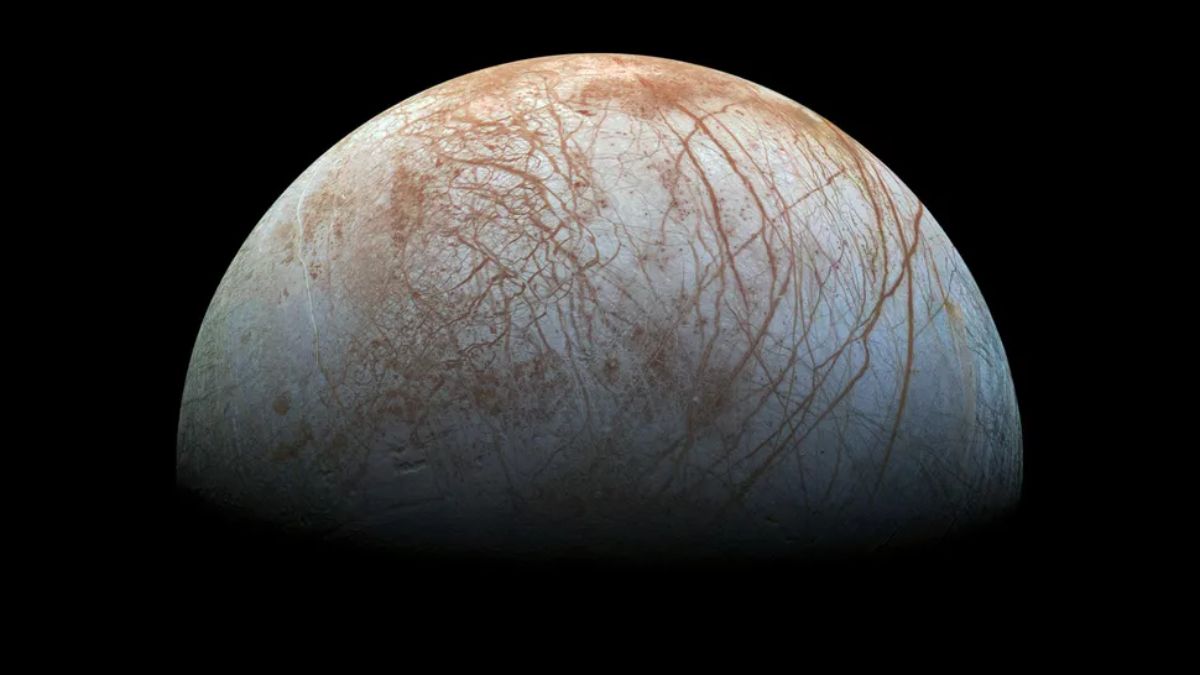
Photo Credit: NASA
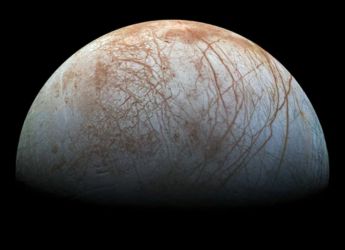
Research suggests Europa’s salty ice sinks into ocean, delivering nutrients, oxidants life
Click Here to Add Gadgets360 As A Trusted Source


Advertisement
The surface of Jupiter's moon is composed of ice and is filled with craters and crevices, which imply the presence of a hidden ocean. A brand-new study indicates this ocean is probably supplied with nourishment. This is enabled through undersurface ice blocks, or ‘drips' of dense and saline ice, falling into the ocean as these ice blocks become extremely heavy and release into the ocean. This ice drip brings with it nutrients and increases its habitable potential.
Salt-rich ice sinks
In the new study, scientists modelled a Europa-like ice shell 30 kilometres thick, finding that salty surface patches become denser and weaker. Under these conditions, the salt-rich ice detaches and slowly sinks through the shell. Simulations showed that all surface layers considered eventually descended toward the base of the shell.
The sinking can occur on geological timescales: in fractured ice, it can begin in as little as ~30,000 years, while intact shells took 5–10 million years. The authors liken this to lithospheric foundering on Earth, where dense crust sinks into the mantle.
Feeding Europa's hidden ocean
Europa's hidden ocean could thus be fed by the sinking ice, which carries down oxidants and nutrients produced on the surface. Simulations suggest this process could recur over geological timescales, acting as a steady pipeline of nutrients into the ocean.
As study lead author Austin Green notes, the idea addresses one of Europa's habitability problems and is "a good sign for the prospects of extraterrestrial life" in the ocean. Launched in 2024, NASA's Europa Clipper will reach the moon in 2030 to make dozens of flybys and study the ice shell and ocean.
Comments
Get your daily dose of tech news, reviews, and insights, in under 80 characters on Gadgets 360 Turbo. Connect with fellow tech lovers on our Forum. Follow us on X, Facebook, WhatsApp, Threads and Google News for instant updates. Catch all the action on our YouTube channel.
Related Stories



Europa’s Hidden Ocean Could Be ‘Fed’ by Sinking Salted Ice; New Study Boosts Hopes for Alien Life


Advertisement
Follow Us




-
05:05
Goboult Mustang Racer Smartwatch Review: Should You Get This Mustang Smartwatch? -
04:58
OnePlus Nord Buds 4 Pro Review: Specs, Sound Quality, ANC, and Battery Backup Tested -
02:29
[Sponsored] Samsung Galaxy S26 Ultra First Look: AI Smartphone for Creators, Gaming & Productivity -
04:25
Vivo X200T Review - Full Camera, Gaming & Battery Test | Worth Buying? -
28:31
The Future of Productivity: Logitech's Anatoliy Polyanker On AI, Hybrid Work, And India's Tech Boom
-
Redmi 15A 5G की सेल शुरू, जानें कितने में मिल रहा 6300mAh बैटरी वाला फोन
-
7300mAh बैटरी, 50MP कैमरा वाले OnePlus फोन पर बंपर डिस्काउंट, जानें
-
Zepto बेच रहा 24 हजार रुपये सस्ता iPhone 17 Pro Max, सबसे तगड़ा डिस्काउंट
-
iPhone 17 Pro Max खरीदें 47 हजार तक सस्ता! Apple की 50वीं वर्षगांठ पर धमाका ऑफर
-
महंगे हो रहे स्मार्टफोन! Xiaomi ने बताई असली वजह
Advertisement
Popular on Gadgets
- Samsung Galaxy Unpacked 2026
- iPhone 17 Pro Max
- ChatGPT
- iOS 26
- Laptop Under 50000
- Smartwatch Under 10000
- Apple Vision Pro
- Oneplus 12
- OnePlus Nord CE 3 Lite 5G
- iPhone 13
- Xiaomi 14 Pro
- Oppo Find N3
- Tecno Spark Go (2023)
- Realme V30
- Best Phones Under 25000
- Samsung Galaxy S24 Series
- Cryptocurrency
- iQoo 12
- Samsung Galaxy S24 Ultra
- Giottus
- Samsung Galaxy Z Flip 5
- Apple 'Scary Fast'
- Housefull 5
- GoPro Hero 12 Black Review
- Invincible Season 2
- JioGlass
- HD Ready TV
- Latest Mobile Phones
- Compare Phones
Latest Gadgets
- Honor Play 80
- Nord 6
- Honor X80i
- Honor Play 80 Pro
- Redmi Note 15 SE 5G
- Redmi A7 Pro
- OPPO K15 Pro
- OPPO K15 Pro+
- Xiaomi Book Pro 14
- MacBook Neo
- Vivo Pad 6 Pro
- Lenovo Legion Y700 Gen 5
- boAt Valour Watch 1R
- Xiaomi Watch S5
- Xiaomi QLED TV X Pro 75
- Haier H5E Series
- Asus ROG Ally
- Nintendo Switch Lite
- Haier 1.6 Ton 5 Star Inverter Split AC (HSU19G-MZAID5BN-INV)
- Haier 1.6 Ton 5 Star Inverter Split AC (HSU19G-MZAIM5BN-INV)

- About Us
- Sitemaps
- Feedback
- Archives
- Contact Us
- RSS
- Advertise
- Career
- Privacy Policy
- Ethics
- Editorial Policy
- Terms & Conditions
- Complaint Redressal
Download Our Apps
Available in Hindi
© Copyright Red Pixels Ventures Limited 2026. All rights reserved.