-
 Isro, Nasa's Nisar Earth Observation Satellite to Be Launched in 202128 August 2015
 -
Prime Minister Modi Congratulates Isro on Successful Launch of GSAT-627 August 2015
-
Isro Launches GSAT-6 Communications Satellite27 August 2015
-
Isro Says Countdown for GSAT-6 Launch to Start Wednesday25 August 2015
-
India to Launch Communications Satellite for Strategic Applications Soon21 May 2015
- Home
- Science
- Science News
- Countdown Begins for Isro's GSAT 6 Launch on Thursday
Countdown Begins for Isro's GSAT-6 Launch on Thursday
By Indo-Asian News Service | Updated: 26 August 2015 13:56 IST

Click Here to Add Gadgets360 As A Trusted Source

Advertisement
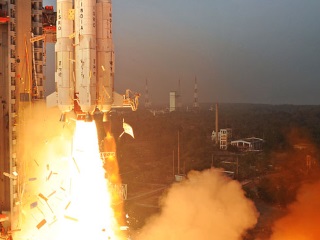
Indian space agency is flying the GSLV rocket with its own cryogenic engine for the second time on Thursday after the successful launch of similar rocket in January 2014 that put into orbit GSAT-14.
A cryogenic engine is more efficient as it provides more thrust for every kilogram of propellant burnt.
The satellite GSAT-6 is India's 25th geostationary communication satellite and twelfth in the GSAT series.
Five of GSAT-6's predecessors were launched by GSLV during 2001, 2003, 2004, 2007 and 2014 respectively.
After its commissioning, GSAT-6 will join the group of India's other operational geostationary satellites.
The satellite provides communication through five spot beams in S-band and a national beam in C-band for strategic users.
The cuboid shaped GSAT-6 has a lift-off mass of 2,117kgs. Of this, propellants weigh 1,132kgs and the dry mass of the satellite is 985kgs.
One of the advanced features of GSAT-6 satellite is its S-Band Unfurlable Antenna of six metre diameter.
This is the largest satellite antenna realised by Isro. This antenna is utilised for five spot beams over the Indian main land.
The spot beams exploit the frequency reuse scheme to increase frequency spectrum utilisation efficiency.
The satellite's life expectancy is nine years.
Comments
Get your daily dose of tech news, reviews, and insights, in under 80 characters on Gadgets 360 Turbo. Connect with fellow tech lovers on our Forum. Follow us on X, Facebook, WhatsApp, Threads and Google News for instant updates. Catch all the action on our YouTube channel.
Related Stories






Advertisement
Follow Us




-
![[Sponsored] LG NANO 4K UHD AI TV NU885: Gemini Search, Dolby Atmos & 5 Years of Updates](https://www.gadgets360.com/static/desktop/images/spacer.png)
04:17
[Sponsored] LG NANO 4K UHD AI TV NU885: Gemini Search, Dolby Atmos & 5 Years of Updates -
00:57
[Sponsored] Samsung Galaxy Z Fold8 My Fan Cam in Action: Find the Moment, Then Share It -
01:41
[Sponsored] What Do You Need To Know Before Your Next Run? | Samsung Galaxy Watch Ultra2 -
01:32
[Sponsored] Big Day Tomorrow? Prep Today | Samsung Galaxy Watch Ultra2 -
04:37
[Sponsored]: CP PLUS CarKam CP-F89B: 4K Dashcam With Rear Camera, GPS & Emergency Recording
-
iPhone 16 आज भी Amazon सेल में मिल रहा ₹15 हजार से ज्यादा सस्ता
-
OnePlus 15 को Amazon Great Indian Festival Sale में खरीदें सस्ता
-
₹2250 सस्ता मिल रहा Motorola का 7000mAh बैटरी वाला फोन! Flipkart पर ऑफर
-
Realme लाई बजट फोन Realme C01, 6500mAh बैटरी के साथ!
-
Coolpad लाई पहला वाइड फोन Cool X Wide, 50MP कैमरा, 4600mAh बैटरी, प्री-ऑर्डर शुरू!
Advertisement
Popular on Gadgets
- Samsung Galaxy S26 Ultra
- Motorola Razr Fold
- ChatGPT
- OPPO Find N6
- Mobiles Under Rs. 40,000
- Vivo X300 Ultra
- Asus Zenbook S14
- iQOO 15
- Vivo X300 Pro
- Lenovo Yoga Slim 7i Aura Edition
- iQOO 15R
- Vivo X Fold 5
- Sony PlayStation 5
- HP OmniPad 12
- OnePlus Nord CE 6 Lite
- OnePlus Pad 4
- OPPO F33 Pro 5G
- Cryptocurrency
- HP OmniBook Ultra 14 (2026)
- iPhone 17
- Eureka Forbes AP 355 Room Air Purifier
- Latest Mobile Phones
- Compare Phones
Latest Gadgets
- Samsung Galaxy F70 5G
- Tecno Spark 50S 5G
- Vivo Y600s Pro
- Vivo Y32 (2026)
- Infinix Smart 20 HD
- Vivo V80
- Vivo S2 FE
- Vivo Y600K Turbo
- HP ZBook Ultra G3a
- Dell Pro Rugged 14
- Amazon Alexa Tablet 8
- Amazon Alexa Tablet 11
- Amazfit T-Rex Dual Solar
- OPPO Watch S2
- Toshiba 65-Inch 4K Ultra HD Smart Mini LED QLED TV (65Z670SP)
- Haier M70 Mini LED 65-inch
- Acer Predator Atlas 8
- Asus ROG Ally
- Blue Star 1.5 Ton 5 Star Inverter Split AC (IE518ZNURS)
- Blue Star 2 Ton 3 Star Inverter Window AC (WIE324L)

- About Us
- Sitemaps
- Feedback
- Archives
- Contact Us
- RSS
- Advertise
- Career
- Privacy Policy
- Ethics
- Editorial Policy
- Terms & Conditions
- Complaint Redressal
Download Our Apps
Available in Hindi
© Copyright Red Pixels Ventures Limited 2026. All rights reserved.