-
 Astronomers Discover Trans-Neptunian Object With Atmosphere in Outer Solar System6 May 2026
 -
New "Kiss-and-Capture" Theory Explains Pluto's Formation of Largest Moon, Charon8 January 2025
-
Discovery of Hidden Ninth Planet in Solar System Could Reshape Astronomy, Claims New Study6 November 2024
-
NASA's New Horizons Spots Kuiper Belt Object as Next Flyby Target From Over 160 Million Kilometres Away30 August 2018
-
NASA's New Horizons Snaps Images Farther From Earth Than Any Spacecraft in History9 February 2018
- Home
- Science
- Science News
- Younger Version of Our Solar System Found Around Nearby Star
Younger Version of Our Solar System Found Around Nearby Star
By Indo-Asian News Service | Updated: 3 June 2015 16:56 IST
Click Here to Add Gadgets360 As A Trusted Source

Advertisement
An international team has discovered a young planetary system that shares remarkable similarities to our own early solar system.
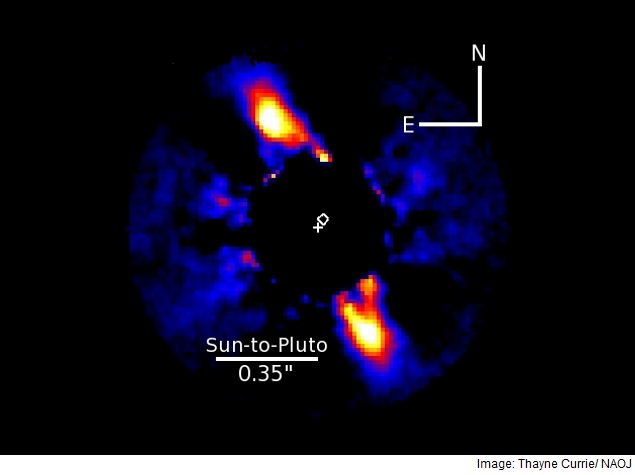
The images reveal a ring-like disk of debris surrounding a Sun-like star, in a birth environment similar to our Sun.
The disk appears to be sculpted by at least one unseen solar system-like planet, is roughly the same size as our solar system's Kuiper Belt and may contain dust and icy particles.
Located just beyond Neptune's orbit, the Kuiper Belt contains numerous icy dwarf planets such as Pluto, Haumea, and Makemake.
This work provides a valuable key to understanding the early formation of the Sun and planets.
"The discovery of the bright ring of orbiting the star HD 115600 changes everything. It is kind of like looking at outer solar system when it was a toddler," said lead astronomer Thayne Currie from the Subaru Telescope in Hawaii.
Remarkably, the ring is almost exactly the same distance from its host star as the Kuiper Belt is from the Sun and it receives about the same amount of light.
The star itself is just slightly more massive than the Sun. Its birth cloud is very similar to the nebula in which the Sun formed some 4.5 billion years ago.
It is also home to thousands of remnants from the earliest stages of icy planet formation, and thus provides a key to understanding the early solar system.
The results are very promising.
"The study of cold, Kuiper belt-like debris rings around nearby young Sun-like stars provides the best picture of what our own early, outer solar system might have been like," the authors said.
The paper is set for publication in the Astrophysical Journal Letters.
Comments
Get your daily dose of tech news, reviews, and insights, in under 80 characters on Gadgets 360 Turbo. Connect with fellow tech lovers on our Forum. Follow us on X, Facebook, WhatsApp, Threads and Google News for instant updates. Catch all the action on our YouTube channel.
Related Stories






Advertisement
Follow Us




-
![[Sponsored] LG NANO 4K UHD AI TV NU885: Gemini Search, Dolby Atmos & 5 Years of Updates](https://www.gadgets360.com/static/desktop/images/spacer.png)
04:17
[Sponsored] LG NANO 4K UHD AI TV NU885: Gemini Search, Dolby Atmos & 5 Years of Updates -
00:57
[Sponsored] Samsung Galaxy Z Fold8 My Fan Cam in Action: Find the Moment, Then Share It -
01:41
[Sponsored] What Do You Need To Know Before Your Next Run? | Samsung Galaxy Watch Ultra2 -
01:32
[Sponsored] Big Day Tomorrow? Prep Today | Samsung Galaxy Watch Ultra2 -
04:37
[Sponsored]: CP PLUS CarKam CP-F89B: 4K Dashcam With Rear Camera, GPS & Emergency Recording
-
iPhone 16 आज भी Amazon सेल में मिल रहा ₹15 हजार से ज्यादा सस्ता
-
OnePlus 15 को Amazon Great Indian Festival Sale में खरीदें सस्ता
-
₹2250 सस्ता मिल रहा Motorola का 7000mAh बैटरी वाला फोन! Flipkart पर ऑफर
-
Flipkart Sale में ₹14000 सस्ता मिल रहा Vivo का 50MP कैमरा, 9020mAh बैटरी वाला फोन
-
HMD Vibe 2 Max बजट फोन लॉन्च होगा 108MP कैमरा, 6,000mAh बैटरी फीचर के साथ!
Advertisement
Popular on Gadgets
- Samsung Galaxy S26 Ultra
- Motorola Razr Fold
- ChatGPT
- OPPO Find N6
- Mobiles Under Rs. 40,000
- Vivo X300 Ultra
- Asus Zenbook S14
- iQOO 15
- Vivo X300 Pro
- Lenovo Yoga Slim 7i Aura Edition
- iQOO 15R
- Vivo X Fold 5
- Sony PlayStation 5
- HP OmniPad 12
- OnePlus Nord CE 6 Lite
- OnePlus Pad 4
- OPPO F33 Pro 5G
- Cryptocurrency
- HP OmniBook Ultra 14 (2026)
- iPhone 17
- Eureka Forbes AP 355 Room Air Purifier
- Latest Mobile Phones
- Compare Phones
Latest Gadgets
- Samsung Galaxy F70 5G
- Tecno Spark 50S 5G
- Vivo Y600s Pro
- Vivo Y32 (2026)
- Infinix Smart 20 HD
- Vivo V80
- Vivo S2 FE
- Vivo Y600K Turbo
- HP ZBook Ultra G3a
- Dell Pro Rugged 14
- Amazon Alexa Tablet 8
- Amazon Alexa Tablet 11
- Amazfit T-Rex Dual Solar
- OPPO Watch S2
- Toshiba 65-Inch 4K Ultra HD Smart Mini LED QLED TV (65Z670SP)
- Haier M70 Mini LED 65-inch
- Acer Predator Atlas 8
- Asus ROG Ally
- Blue Star 1.5 Ton 5 Star Inverter Split AC (IE518ZNURS)
- Blue Star 2 Ton 3 Star Inverter Window AC (WIE324L)

- About Us
- Sitemaps
- Feedback
- Archives
- Contact Us
- RSS
- Advertise
- Career
- Privacy Policy
- Ethics
- Editorial Policy
- Terms & Conditions
- Complaint Redressal
Download Our Apps
Available in Hindi
© Copyright Red Pixels Ventures Limited 2026. All rights reserved.