- Home
- Glance
This Day That Year: What Happened on February 5
This Day That Year: What Happened on February 5
Updated: 3 February 2024 13:34 IST
This Day That Year: What Happened on February 5
Click Here to Add Gadgets360 As A Trusted Source

Advertisement
Moonstruck! Apollo 14 Makes History on This Day in 1971
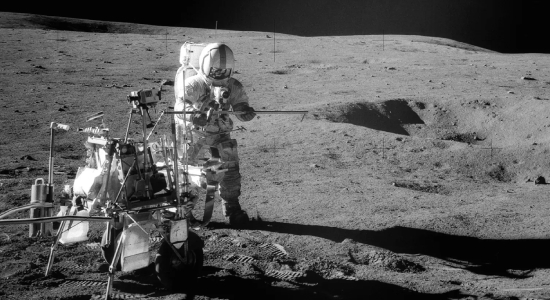
Fifty-three years ago today, on February 5th, 1971, the world held its breath as the lunar module "Antares" of Apollo 14 touched down on the dusty plains of the Moon. This wasn't just another landing; it was the third successful crewed mission to our celestial neighbor, marking a giant leap for humanity and proving that the "giant leap" of Apollo 11 wasn't a one-off fluke.
But Apollo 14 wasn't just about replicating past triumphs. It aimed higher, literally. Unlike its predecessors, this mission set its sights on the rugged lunar highlands, a region brimming with scientific mysteries. At the helm was the iconic astronaut Alan Shepard, who had become the first American in space a decade earlier. Now, at the age of 47, he was returning to fulfill a lifelong dream of walking on the Moon.
The journey wasn't smooth sailing. Technical glitches threatened to derail the mission, pushing the crew and ground control to their limits. But with nerves of steel and ingenuity, they persevered, their determination etched in the crackle of radio transmissions that echoed across the vast distance.
And then came the touchdown. The grainy black and white footage that flickered onto television screens worldwide showed Shepard and his lunar module pilot, Edgar Mitchell, emerging onto the alien landscape. Their first steps, captured in history books and documentaries, were a testament to human courage and ambition.
For two moonwalks, Shepard and Mitchell explored the Fra Mauro formation, collecting precious rock samples and setting up scientific experiments.
They even brought along a golf club, taking a playful "lunar swing" that became a lighthearted moment amidst the seriousness of their mission.
After a whirlwind adventure, they blasted off from the lunar surface, leaving behind the American flag fluttering in the airless wind. Their successful return splashed down in the Pacific Ocean, marking the end of another successful chapter in humankind's lunar odyssey.
A World Transformed: Bakelite Unveiled on This Day in 1907
There was once a world without plastics. No lightweight water bottles, no sleek phones, no colorful buttons adorning your favourite shirt. It might seem strange, but on February 5th, 1907, such a world was reality. That's when Belgian chemist Leo Baekeland revealed his revolutionary creation: Bakelite, the world's first fully synthetic plastic.
Baekeland wasn't just tinkering in his lab; he was on a mission. Tired of relying on unreliable, naturally occurring materials like shellac, he sought a versatile, durable alternative. After years of experimentation, he struck gold (or, perhaps, black?) with Bakelite.
This wasn't your grandma's Tupperware. Bakelite was revolutionary. It was moldable, heat-resistant, and an insulator to boot. Suddenly, the possibilities were endless. Radios, telephones, billiard balls, jewelry – Bakelite adorned them all, adding a touch of sleek modernity to everyday life.
But Bakelite's impact wasn't just aesthetic. It ushered in a new era of mass production. Imagine cars rolling off assembly lines, each with Bakelite parts humming and clicking. Imagine the affordability it brought to everyday goods, making them accessible to the masses.
Of course, the story doesn't end there. Bakelite paved the way for countless other plastics, some with their own share of challenges. But its legacy remains: a testament to human ingenuity and its power to shape the world around us. So, the next time you hold a plastic object, remember February 5th, 1907, the day a Belgian chemist dared to dream of a world transformed, and Bakelite made it a reality.
Comments
Get your daily dose of tech news, reviews, and insights, in under 80 characters on Gadgets 360 Turbo. Connect with fellow tech lovers on our Forum. Follow us on X, Facebook, WhatsApp, Threads and Google News for instant updates. Catch all the action on our YouTube channel.
Further reading:
This Day That Year


Advertisement
Follow Us




-

05:05
Goboult Mustang Racer Smartwatch Review: Should You Get This Mustang Smartwatch? -
04:58
OnePlus Nord Buds 4 Pro Review: Specs, Sound Quality, ANC, and Battery Backup Tested -
02:29
[Sponsored] Samsung Galaxy S26 Ultra First Look: AI Smartphone for Creators, Gaming & Productivity -
04:25
Vivo X200T Review - Full Camera, Gaming & Battery Test | Worth Buying? -
28:31
The Future of Productivity: Logitech's Anatoliy Polyanker On AI, Hybrid Work, And India's Tech Boom
-
Redmi 15A 5G की सेल शुरू, जानें कितने में मिल रहा 6300mAh बैटरी वाला फोन
-
7300mAh बैटरी, 50MP कैमरा वाले OnePlus फोन पर बंपर डिस्काउंट, जानें
-
Zepto बेच रहा 24 हजार रुपये सस्ता iPhone 17 Pro Max, सबसे तगड़ा डिस्काउंट
-
Xiaomi ने सस्ता वैक्यूम क्लीनर किया लॉन्च, 10000Pa सक्शन, 180 मिनट का बैटरी बैकअप, जानें कीमत
-
3 हफ्तों तक चलने वाली Honor Watch X5i स्मार्टवॉच लॉन्च, 60Hz AMOLED डिस्प्ले, जानें कीमत
Advertisement
Popular on Gadgets
- Samsung Galaxy Unpacked 2026
- iPhone 17 Pro Max
- ChatGPT
- iOS 26
- Laptop Under 50000
- Smartwatch Under 10000
- Apple Vision Pro
- Oneplus 12
- OnePlus Nord CE 3 Lite 5G
- iPhone 13
- Xiaomi 14 Pro
- Oppo Find N3
- Tecno Spark Go (2023)
- Realme V30
- Best Phones Under 25000
- Samsung Galaxy S24 Series
- Cryptocurrency
- iQoo 12
- Samsung Galaxy S24 Ultra
- Giottus
- Samsung Galaxy Z Flip 5
- Apple 'Scary Fast'
- Housefull 5
- GoPro Hero 12 Black Review
- Invincible Season 2
- JioGlass
- HD Ready TV
- Latest Mobile Phones
- Compare Phones
Latest Gadgets
- Honor Play 80
- Nord 6
- Honor X80i
- Honor Play 80 Pro
- Redmi Note 15 SE 5G
- Redmi A7 Pro
- OPPO K15 Pro
- OPPO K15 Pro+
- Xiaomi Book Pro 14
- MacBook Neo
- Vivo Pad 6 Pro
- Lenovo Legion Y700 Gen 5
- boAt Valour Watch 1R
- Xiaomi Watch S5
- Xiaomi QLED TV X Pro 75
- Haier H5E Series
- Asus ROG Ally
- Nintendo Switch Lite
- Haier 1.6 Ton 5 Star Inverter Split AC (HSU19G-MZAID5BN-INV)
- Haier 1.6 Ton 5 Star Inverter Split AC (HSU19G-MZAIM5BN-INV)

- About Us
- Sitemaps
- Feedback
- Archives
- Contact Us
- RSS
- Advertise
- Career
- Privacy Policy
- Ethics
- Editorial Policy
- Terms & Conditions
- Complaint Redressal
Download Our Apps
Available in Hindi
© Copyright Red Pixels Ventures Limited 2026. All rights reserved.