-
 Thailand, Hungary Join Hands to Dive Into Blockchain Tech Together31 October 2022
 -
Facebook Removes, Then Restores Anti-Immigrant Video in Hungary8 March 2018
-
Uber Vows to Stay in Hungary Despite Clampdown19 February 2016
-
Around 100,000 Hungarians Rally for Democracy as Internet Tax Hits Nerve29 October 2014
-
Anger Mounts in Hungary Over Internet Tax27 October 2014
- Home
- Internet
- Internet News
- Hungary Suspends Internet Tax After Huge Protests
Hungary Suspends Internet Tax After Huge Protests
By Associated Press | Updated: 31 October 2014 17:35 IST
Click Here to Add Gadgets360 As A Trusted Source

Advertisement
Following large-scale protests, Hungary's prime minister said Friday that the government would suspend a planned tax on Internet use and reconsider the matter next year.
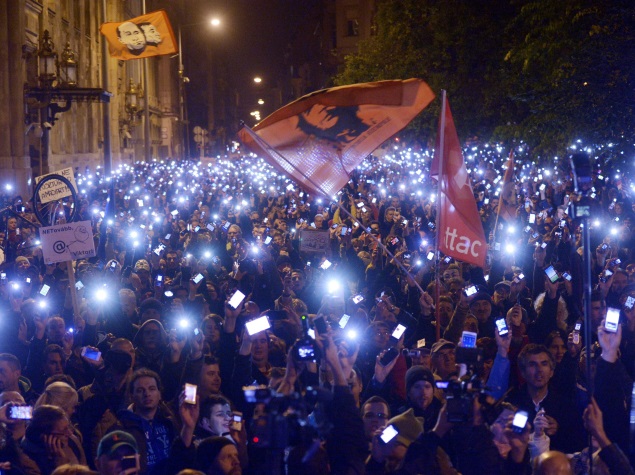
A scheme to make Internet service providers pay HUF 150 (roughly $0.62 or Rs. 38) per gigabyte of Internet traffic, later proposed to be capped at different monthly rates for individual and business users, prompted tens of thousands of people to make their discontent known during two protests in the capital Budapest over the past week.
Many protesters also considered the tax as another effort by Prime Minister Viktor Orban to centralize power, muffle the media and greatly increase the role and influence of the state in many walks of life, from business and religion to education and sports.
While Orban's Fidesz party retained its two-thirds majority in Parliament in April's elections and the prime minister is at the start of his third, four-year term, anti-government sentiment appears to be on the rise.
Arguments with the European Union and the United States, which recently banned six unnamed public officials from entering the U.S. because of corruption, have eroded some of Orban's support.
Orban said the tax would not be introduced because "people have questioned the rationality" of the measure. However, he said the government will hold a national consultation from mid-January about regulating and taxing the Internet.
"We are not communists," Orban said on state radio. "We are not governing against the people but together with the people."
Initially, the government tried to paint the protests as a left-wing initiative. However, it soon became clear the planned tax mobilized mostly youthful crowds from across the political spectrum, including many who said they were marching for the first time.
The government said it was necessary to expand the telecommunications tax to include the Internet because people were increasingly using it to make phone calls. Hungary needs more money to meet its deficit targets.
Comments
Get your daily dose of tech news, reviews, and insights, in under 80 characters on Gadgets 360 Turbo. Connect with fellow tech lovers on our Forum. Follow us on X, Facebook, WhatsApp, Threads and Google News for instant updates. Catch all the action on our YouTube channel.
Related Stories







Advertisement
Follow Us




-
![[Sponsored] LG NANO 4K UHD AI TV NU885: Gemini Search, Dolby Atmos & 5 Years of Updates](https://www.gadgets360.com/static/desktop/images/spacer.png)
04:17
[Sponsored] LG NANO 4K UHD AI TV NU885: Gemini Search, Dolby Atmos & 5 Years of Updates -
00:57
[Sponsored] Samsung Galaxy Z Fold8 My Fan Cam in Action: Find the Moment, Then Share It -
01:41
[Sponsored] What Do You Need To Know Before Your Next Run? | Samsung Galaxy Watch Ultra2 -
01:32
[Sponsored] Big Day Tomorrow? Prep Today | Samsung Galaxy Watch Ultra2 -
04:37
[Sponsored]: CP PLUS CarKam CP-F89B: 4K Dashcam With Rear Camera, GPS & Emergency Recording
-
iPhone 16 आज भी Amazon सेल में मिल रहा ₹15 हजार से ज्यादा सस्ता
-
OnePlus 15 को Amazon Great Indian Festival Sale में खरीदें सस्ता
-
₹2250 सस्ता मिल रहा Motorola का 7000mAh बैटरी वाला फोन! Flipkart पर ऑफर
-
Coolpad लाई पहला वाइड फोन Cool X Wide, 50MP कैमरा, 4600mAh बैटरी, प्री-ऑर्डर शुरू!
-
Samsung Galaxy F70 5G की भारत में शुरू हुई बिक्री, जानें प्राइस, ऑफर्स
Advertisement
Popular on Gadgets
- Samsung Galaxy S26 Ultra
- Motorola Razr Fold
- ChatGPT
- OPPO Find N6
- Mobiles Under Rs. 40,000
- Vivo X300 Ultra
- Asus Zenbook S14
- iQOO 15
- Vivo X300 Pro
- Lenovo Yoga Slim 7i Aura Edition
- iQOO 15R
- Vivo X Fold 5
- Sony PlayStation 5
- HP OmniPad 12
- OnePlus Nord CE 6 Lite
- OnePlus Pad 4
- OPPO F33 Pro 5G
- Cryptocurrency
- HP OmniBook Ultra 14 (2026)
- iPhone 17
- Eureka Forbes AP 355 Room Air Purifier
- Latest Mobile Phones
- Compare Phones
Latest Gadgets
- Samsung Galaxy F70 5G
- Tecno Spark 50S 5G
- Vivo Y600s Pro
- Vivo Y32 (2026)
- Infinix Smart 20 HD
- Vivo V80
- Vivo S2 FE
- Vivo Y600K Turbo
- HP ZBook Ultra G3a
- Dell Pro Rugged 14
- Amazon Alexa Tablet 8
- Amazon Alexa Tablet 11
- Amazfit T-Rex Dual Solar
- OPPO Watch S2
- Toshiba 65-Inch 4K Ultra HD Smart Mini LED QLED TV (65Z670SP)
- Haier M70 Mini LED 65-inch
- Acer Predator Atlas 8
- Asus ROG Ally
- Blue Star 1.5 Ton 5 Star Inverter Split AC (IE518ZNURS)
- Blue Star 2 Ton 3 Star Inverter Window AC (WIE324L)

- About Us
- Sitemaps
- Feedback
- Archives
- Contact Us
- RSS
- Advertise
- Career
- Privacy Policy
- Ethics
- Editorial Policy
- Terms & Conditions
- Complaint Redressal
Download Our Apps
Available in Hindi
© Copyright Red Pixels Ventures Limited 2026. All rights reserved.