- Home
- Glance
Moon's Craters Found To be Less Icy Than Expected
Moon's Craters Less Icy Than Expected
By Gadgets 360 Staff | Updated: 23 September 2023 17:53 IST
Click Here to Add Gadgets360 As A Trusted Source


Advertisement
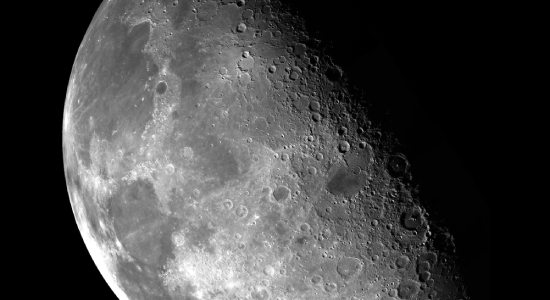
New research on lunar craters indicates that the blemishes and divots on the moon's surface are too young to hold onto ancient reserves of water ice over the long term. According to physicist Norbert Schörghofer of the Planetary Science Institute in the US and astrophysicist Raluca Rufu of the Southwest Research Institute in the US, the majority of the craters that include lasting pockets of shadow — a key focus for future Moon exploration — are younger than 2.2 billion years old.
According to Schörghofer, these results significantly alter estimations of the amount of water ice on the Moon as well as the prediction of where we are likely to discover it. It is no longer expected to find ancient water ice reservoirs on Moon.
Now, we are aware that the Moon has water. There is no serious dispute about that. Researchers are interested in finding out how much water is present up there and where it is hidden. In recent years, investigators have focused more on permanently shadowed areas, or PSRs, such as deep craters. It was once believed that ice might survive in PSRs, which have temperatures that hardly rise beyond -163 degrees Celsius (-260 degrees Fahrenheit), where sunlight may be warm and cause the water to evaporate over billions of years. These craters are thought to be capable of harbouring water ice areas that are several metres thick.
These higher estimates, nevertheless, call for a buildup spanning billions of years. And it appears that the PSRs have not received sufficient protection from the Sun for that accumulation. The revelation follows a study released a year ago that aimed to explain a disparity between the Moon's age (4.5 billion years) and its speed of travel away from Earth (3.8 centimetres, or 1.5 inches, per year). The two figures cannot be compared.
This team discovered that fluctuations in the lunar recession rate would have been caused by resonance between Earth and the Moon. The model took into consideration variations in the lunar axis' orientation. Scientists believe that the inner Solar System was heavily pummelling with comets and asteroids early in the Solar System's history, before roughly 3.8 billion years ago. In this late heavy bombardment, Mercury, Venus, Earth, and Mars were all severely damaged. The Moon would have been there as well, of course.
This would have allowed water to escape from the Moon's interior while it was still hot and pliable from volcanism. The PSRs may have captured a large amount of it if they had been present at that time. However, the PSRs are far more recent based on the most recent theories of the reorientation of the Moon's spin-axis and the evolution of the Earth-Moon distance. According to the researchers, this implies that any ice present must also be more recent.
Comments
Get your daily dose of tech news, reviews, and insights, in under 80 characters on Gadgets 360 Turbo. Connect with fellow tech lovers on our Forum. Follow us on X, Facebook, WhatsApp, Threads and Google News for instant updates. Catch all the action on our YouTube channel.
Further reading:
Science Daily


Advertisement
Follow Us




-
10:42
[Partner Content] OPPO Find X9 Two Week Experience: Here's Why It Stands Out -
04:38
Realme Watch 5 Review: Watch This Before You Buy The Latest Realme Smartwatch -
07:03
Vivo X300 Pro Review | Best Camera Phone You Can Buy For 2026 -
04:56
Vivo X300 Review | Best Flagship of 2025? | Unbelievable Camera & Performance Test -
03:49
Lava Agni 4 Review - Best Indian 5G Phone Under Budget?
Advertisement
Popular on Gadgets
- Samsung Galaxy Unpacked 2025
- ChatGPT
- Redmi Note 14 Pro+
- iPhone 16
- Apple Vision Pro
- Oneplus 12
- OnePlus Nord CE 3 Lite 5G
- iPhone 13
- Xiaomi 14 Pro
- Oppo Find N3
- Tecno Spark Go (2023)
- Realme V30
- Best Phones Under 25000
- Samsung Galaxy S24 Series
- Cryptocurrency
- iQoo 12
- Samsung Galaxy S24 Ultra
- Giottus
- Samsung Galaxy Z Flip 5
- Apple 'Scary Fast'
- Housefull 5
- GoPro Hero 12 Black Review
- Invincible Season 2
- JioGlass
- HD Ready TV
- Laptop Under 50000
- Smartwatch Under 10000
- Latest Mobile Phones
- Compare Phones
Latest Gadgets
- Xiaomi 17 Ultra Leica Edition
- Xiaomi 17 Ultra
- Huawei Nova 15
- Huawei Nova 15 Pro
- Huawei Nova 15 Ultra
- OnePlus 15R
- Realme Narzo 90x 5G
- Realme Narzo 90 5G
- Asus ProArt P16
- MacBook Pro 14-inch (M5, 2025)
- OPPO Pad Air 5
- Huawei MatePad 11.5 (2026)
- Huawei Watch 10th Anniversary Edition
- OnePlus Watch Lite
- Acerpure Nitro Z Series 100-inch QLED TV
- Samsung 43 Inch LED Ultra HD (4K) Smart TV (UA43UE81AFULXL)
- Asus ROG Ally
- Nintendo Switch Lite
- Haier 1.6 Ton 5 Star Inverter Split AC (HSU19G-MZAID5BN-INV)
- Haier 1.6 Ton 5 Star Inverter Split AC (HSU19G-MZAIM5BN-INV)

- About Us
- Sitemaps
- Feedback
- Archives
- Contact Us
- RSS
- Advertise
- Career
- Privacy Policy
- Ethics
- Editorial Policy
- Terms & Conditions
- Complaint Redressal
Download Our Apps
Available in Hindi
© Copyright Red Pixels Ventures Limited 2025. All rights reserved.