-
 Elon Musk's Neuralink to Test Brain Chips in Clinical Study in Great Britain1 August 2025
 -
Neuralink Device Helps Monkey See Something That’s Not There14 June 2025
-
Apple Reportedly Partnering With Synchron to Develop Brain-Computer Interfaces14 May 2025
-
Elon Musk’s Neuralink Cleared to Start Brain Chip Trial in Canada21 November 2024
-
Elon Musk's Neuralink Gets FDA's 'Breakthrough Device' Tag for Implant Aimed at Restoring Vision18 September 2024
- Home
- Internet
- Internet News
- Elon Musk's Neuralink Says Implant Had Issues After First Human Surgery
Elon Musk's Neuralink Says Implant Had Issues After First Human Surgery
Neuralink said that it’s currently working on improving text entry for the device as well as cursor control
By Sarah McBride, Bloomberg | Updated: 9 May 2024 15:55 IST

Photo Credit: Reuters
Traditionally, surgeons have placed brain implants directly on top of the brain tissue itself
Click Here to Add Gadgets360 As A Trusted Source

Advertisement
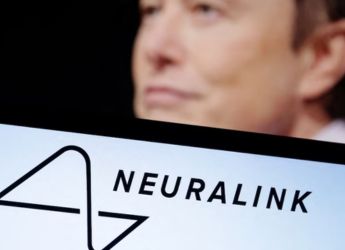
In a setback for Elon Musk's brain technology company, Neuralink, the device it implanted in its first human patient has had mechanical issues, the company wrote in a blog post.
In the weeks following the January surgery on patient Noland Arbaugh, some of the electrode-studded threads that sit in the brain tissue began to retract from that tissue, the company said, resulting in the device not working properly.
The Wall Street Journal earlier reported news of the malfunction.
Neuralink said it compensated for that retraction through a series of software fixes, which “produced a rapid and sustained improvement that has now superseded Noland's initial performance.”
The company said that it's currently working on improving text entry for the device as well as cursor control — and that it eventually aims to extend to the use of physical world devices such as robotic arms and wheelchairs.
People who work in the brain-implant field said the complications may have arisen from the fact that the threads connect to a device that sits within the skull bone, rather than on the surface of the brain tissue. “One thing engineers and scientists fail to appreciate is how much the brain moves within the intracrainial space,” said Eric Leuthardt, a neurosurgeon at the Washington University School of Medicine in St Louis. “Just nodding your head or abruptly moving it can lead to perturbations of several millimeters.”
Traditionally, surgeons have placed brain implants directly on top of the brain tissue itself, where they move “like a boat on the water,” said Matt Angle, chief executive officer of rival brain-implant company Paradromics Inc. Having threads that retract “is not normal for a brain implant,” he said.
Before implanting the device in Arbaugh, a quadriplegic, Neuralink had tested the device extensively in animals. One potential issue, though, is that because animals' brains are smaller, the electrodes don't shift as much as they do in humans, Leuthardt said.
The report comes as Neuralink is seeking to implant its device in more human subjects. Any malfunctions could cause delays in the Food and Drug Administration approval process.
© 2024 Bloomberg LP
Is the Samsung Galaxy Z Flip 5 the best foldable phone you can buy in India right now? We discuss the company's new clamshell-style foldable handset on the latest episode of Orbital, the Gadgets 360 podcast. Orbital is available on Spotify, Gaana, JioSaavn, Google Podcasts, Apple Podcasts, Amazon Music and wherever you get your podcasts.
Affiliate links may be automatically generated - see our ethics statement for details.
Comments
Get your daily dose of tech news, reviews, and insights, in under 80 characters on Gadgets 360 Turbo. Connect with fellow tech lovers on our Forum. Follow us on X, Facebook, WhatsApp, Threads and Google News for instant updates. Catch all the action on our YouTube channel.
Related Stories


Advertisement
Follow Us




-
![[Sponsored] LG NANO 4K UHD AI TV NU885: Gemini Search, Dolby Atmos & 5 Years of Updates](https://www.gadgets360.com/static/desktop/images/spacer.png)
04:17
[Sponsored] LG NANO 4K UHD AI TV NU885: Gemini Search, Dolby Atmos & 5 Years of Updates -
00:57
[Sponsored] Samsung Galaxy Z Fold8 My Fan Cam in Action: Find the Moment, Then Share It -
01:41
[Sponsored] What Do You Need To Know Before Your Next Run? | Samsung Galaxy Watch Ultra2 -
01:32
[Sponsored] Big Day Tomorrow? Prep Today | Samsung Galaxy Watch Ultra2 -
04:37
[Sponsored]: CP PLUS CarKam CP-F89B: 4K Dashcam With Rear Camera, GPS & Emergency Recording
Advertisement
Popular on Gadgets
- Samsung Galaxy S26 Ultra
- Motorola Razr Fold
- ChatGPT
- OPPO Find N6
- Mobiles Under Rs. 40,000
- Vivo X300 Ultra
- Asus Zenbook S14
- iQOO 15
- Vivo X300 Pro
- Lenovo Yoga Slim 7i Aura Edition
- iQOO 15R
- Vivo X Fold 5
- Sony PlayStation 5
- HP OmniPad 12
- OnePlus Nord CE 6 Lite
- OnePlus Pad 4
- OPPO F33 Pro 5G
- Cryptocurrency
- HP OmniBook Ultra 14 (2026)
- iPhone 17
- Eureka Forbes AP 355 Room Air Purifier
- Latest Mobile Phones
- Compare Phones
Latest Gadgets
- Lava Aura Curve
- Poco X8s
- Samsung Galaxy F70 5G
- Tecno Spark 50S 5G
- Vivo Y600s Pro
- Vivo Y32 (2026)
- Infinix Smart 20 HD
- Vivo V80
- HP ZBook Ultra G3a
- Dell Pro Rugged 14
- Amazon Alexa Tablet 8
- Amazon Alexa Tablet 11
- Pebble Qore 2
- Amazfit T-Rex Dual Solar
- Toshiba 65-Inch 4K Ultra HD Smart Mini LED QLED TV (65Z670SP)
- Haier M70 Mini LED 65-inch
- Acer Predator Atlas 8
- Asus ROG Ally
- Blue Star 1.5 Ton 5 Star Inverter Split AC (IE518ZNURS)
- Blue Star 2 Ton 3 Star Inverter Window AC (WIE324L)

- About Us
- Sitemaps
- Feedback
- Archives
- Contact Us
- RSS
- Advertise
- Career
- Privacy Policy
- Ethics
- Editorial Policy
- Terms & Conditions
- Complaint Redressal
Download Our Apps
Available in Hindi
© Copyright Red Pixels Ventures Limited 2026. All rights reserved.