Google Expands Eighth-Generation TPU Portfolio With 8tx and 8i Max Chips for Secure AI Inference, High Compute Density
Google announced that this is the first time it has introduced four TPU systems in one year.
Written by Dhruv Raghav, Edited by Ketan Pratap | Updated: 11 November 2026 09:15 IST
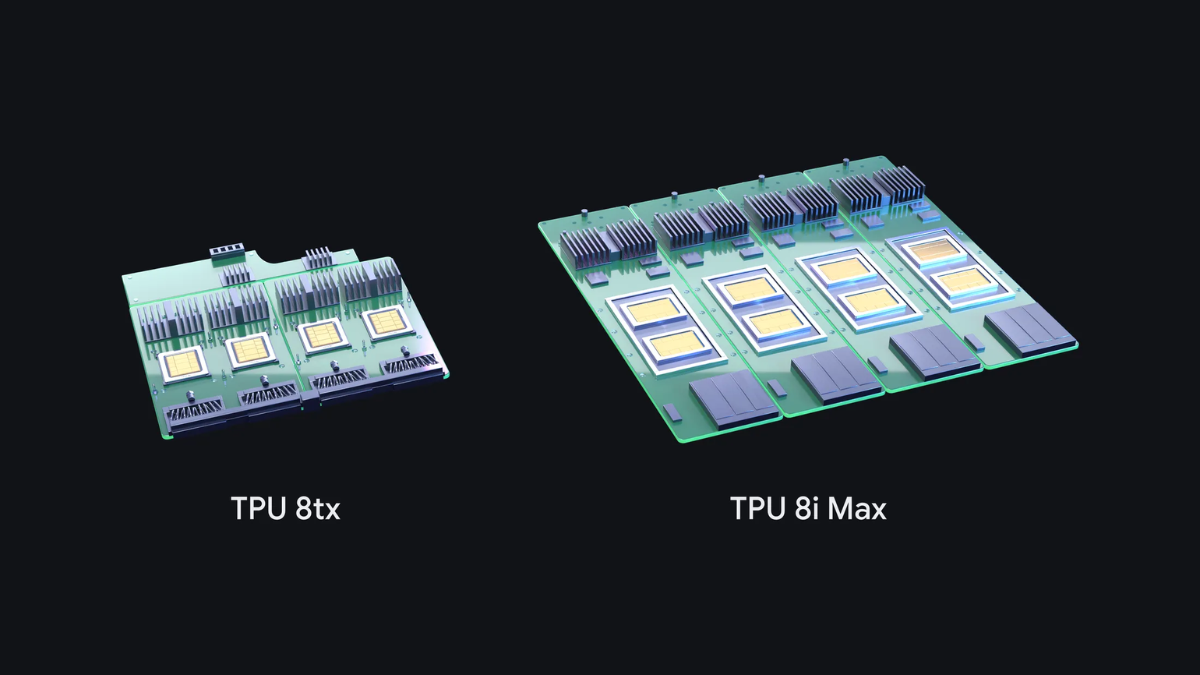
Photo Credit: Google
Google TPUs 8tx and 8i Max were co-designed with Google DeepMind
Click Here to Add Gadgets360 As A Trusted Source

Advertisement
Google introduced the 8tx and 8i Max chips on Wednesday as its two new eighth-generation Tensor Processing Unit (TPU) systems. With the unveiling of the two new TPUs, the Mountain View-based tech giant now has four eighth-generation chips, including TPUs 8t and 8i. The company first introduced its eighth-generation range of TPUs at Google Cloud Next in April, initially including two chips. Google further highlighted that the launch of the two TPUs marks the first time it has introduced four systems in a single year. The new TPU 8tx and TPU 8i Max are designed for confidential computing and large context and density computing, respectively.
Google Introduces TPU 8tx and TPU 8i Max for Confidential AI Inference
In a blog post, Google introduced its two new specialised TPU systems, namely TPU 8tx and TPU 8i Max. The TPU 8tx is designed and optimised for secure and confidential AI inference. The company claims that the chip can also be used for small-scale training of AI models. Google's TPU 8tx is built for regulated enterprises and governments, who want to run frontier or proprietary AI models and autonomous AI agents, while ensuring the security of their sensitive data.
The TPU 8tx has been paired with the fifth-generation AMD EPYC CPU hosts. It is built on the same silicon as the 8t model, launched earlier this year. Google claims that TPU 8tx builds security directly into the hardware to secure and isolate sensitive data and model weights during active use. Further, it features the low-latency Boardfly network for real-time reasoning, delivering up to 2x lower latency than TPU 8t “with a near-zero performance penalty”. The TPU also allows customers to fine-tune AI models using private data, distill large AI models into smaller models, and train AI agents through reinforcement learning.
On the other hand, the TPU 8i Max system is built for “massive” context windows and the “highest compute” density per rack. It is claimed to scale compute and memory in lockstep, which enables 2x compute, SRAM bandwidth, and HBM bandwidth. The TPU system is claimed to fit 2x the silicon within existing racks, allowing data centres to “deploy significantly more computing power per square foot and per watt”.
The tech giant co-designed the new 8i Max and 8tx TPUs, like the previous systems, with Google DeepMind. However, the company claims that feedback and inputs from external organisations, such as “some highly” regulated and cloud customers, were also taken into consideration.
Comments
Get your daily dose of tech news, reviews, and insights, in under 80 characters on Gadgets 360 Turbo. Connect with fellow tech lovers on our Forum. Follow us on X, Facebook, WhatsApp, Threads and Google News for instant updates. Catch all the action on our YouTube channel.


Google Expands Eighth-Generation TPU Portfolio With 8tx and 8i Max Chips for Secure AI Inference, High Compute Density


Advertisement
Follow Us


-
Best Solid Wood Dressing Tables with Mirror & Storage Under ₹17,500
-
Top Waterproof Mascaras Under ₹499 for Sweat-Proof Festive Looks
-
Top 5 Lumbar Support Backrest Cushions for Car & Office Seats
-
Amazon Great Indian Festival Ends Tonight: Best Backpack Deals To Grab At Earliest
-
Best Heavy-Duty Electronic Safes for Home Jewellery & Documents
-
Instagram पर AI करेगा आयु की पहचान, फिर दिखाएगा कंटेंट, झूठ होने पर करेगा
-
1 रिचार्ज और साल भर तक डेली 2GB डाटा, अनलिमिटेड कॉल और फ्री TV के फायदे
-
₹30000 एमआरपी वाला Ai+ Nova 2 Power 5G खरीदें ₹17,999 में!
-
Vivo X500 Ultra में मिल सकते हैं डुअल Sony LYT-L910 कैमरा
-
भाई दूज पर गिफ्ट करें 5G स्मार्टफोन, कीमत 11 हजार से भी कम से शुरू
Advertisement
Popular on Gadgets
- Samsung Galaxy S26 Ultra
- Motorola Razr Fold
- ChatGPT
- OPPO Find N6
- Mobiles Under Rs. 40,000
- Vivo X300 Ultra
- Asus Zenbook S14
- iQOO 15
- Vivo X300 Pro
- Lenovo Yoga Slim 7i Aura Edition
- iQOO 15R
- Vivo X Fold 5
- Sony PlayStation 5
- HP OmniPad 12
- OnePlus Nord CE 6 Lite
- OnePlus Pad 4
- OPPO F33 Pro 5G
- Cryptocurrency
- HP OmniBook Ultra 14 (2026)
- iPhone 17
- Eureka Forbes AP 355 Room Air Purifier
- Latest Mobile Phones
- Compare Phones
Latest Gadgets
- Vivo Y6k
- Karbonn Rebel
- Karbonn Rebel Pro
- OnePlus Turbo 6Vs
- Redmi M100 Pro
- OnePlus Ace 7 Pro
- OnePlus Ace 7
- Samsung W27
- Dell 14S (2026)
- HP ProBook 4 G2iS 14
- iPad mini (2026)
- Amazon Alexa Tablet 8
- Moto Watch 2 Fit
- Pebble Qore 2
- Toshiba 65-Inch 4K Ultra HD Smart Mini LED QLED TV (65Z670SP)
- Haier M70 Mini LED 65-inch
- Acer Predator Atlas 8
- Asus ROG Ally
- Blue Star 1.5 Ton 5 Star Inverter Split AC (IE518ZNURS)
- Blue Star 2 Ton 3 Star Inverter Window AC (WIE324L)

- About Us
- Sitemaps
- Feedback
- Archives
- Contact Us
- RSS
- Advertise
- Career
- Privacy Policy
- Ethics
- Editorial Policy
- Terms & Conditions
- Complaint Redressal
Download Our Apps
Available in Hindi
© Copyright Red Pixels Ventures Limited 2026. All rights reserved.