-
 JWST Reveals Salt Clouds in the Atmosphere of the ‘Pink Planet’ GJ 504b21 June 2026
 -
JWST Watches HD 80606 bExoplanet Heat Up by 1,100 Degrees in Hours19 June 2026
-
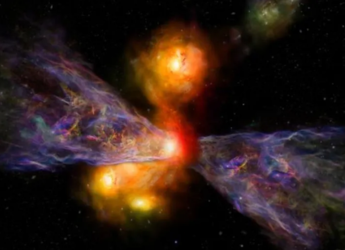
Scientists May Have Solved the Missing Sulfur Mystery in Star-Forming Clouds16 June 2026
-
Astronomers Discover Why Massive Galaxies Died Early in the Universe13 June 2026
-
JWST Reveals the True Identity of Mysterious Little Red Dots11 June 2026
- Home
- Science
- Science News
- JWST Discovers Ancient Black Hole Older Than Its Own Galaxy
JWST Discovers Ancient Black Hole Older Than Its Own Galaxy
The James Webb Space Telescope has discovered a massive black hole dating back just 700 million years after the Big Bang — one so enormous it makes up most of its galaxy’s mass.
Written by Gadgets 360 Staff | Updated: 31 May 2026 17:12 IST
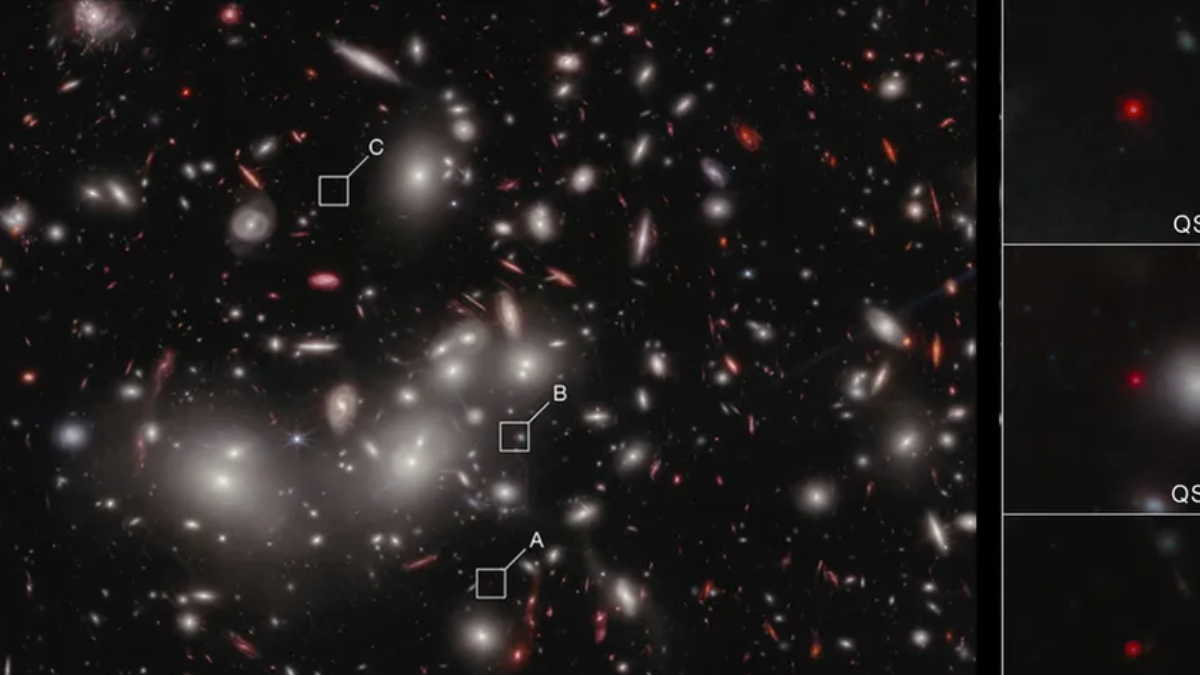
Photo Credit: NASA
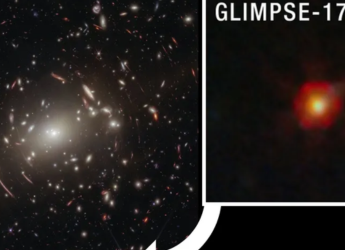
An image from NIRCam on NASA’s James Webb Space Telescope shows Little Red Dot .
Click Here to Add Gadgets360 As A Trusted Source


Advertisement
One of the longstanding theories of astronomy is being challenged by the discoveries made by the James Webb Space Telescope; that is, that black holes form within their galaxies. According to a study published on May 27th in Nature, there is evidence of a supermassive black hole that was already existing when its galaxy had not yet formed, only 700 million years after the birth of the universe.
A Black Hole Heavier Than Its Own Galaxy
According to Space.com, the central focus of this finding is Abell2744-QSO1, one of a family of miniature relics of old age known as "little red dots," initially found by the JWST telescope in 2022. By making use of the NIRSpec device on JWST, scientists were able to measure gas swirling around the object, like how gas moves around in orbit around a star; hence, a successful direct weighing of an ancient universe black hole was possible, weighing 50 million solar masses. In QSO1 alone, this lone black hole makes up 66% of its total mass, a factor of thousands greater than any modern-day galaxy.
Born Before the Stars
In the standard model, supermassive black holes grow from collapsed stellar remnants inside already-formed galaxies. But a black hole that outweighs most of its own galaxy's stars cannot have followed that path. Researchers now believe QSO1's black hole was "born big" — possibly from the direct collapse of a primordial gas cloud, or through an unknown process in the Big Bang's first moments. With the galaxy still assembling around it, the team is now studying other Little Red Dots to determine whether this startling reversal of cosmic order is widely prevalent in the early universe.
Comments
Get your daily dose of tech news, reviews, and insights, in under 80 characters on Gadgets 360 Turbo. Connect with fellow tech lovers on our Forum. Follow us on X, Facebook, WhatsApp, Threads and Google News for instant updates. Catch all the action on our YouTube channel.
Further reading:
James Webb Space Telescope, JWST, Black Hole, Early Universe, Galaxy Formation, Little Red Dots, Cosmology, Space.com, Astrophysics, big bang
Related Stories


Advertisement
Follow Us




-
04:37
[Sponsored]: CP PLUS CarKam CP-F89B: 4K Dashcam With Rear Camera, GPS & Emergency Recording -
04:23
[Partner Content] Your Phone Can Do WAY More Than You Think | OPPO ColorOS 16 -
01:59
Samsung Galaxy Z Fold8 Ultra: Unfold the Ultra Night -
03:24
Apple Pay Launches In India: Supported Devices, Cards And Payments Explained -
00:21
[Sponsored] Samsung Galaxy Z Fold8, Fold8 Ultra
Advertisement
Popular on Gadgets
- Samsung Galaxy S26 Ultra
- Motorola Razr Fold
- ChatGPT
- OPPO Find N6
- Mobiles Under Rs. 40,000
- Vivo X300 Ultra
- Asus Zenbook S14
- iQOO 15
- Vivo X300 Pro
- Lenovo Yoga Slim 7i Aura Edition
- iQOO 15R
- Vivo X Fold 5
- Sony PlayStation 5
- HP OmniPad 12
- OnePlus Nord CE 6 Lite
- OnePlus Pad 4
- OPPO F33 Pro 5G
- Cryptocurrency
- HP OmniBook Ultra 14 (2026)
- iPhone 17
- Eureka Forbes AP 355 Room Air Purifier
- Latest Mobile Phones
- Compare Phones
Latest Gadgets
- Vivo Y600s Pro
- Vivo Y32 (2026)
- Infinix Smart 20 HD
- Vivo V80
- Vivo S2 FE
- Vivo Y600K Turbo
- Realme P4s Lite
- Vivo S60t
- Dell Pro Rugged 14
- Dell Pro Rugged 13 Extreme
- Amazon Alexa Tablet 8
- Amazon Alexa Tablet 11
- Amazfit T-Rex Dual Solar
- OPPO Watch S2
- Toshiba 65-Inch 4K Ultra HD Smart Mini LED QLED TV (65Z670SP)
- Haier M70 Mini LED 65-inch
- Acer Predator Atlas 8
- Asus ROG Ally
- Blue Star 1.5 Ton 5 Star Inverter Split AC (IE518ZNURS)
- Blue Star 2 Ton 3 Star Inverter Window AC (WIE324L)

- About Us
- Sitemaps
- Feedback
- Archives
- Contact Us
- RSS
- Advertise
- Career
- Privacy Policy
- Ethics
- Editorial Policy
- Terms & Conditions
- Complaint Redressal
Download Our Apps
Available in Hindi
© Copyright Red Pixels Ventures Limited 2026. All rights reserved.