-
 JWST Reveals Salt Clouds in the Atmosphere of the ‘Pink Planet’ GJ 504b21 June 2026
 -
IceCube Traces High-Energy Neutrino to Distant Starburst Galaxy20 June 2026
-
JWST Watches HD 80606 bExoplanet Heat Up by 1,100 Degrees in Hours19 June 2026
-
Chandra Captures Sharpest-Ever X-Ray View of M87 Black Hole Jet18 June 2026
-
Scientists Discover Giant Planet Formation Around Supermassive Black Holes17 June 2026
- Home
- Science
- Science News
- Scientists May Have Solved the Missing Sulfur Mystery in Star Forming Clouds
Scientists May Have Solved the Missing Sulfur Mystery in Star-Forming Clouds
For decades, astronomers have struggled to explain why most sulfur appears missing from star-forming clouds.
Written by Gadgets 360 Staff | Updated: 16 June 2026 20:27 IST
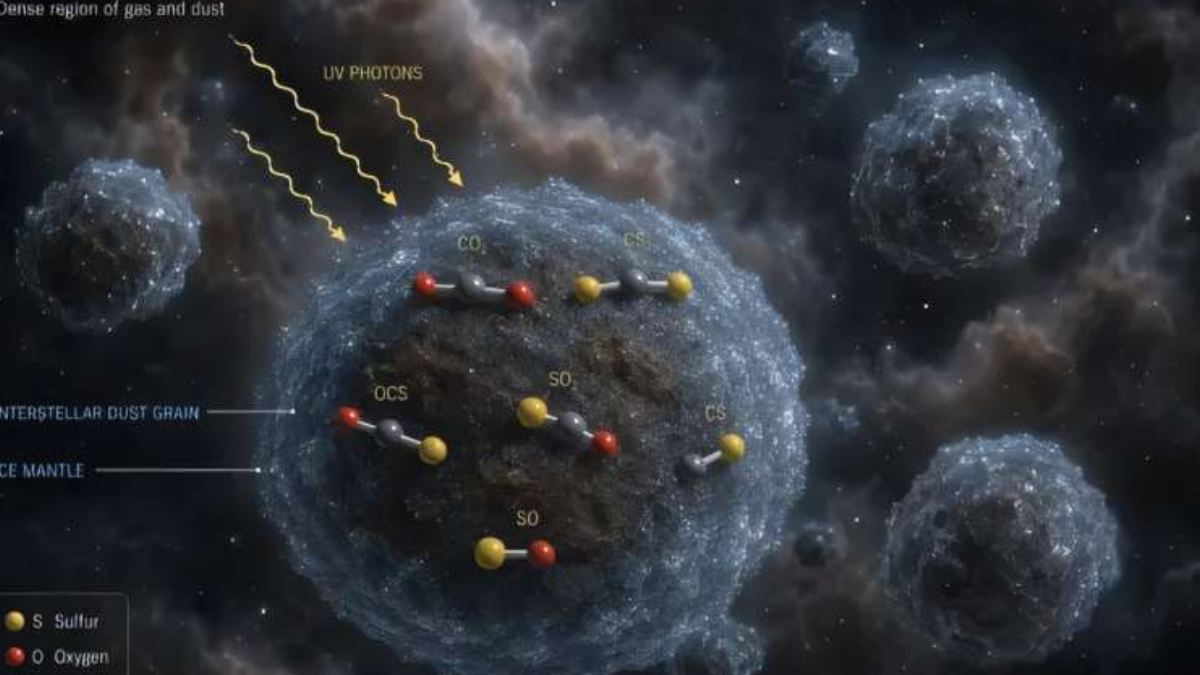
Photo Credit: Olli Sipilä
Representation of how VUV photons break up sulfur molecules.
Click Here to Add Gadgets360 As A Trusted Source


Advertisement
Sulfur is the tenth most abundant element in the universe, yet in the dense molecular clouds where stars are born, scientists find only about one percent of the expected amount. This decades-old riddle, the missing sulfur problem, has baffled astrochemists for generations. A leading theory holds that sulfur lies frozen within dust grain ice mantles, invisible to telescopes. A new computer simulation now brings scientists closer to solving it.
Simulating Frozen Chemistry with pyRate
Published in the journal Astronomy & Astrophysics, the study from the Max Planck Institute for Extraterrestrial Physics and Spain's Centro de Astrobiología, led by Olli Sipilä, used the pyRate code to model a 2024 laboratory experiment. Researchers cooled carbon dioxide and carbon disulfide ice to 10 Kelvin and irradiated it with ultraviolet photons. When the simulation used standard diffusive chemistry, where molecules wander until colliding, almost no reactions occurred. Only non-diffusive chemistry, allowing freshly released atoms to react instantly, reproduced the observed sulfur compounds and confirmed UV radiation penetrates roughly 100 ice monolayers deep.
Why Sulfur's Cosmic Address Matters
This problem extends beyond the field of chemistry. Sulfur is necessary for biological processes because it forms amino acids and proteins, making its existence in space of immense astrobiological importance. Nonetheless, out of all known sulfur compounds in interstellar ices, there are only carbonyl sulfide and sulfur dioxide, comprising less than five percent of the expected amount of sulfur. Allotropes, long chains of sulfur molecules, are most likely. Even though pyRate simulations point out some deficiencies of current knowledge on interstellar ice chemistry, it lays out a promising route for further observations with the help of the James Webb Telescope.
Comments
Get your daily dose of tech news, reviews, and insights, in under 80 characters on Gadgets 360 Turbo. Connect with fellow tech lovers on our Forum. Follow us on X, Facebook, WhatsApp, Threads and Google News for instant updates. Catch all the action on our YouTube channel.
Further reading:
Astronomy, Astrochemistry, Sulfur, Interstellar Clouds, Molecular Clouds, James Webb Space Telescope, JWST, Astrobiology, Space Science, Max Planck Institute, Chemistry, Astronomy and Astrophysics, Star Formation, Cosmic Ice, Sulfur Compounds
Related Stories


Advertisement
Follow Us




-
05:20
Samsung Galaxy Watch Ultra 2 Review: Is This the Best Android Smartwatch? -
07:01
Samsung Galaxy Z Fold 8 Review: Is This the Best Foldable Phone? -
06:39
Samsung Galaxy Z Fold8 Ultra Review: Cameras, Battery, Performance Tested -
04:33
[Sponsored] JBL Live 780NC: Great Sound, Perfect Comfort, Smart ANC & 80-Hour Battery -
12:04
[Partner Content] OPPO Reno16 Series Deep Dive: Built for Creators?
-
Ganesh Chaturthi Stickers: ऐसे डाउनलोड करें और भेजे गणपति बप्पा के स्टिकर
-
iQOO 16 में होगा दुनिया का पहला 2K 165Hz डिस्प्ले
-
Xiaomi का ये छोटा सा सॉकेट पुराने पंखे-लैंप को बना देगा सुपर स्मार्ट
-
150 इंच स्क्रीन पर 4K सिनेमा और बिल्ट-इन 2.1 चैनल स्पीकर सिस्टम! लॉन्च हुआ OBE R3 Ultra Max Projector
-
Samsung Galaxy S26 FE vs Oppo Reno 16 vs Xiaomi 17T: जानें कौन सा फोन है बेस्ट?
Advertisement
Popular on Gadgets
- Samsung Galaxy S26 Ultra
- Motorola Razr Fold
- ChatGPT
- OPPO Find N6
- Mobiles Under Rs. 40,000
- Vivo X300 Ultra
- Asus Zenbook S14
- iQOO 15
- Vivo X300 Pro
- Lenovo Yoga Slim 7i Aura Edition
- iQOO 15R
- Vivo X Fold 5
- Sony PlayStation 5
- HP OmniPad 12
- OnePlus Nord CE 6 Lite
- OnePlus Pad 4
- OPPO F33 Pro 5G
- Cryptocurrency
- HP OmniBook Ultra 14 (2026)
- iPhone 17
- Eureka Forbes AP 355 Room Air Purifier
- Latest Mobile Phones
- Compare Phones
Latest Gadgets
- iPhone Duo
- OPPO A7 Pro
- Huawei Mate XT 2 Ultimate Design
- Realme 16 Pro Harry Potter Edition
- Samsung Galaxy A07s
- Huawei Pura X View
- Tecno Camon Slim 5G
- iQOO Z11xa
- Acer Aspire G 3D 16
- Acer Swift Air 16 (2026)
- Xiaomi Pad 9 Pro
- Xiaomi Pad 9
- Apple Watch Ultra 4
- Apple Watch Series 12
- Haier M70 Mini LED 65-inch
- Xiaomi TV FX Mini LED 65
- Acer Predator Atlas 8
- Asus ROG Ally
- Blue Star 1.5 Ton 5 Star Inverter Split AC (IE518ZNURS)
- Blue Star 2 Ton 3 Star Inverter Window AC (WIE324L)

- About Us
- Sitemaps
- Feedback
- Archives
- Contact Us
- RSS
- Advertise
- Career
- Privacy Policy
- Ethics
- Editorial Policy
- Terms & Conditions
- Complaint Redressal
Download Our Apps
Available in Hindi
© Copyright Red Pixels Ventures Limited 2026. All rights reserved.