

-
 NASA's Hubble Images Show Binary Stars Can Shape the Evolution of Star Clusters8 March 2026
 -
Scientists Study Ancient Interstellar Comet 3I/ATLAS, Seeking Clues to Early Star System Formation14 December 2025
-
Kepler and TESS Discoveries Help Astronomers Confirm Over 6,000 Exoplanets Orbiting Other Stars13 December 2025
-
Uranus and Neptune May Be Rocky Worlds Not Ice Giants, New Research Shows11 December 2025
-
ESA’s Euclid Telescope Charts Over a Million Galaxies in Landmark First Data19 November 2025
- Home
- Science
- Science News
- Scientists Spot Pebbles Making Planets
Scientists Spot Pebbles Making Planets
By Indo-Asian News Service | Updated: 6 July 2015 17:45 IST
Click Here to Add Gadgets360 As A Trusted Source

Advertisement
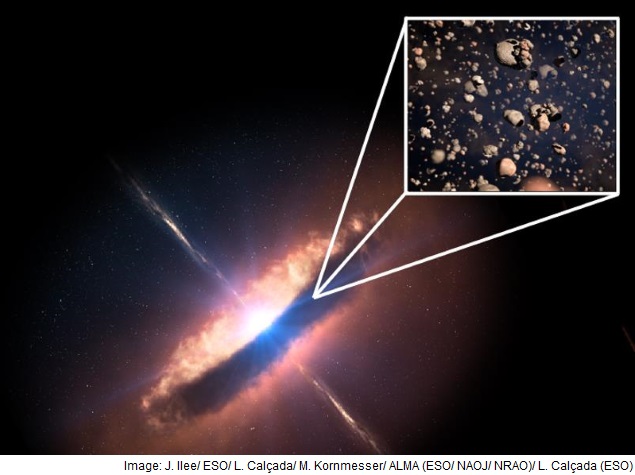
Astronomers have detected a ring of rocks or what is called a belt of pebbles, thought to be a crucial link in building planets, circling a very young star.
For the project, the researchers used the e-MERLIN array of radio telescopes centred on Jodrell Bank observatory in Britain.
"We found a belt of pebbles...just where they are needed if a planet is to grow in the next few million years. Although we thought this was how planets must get started, it is very exciting to actually see the process in action!" said Jane Greaves from University of St Andrews in Scotland.
Planets are thought to form from the dust and gas that encircles young stars in a disk. Over time, dust particles stick together, until they build up bigger clumps. Over millions of years the clumps crash together to make planets and moons.
In our own solar system, this process took place about 4,500 million years ago, with the giant planet Jupiter the first to form, the astronomers said.
Since the 1990s, astronomers have found both disks of gas and dust, and nearly 2,000 fully formed planets, but the intermediate stages of formation are harder to detect.
The scientists observed the star DG Tauri, a relatively youthful star just 2.5 million years old and 450 light years away from the Earth in the constellation of Taurus.
Looking at radio wavelengths, they discovered a faint glow characteristic of rocks in orbit around the newly formed star.
"We knew DG Tauri had a jet of hot gas flowing off its poles a beacon for stars still in the process of forming so we had an idea of what to look for," Anita Richards from the University of Manchester said.
"It was a real surprise to also see a belt of pebbles, with only a fraction of the data we hope to acquire. With the four-fold increase in radio bandwidth we are now working on, we hope to get similar images for a whole zoo of other young stars."
The researchers presented the work at the National Astronomy Meeting in Llandudno, Wales in Britain.
Comments
Get your daily dose of tech news, reviews, and insights, in under 80 characters on Gadgets 360 Turbo. Connect with fellow tech lovers on our Forum. Follow us on X, Facebook, WhatsApp, Threads and Google News for instant updates. Catch all the action on our YouTube channel.
Related Stories





Advertisement
Follow Us




-
![[Sponsored] Galaxy Watch9 for Everyday Health Insights | Smarter Wellness Choices](https://www.gadgets360.com/static/desktop/images/spacer.png)
01:42
[Sponsored] Galaxy Watch9 for Everyday Health Insights | Smarter Wellness Choices -
01:15
[Sponsored] Galaxy Tab S10 Lite for Students: Notes, Solve Math and More -
04:17
[Sponsored] LG NANO 4K UHD AI TV NU885: Gemini Search, Dolby Atmos & 5 Years of Updates -
00:57
[Sponsored] Samsung Galaxy Z Fold8 My Fan Cam in Action: Find the Moment, Then Share It -
01:41
[Sponsored] What Do You Need To Know Before Your Next Run? | Samsung Galaxy Watch Ultra2
-
NVIDIA के सीईओ ने पेश किए माइक्रोडक रोबोट, AI से चलते हैं, क्या काम आएंगे
-
iPhone Duo को बीच से खोला, फोल्डेबल डिस्प्ले से हटाया कवर, फिर क्या दिखा?
-
1 जनवरी से फोन में बिना सिम नहीं चलेगा WhatsApp, सिम बाइडिंग हुआ अनिवार्य
-
Redmi K100 में होगी 16GB रैम, Snapdragon 8 Elite चिप! 27 अक्टूबर को है लॉन्च
-
Amazon Sale में ₹11 हजार सस्ता खरीदें Motorola का 50MP Sony कैमरा, 5500mAh बैटरी वाला 5G फोन!
Advertisement
Popular on Gadgets
- Samsung Galaxy S26 Ultra
- Motorola Razr Fold
- ChatGPT
- OPPO Find N6
- Mobiles Under Rs. 40,000
- Vivo X300 Ultra
- Asus Zenbook S14
- iQOO 15
- Vivo X300 Pro
- Lenovo Yoga Slim 7i Aura Edition
- iQOO 15R
- Vivo X Fold 5
- Sony PlayStation 5
- HP OmniPad 12
- OnePlus Nord CE 6 Lite
- OnePlus Pad 4
- OPPO F33 Pro 5G
- Cryptocurrency
- HP OmniBook Ultra 14 (2026)
- iPhone 17
- Eureka Forbes AP 355 Room Air Purifier
- Latest Mobile Phones
- Compare Phones
Latest Gadgets
- HMD 2660 Flip Senior Edition
- Lava Aura Curve
- Poco X8s
- Samsung Galaxy F70 5G
- Tecno Spark 50S 5G
- Vivo Y600s Pro
- Vivo Y32 (2026)
- Infinix Smart 20 HD
- Lenovo Yoga 9n 2-in-1
- Lenovo Yoga Pro 9n
- Amazon Alexa Tablet 8
- Amazon Alexa Tablet 11
- Pebble Qore 2
- Amazfit T-Rex Dual Solar
- Toshiba 65-Inch 4K Ultra HD Smart Mini LED QLED TV (65Z670SP)
- Haier M70 Mini LED 65-inch
- Acer Predator Atlas 8
- Asus ROG Ally
- Blue Star 1.5 Ton 5 Star Inverter Split AC (IE518ZNURS)
- Blue Star 2 Ton 3 Star Inverter Window AC (WIE324L)

- About Us
- Sitemaps
- Feedback
- Archives
- Contact Us
- RSS
- Advertise
- Career
- Privacy Policy
- Ethics
- Editorial Policy
- Terms & Conditions
- Complaint Redressal
Download Our Apps
Available in Hindi
© Copyright Red Pixels Ventures Limited 2026. All rights reserved.