-
 New Study Suggests Uranus and Neptune May Contain More Rock Than Ice14 May 2026
 -
Uranus’ Outer Rings May Reveal Hidden Moons, Scientists Say24 April 2026
-
James Webb Telescope Maps Uranus in 3D for the First Time; Data Reveals Hidden Storms, Methane Clouds25 February 2026
-
Uranus and Neptune May Be Rock-Dominated Planets, Study Suggests13 December 2025
-
James Webb Telescope Discovers Tiny New Moon Orbiting Uranus23 August 2025
- Home
- Science
- Science News
- Uranus and Neptune May Be Rocky Worlds Not Ice Giants, New Research Shows
Uranus and Neptune May Be Rocky Worlds Not Ice Giants, New Research Shows
New models suggest Uranus and Neptune may be far rockier than long believed, reshaping theories of ice-giant interiors, magnetic fields, and future mission priorities.
Written by Gadgets 360 Staff | Updated: 11 December 2025 22:30 IST

Photo Credit: NASA
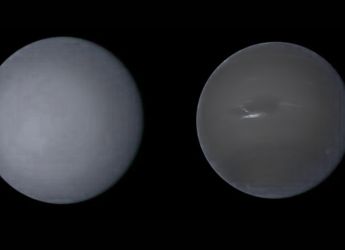
Rock-rich Uranus and Neptune models reshape views of the ice giants
Click Here to Add Gadgets360 As A Trusted Source


Advertisement
Recent discoveries indicate that Uranus and Neptune are not lowly ice giants as they have always been portrayed to be, but may have rocky interiors at least as much as watery ices, disproving decades of textbook models of the distant worlds. This new analysis of their internal makeup can be used to explain their strange magnetic fields, and calls on future missions to look at what is actually beneath their blue skies.
Rethinking Ice Giants' Interiors
According to the paper, University of Zurich scientists put up new hybrid simulations which are unbiased statistical models, but with physical constraints to investigate potential interior compositions of Uranus and Neptune. They present their work to demonstrate that the internal composition of these planets is no longer constrained to water, ammonia, and methane ices, but may also be highly rocky, depending on the relationship between the internal densities and pressures and the gravitational data. This increased variety of models extends our knowledge of so-called ice giants to a much greater extent and indicates the constraints of previous thoughts regarding their composition.
Magnetic Mysteries and Future Exploration
Uranus and Neptune also have bizarre, multi-polar magnetic fields that are very different from the Earth's straightforward north-south ones. According to the latest models, the magnetic fields of these two planets could be produced by the different layers of ionic water and rock in their interiors, with the depth of the dynamo regions determining the field geometry.
Nevertheless, there are still significant questions, most notably about the behaviour of materials under very high pressures, and the scientists state that only specially designed spacecraft missions can help figure out the real internal structures and reveal the secrets of these mysterious planets.
Comments
Get your daily dose of tech news, reviews, and insights, in under 80 characters on Gadgets 360 Turbo. Connect with fellow tech lovers on our Forum. Follow us on X, Facebook, WhatsApp, Threads and Google News for instant updates. Catch all the action on our YouTube channel.
Related Stories



Advertisement
Follow Us




-
01:42
[Sponsored] Galaxy Watch9 for Everyday Health Insights | Smarter Wellness Choices -
01:15
[Sponsored] Galaxy Tab S10 Lite for Students: Notes, Solve Math and More -
04:17
[Sponsored] LG NANO 4K UHD AI TV NU885: Gemini Search, Dolby Atmos & 5 Years of Updates -
00:57
[Sponsored] Samsung Galaxy Z Fold8 My Fan Cam in Action: Find the Moment, Then Share It -
01:41
[Sponsored] What Do You Need To Know Before Your Next Run? | Samsung Galaxy Watch Ultra2
Advertisement
Popular on Gadgets
- Samsung Galaxy S26 Ultra
- Motorola Razr Fold
- ChatGPT
- OPPO Find N6
- Mobiles Under Rs. 40,000
- Vivo X300 Ultra
- Asus Zenbook S14
- iQOO 15
- Vivo X300 Pro
- Lenovo Yoga Slim 7i Aura Edition
- iQOO 15R
- Vivo X Fold 5
- Sony PlayStation 5
- HP OmniPad 12
- OnePlus Nord CE 6 Lite
- OnePlus Pad 4
- OPPO F33 Pro 5G
- Cryptocurrency
- HP OmniBook Ultra 14 (2026)
- iPhone 17
- Eureka Forbes AP 355 Room Air Purifier
- Latest Mobile Phones
- Compare Phones
Latest Gadgets
- Vivo Y600
- HMD 2660 Flip Senior Edition
- Lava Aura Curve
- Poco X8s
- Samsung Galaxy F70 5G
- Tecno Spark 50S 5G
- Vivo Y600s Pro
- Vivo Y32 (2026)
- Lenovo Yoga 9n 2-in-1
- Lenovo Yoga Pro 9n
- Amazon Alexa Tablet 8
- Amazon Alexa Tablet 11
- Pebble Qore 2
- Amazfit T-Rex Dual Solar
- Toshiba 65-Inch 4K Ultra HD Smart Mini LED QLED TV (65Z670SP)
- Haier M70 Mini LED 65-inch
- Acer Predator Atlas 8
- Asus ROG Ally
- Blue Star 1.5 Ton 5 Star Inverter Split AC (IE518ZNURS)
- Blue Star 2 Ton 3 Star Inverter Window AC (WIE324L)

- About Us
- Sitemaps
- Feedback
- Archives
- Contact Us
- RSS
- Advertise
- Career
- Privacy Policy
- Ethics
- Editorial Policy
- Terms & Conditions
- Complaint Redressal
Download Our Apps
Available in Hindi
© Copyright Red Pixels Ventures Limited 2026. All rights reserved.