- Home
- Smart home
- Smart home News
- Amazon Ring Drone Cam, Ring Rover Cam Launched With AI Powered Navigation: Price, Features
Amazon Ring Drone Cam, Ring Rover Cam Launched With AI-Powered Navigation: Price, Features
Both Ring Drone Cam and Rover Cam have LED indicators that show when they are recording.
Written by Sucharita Ganguly, Edited by Rohan Pal | Updated: 11 November 2026 11:40 IST
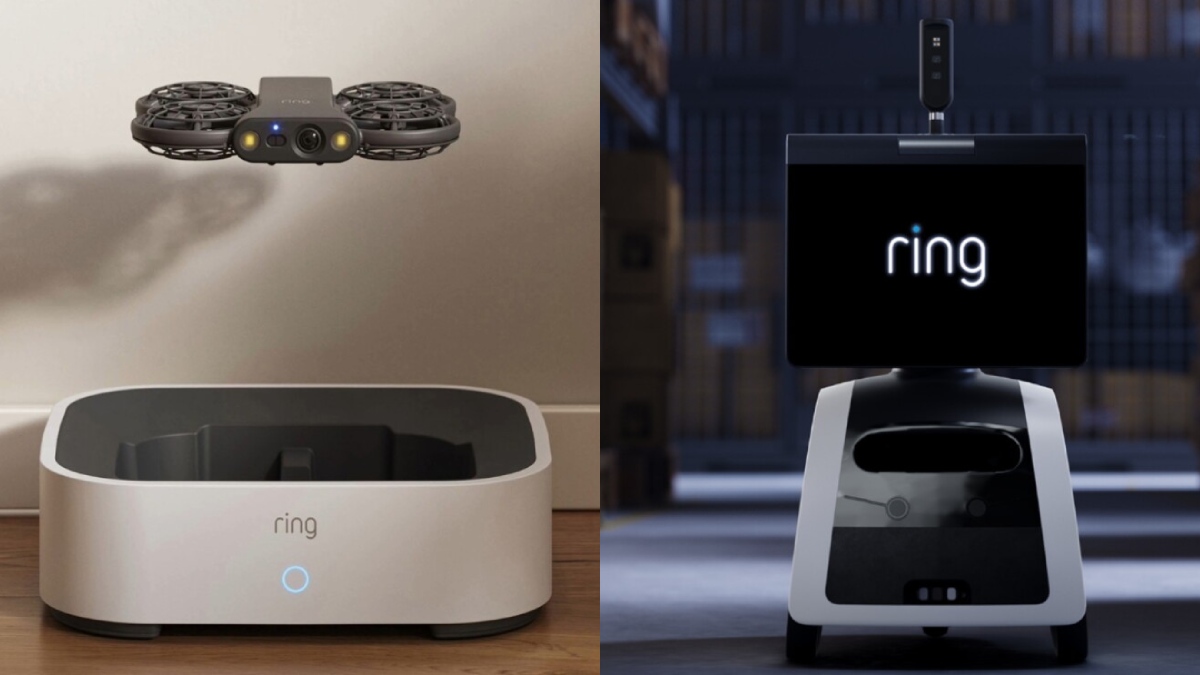
Photo Credit: Amazon
Both devices require a compatible Ring Protect subscription
Click Here to Add Gadgets360 As A Trusted Source
Advertisement
Amazon has expanded its Ring security lineup with two new devices that can move around indoor spaces to monitor different areas. The Ring Drone Cam is designed to fly around homes, while the Ring Rover Cam uses wheels to patrol business premises. Both can follow scheduled routes and respond to alerts from compatible security devices. They also use AI-powered navigation to map their surroundings, identify obstacles and move between preset patrol points.
Ring Drone Cam, Rover Cam Price and Availability
The Ring Drone Cam costs $249.99 (roughly Rs. 23,400) in the US and is expected to start shipping on January 27, 2027. However, Amazon will need to secure approval from the US Federal Communications Commission (FCC) before it can begin selling or leasing the device.
The Ring Rover Cam, meanwhile, is priced at $999.99 (roughly Rs. 93,000) and will start shipping on December 16, 2026. It is already available for preorder in the US.
Amazon has yet to announce India pricing or availability for either device. Both cameras require a compatible Ring Protect subscription for scheduled patrols and access to recorded footage.
Ring Drone Cam, Rover Cam Features, Specifications
The Ring Drone Cam can fly around a house, check different rooms, and respond to activity picked up by other Ring devices. Owners can set flight routes and schedules in the Ring app, or send the drone to a specific location. It can also take off when a compatible Ring camera, sensor or alarm detects activity, and head to a preset patrol point.
The drone records in 2K resolution and has a 148-degree field of view. Its camera rotates 360 degrees, with two LED lights available for darker rooms. Recording stops when the Drone Cam returns to its dock and resumes when it takes off. It can also be controlled through Amazon's Alexa Home Map interface.
The Ring Rover Cam is built for business premises, including shops, offices and storage areas. It moves on wheels, following scheduled patrol routes or heading to a location after a connected Ring device detects activity. Its 360-degree camera scans the area, while a periscope camera can rise above counters and shelves. Owners can save different camera heights for individual patrol points.
Unlike the Drone Cam, the Rover Cam can record in up to 4K resolution while moving. It comes with a siren, a light tower and two-way audio, allowing users to speak to people nearby. The robot can also detect people and record activity while docked. Ring says it can cover up to 5,000 sq ft.
Ring's AI Pilot system handles navigation by mapping the surroundings using cameras and onboard sensors. Setting it up involves carrying the Drone Cam around the house, while the Rover Cam can explore business premises on its own. The system identifies rooms and suggests patrol points such as windows, doors and corridors. Owners can adjust these locations and set routes through the app. AI Pilot also helps both devices avoid furniture and other obstacles.
Ring has built in a few privacy measures, although they work differently on the two devices. The Drone Cam switches off its camera while docked. On the Rover Cam, Sleep Mode retracts the periscope and disables the microphone. Both have LED indicators that show when they are recording. Amazon says footage from the devices is protected by its Throw Away the Key (TAKE) encryption system.
Comments
Get your daily dose of tech news, reviews, and insights, in under 80 characters on Gadgets 360 Turbo. Connect with fellow tech lovers on our Forum. Follow us on X, Facebook, WhatsApp, Threads and Google News for instant updates. Catch all the action on our YouTube channel.


Advertisement
Follow Us


-
 Best Heavy-Duty Pull-Up Bars for Home Door Frames Under ₹1,200
-
Best Niacinamide Serums for Open Pores & Oil Control Under 450
-
Is It Better to Buy a Larger Budget TV Or A Smaller Premium TV?
-
Best Solid Wood Dressing Tables with Mirror & Storage Under ₹17,500
-
Top Waterproof Mascaras Under ₹499 for Sweat-Proof Festive Looks
Advertisement
Popular on Gadgets
- Samsung Galaxy S26 Ultra
- Motorola Razr Fold
- ChatGPT
- OPPO Find N6
- Mobiles Under Rs. 40,000
- Vivo X300 Ultra
- Asus Zenbook S14
- iQOO 15
- Vivo X300 Pro
- Lenovo Yoga Slim 7i Aura Edition
- iQOO 15R
- Vivo X Fold 5
- Sony PlayStation 5
- HP OmniPad 12
- OnePlus Nord CE 6 Lite
- OnePlus Pad 4
- OPPO F33 Pro 5G
- Cryptocurrency
- HP OmniBook Ultra 14 (2026)
- iPhone 17
- Eureka Forbes AP 355 Room Air Purifier
- Latest Mobile Phones
- Compare Phones
Latest Gadgets
- Vivo Y6k
- Karbonn Rebel
- Karbonn Rebel Pro
- OnePlus Turbo 6Vs
- Redmi M100 Pro
- OnePlus Ace 7 Pro
- OnePlus Ace 7
- Samsung W27
- Dell 14S (2026)
- HP ProBook 4 G2iS 14
- iPad mini (2026)
- Amazon Alexa Tablet 8
- Moto Watch 2 Fit
- Pebble Qore 2
- Toshiba 65-Inch 4K Ultra HD Smart Mini LED QLED TV (65Z670SP)
- Haier M70 Mini LED 65-inch
- Acer Predator Atlas 8
- Asus ROG Ally
- Blue Star 1.5 Ton 5 Star Inverter Split AC (IE518ZNURS)
- Blue Star 2 Ton 3 Star Inverter Window AC (WIE324L)

- About Us
- Sitemaps
- Feedback
- Archives
- Contact Us
- RSS
- Advertise
- Career
- Privacy Policy
- Ethics
- Editorial Policy
- Terms & Conditions
- Complaint Redressal
Download Our Apps
Available in Hindi
© Copyright Red Pixels Ventures Limited 2026. All rights reserved.