-
 Google Rolls Out SynthID Detector Globally for AI-Generated Images, Videos and Audio8 October 2026
 -
Gemini in Chrome Gets Auto Browse in India, Letting AI Handle Web Tasks7 October 2026
-
Google Chrome Gets New AI Features for Students, Including Interactive Quizzes and More25 September 2026
-
Google’s Chrome 153 Starts Two-Week Release Cycle Promising Faster Updates and Secure Browsing9 September 2026
-
Chrome Users Report Trouble With Google Lens; Google Says Fix Is Coming30 July 2026
- Home
- Internet
- Internet News
- Chrome exposes user passwords in plain text without additional verification
Chrome exposes user passwords in plain-text without additional verification
By Anupam Saxena | Updated: 9 August 2013 09:32 IST
Click Here to Add Gadgets360 As A Trusted Source
Advertisement
If you've enabled Google Chrome's 'Offer to save passwords I enter on the web' feature and have saved some or all of your passwords through it, you should remember to sign-out of your Google account in Chrome, especially if you use the browser on a shared computer.
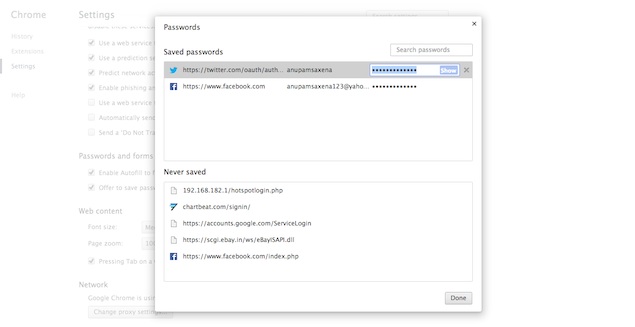
Google's popular Web browser allows you to save your passwords and manage them through a menu in the browser's Settings page. When you click on 'Manage saved passwords' you get a list of your Saved passwords as well as a list of websites where you have instructed the browser to 'never save'. Interestingly, when you click on one of your saved passwords, Google gives you the option to see the password in plain text by clicking on the 'Show' button which is placed along with the listing. It doesn't ask for a confirmation or any additional verification by, say, prompting for your Google account's password.
 It's worth pointing out that this 'vulnerability' - or feature as Google calls it (see below) - has been present in Chrome since its early days.
Once signed in to your Google account on Chrome, the browser pulls all your bookmarks, browsing history and passwords. This means that if you forget to sign out while using Chrome on a shared computer, anyone will be able to access your saved passwords easily. Or someone sitting next to you while you are using the computer can distracting you momentarily. Someone accessing your computer remotely can also see these passwords, if you're not constantly supervising. The intruder can change the password and block access to your service accounts, as well.
Software designer Elliott Kember pointed out the security flaw through a blog post. Interestingly, a Chrome developer told Kember on a discussion thread on Hacker News that the security flaw is in fact a feature of the browser. He said that the main password boundary for the user was the OS user account and there were vulnerabilities that could be exploited if that is breached.
We'd recommend not to sign-in to Chrome while using a shared computer, but the best option would be to not save passwords through the browser's default passwords manager. Tools like 1Password and LastPass are better ways of storing passwords, and they need a master password before giving you access to your passwords, offering increased security.
Update - Editor's Note: As our readers have pointed out via the comments, Firefox also lets anyone with access to the PC view the passwords by default. However, the reason Firefox was not mentioned - but perhaps should have been as a comparison - is that it lets you set a master password to prevent this from happening.
Further, yes, this is not a new discovery about Chrome and has been around since its initial days - as mentioned in the story. It's great that so many of our readers are aware of this behaviour, but it's still worth highlighting for the large percentage who aren't.
Google's popular Web browser allows you to save your passwords and manage them through a menu in the browser's Settings page. When you click on 'Manage saved passwords' you get a list of your Saved passwords as well as a list of websites where you have instructed the browser to 'never save'. Interestingly, when you click on one of your saved passwords, Google gives you the option to see the password in plain text by clicking on the 'Show' button which is placed along with the listing. It doesn't ask for a confirmation or any additional verification by, say, prompting for your Google account's password.
It's worth pointing out that this 'vulnerability' - or feature as Google calls it (see below) - has been present in Chrome since its early days.Once signed in to your Google account on Chrome, the browser pulls all your bookmarks, browsing history and passwords. This means that if you forget to sign out while using Chrome on a shared computer, anyone will be able to access your saved passwords easily. Or someone sitting next to you while you are using the computer can distracting you momentarily. Someone accessing your computer remotely can also see these passwords, if you're not constantly supervising. The intruder can change the password and block access to your service accounts, as well.
Software designer Elliott Kember pointed out the security flaw through a blog post. Interestingly, a Chrome developer told Kember on a discussion thread on Hacker News that the security flaw is in fact a feature of the browser. He said that the main password boundary for the user was the OS user account and there were vulnerabilities that could be exploited if that is breached.
"The only strong permission boundary for your password storage is the OS user account. So, Chrome uses whatever encrypted storage the system provides to keep your passwords safe for a locked account. Beyond that, however, we've found that boundaries within the OS user account just aren't reliable, and are mostly just theater.
Consider the case of someone malicious getting access to your account. Said bad guy can dump all your session cookies, grab your history, install malicious extension to intercept all your browsing activity, or install OS user account level monitoring software. My point is that once the bad guy got access to your account the game was lost, because there are just too many vectors for him to get what he wants.
We've also been repeatedly asked why we don't just support a master password or something similar, even if we don't believe it works. We've debated it over and over again, but the conclusion we always come to is that we don't want to provide users with a false sense of security, and encourage risky behavior. We want to be very clear that when you grant someone access to your OS user account, that they can get at everything. Because in effect, that's really what they get."
We'd recommend not to sign-in to Chrome while using a shared computer, but the best option would be to not save passwords through the browser's default passwords manager. Tools like 1Password and LastPass are better ways of storing passwords, and they need a master password before giving you access to your passwords, offering increased security.
Update - Editor's Note: As our readers have pointed out via the comments, Firefox also lets anyone with access to the PC view the passwords by default. However, the reason Firefox was not mentioned - but perhaps should have been as a comparison - is that it lets you set a master password to prevent this from happening.
Further, yes, this is not a new discovery about Chrome and has been around since its initial days - as mentioned in the story. It's great that so many of our readers are aware of this behaviour, but it's still worth highlighting for the large percentage who aren't.
Comments
Get your daily dose of tech news, reviews, and insights, in under 80 characters on Gadgets 360 Turbo. Connect with fellow tech lovers on our Forum. Follow us on X, Facebook, WhatsApp, Threads and Google News for instant updates. Catch all the action on our YouTube channel.
Related Stories



Advertisement
Follow Us




-
![[Sponsored] LG NANO 4K UHD AI TV NU885: Gemini Search, Dolby Atmos & 5 Years of Updates](https://www.gadgets360.com/static/desktop/images/spacer.png)
04:17
[Sponsored] LG NANO 4K UHD AI TV NU885: Gemini Search, Dolby Atmos & 5 Years of Updates -
00:57
[Sponsored] Samsung Galaxy Z Fold8 My Fan Cam in Action: Find the Moment, Then Share It -
01:41
[Sponsored] What Do You Need To Know Before Your Next Run? | Samsung Galaxy Watch Ultra2 -
01:32
[Sponsored] Big Day Tomorrow? Prep Today | Samsung Galaxy Watch Ultra2 -
04:37
[Sponsored]: CP PLUS CarKam CP-F89B: 4K Dashcam With Rear Camera, GPS & Emergency Recording
-
iPhone 16 आज भी Amazon सेल में मिल रहा ₹15 हजार से ज्यादा सस्ता
-
OnePlus 15 को Amazon Great Indian Festival Sale में खरीदें सस्ता
-
₹2250 सस्ता मिल रहा Motorola का 7000mAh बैटरी वाला फोन! Flipkart पर ऑफर
-
Coolpad लाई पहला वाइड फोन Cool X Wide, 50MP कैमरा, 4600mAh बैटरी, प्री-ऑर्डर शुरू!
-
Realme लाई बजट फोन Realme C01, 6500mAh बैटरी के साथ!
Advertisement
Popular on Gadgets
- Samsung Galaxy S26 Ultra
- Motorola Razr Fold
- ChatGPT
- OPPO Find N6
- Mobiles Under Rs. 40,000
- Vivo X300 Ultra
- Asus Zenbook S14
- iQOO 15
- Vivo X300 Pro
- Lenovo Yoga Slim 7i Aura Edition
- iQOO 15R
- Vivo X Fold 5
- Sony PlayStation 5
- HP OmniPad 12
- OnePlus Nord CE 6 Lite
- OnePlus Pad 4
- OPPO F33 Pro 5G
- Cryptocurrency
- HP OmniBook Ultra 14 (2026)
- iPhone 17
- Eureka Forbes AP 355 Room Air Purifier
- Latest Mobile Phones
- Compare Phones
Latest Gadgets
- Samsung Galaxy F70 5G
- Tecno Spark 50S 5G
- Vivo Y600s Pro
- Vivo Y32 (2026)
- Infinix Smart 20 HD
- Vivo V80
- Vivo S2 FE
- Vivo Y600K Turbo
- HP ZBook Ultra G3a
- Dell Pro Rugged 14
- Amazon Alexa Tablet 8
- Amazon Alexa Tablet 11
- Amazfit T-Rex Dual Solar
- OPPO Watch S2
- Toshiba 65-Inch 4K Ultra HD Smart Mini LED QLED TV (65Z670SP)
- Haier M70 Mini LED 65-inch
- Acer Predator Atlas 8
- Asus ROG Ally
- Blue Star 1.5 Ton 5 Star Inverter Split AC (IE518ZNURS)
- Blue Star 2 Ton 3 Star Inverter Window AC (WIE324L)

- About Us
- Sitemaps
- Feedback
- Archives
- Contact Us
- RSS
- Advertise
- Career
- Privacy Policy
- Ethics
- Editorial Policy
- Terms & Conditions
- Complaint Redressal
Download Our Apps
Available in Hindi
© Copyright Red Pixels Ventures Limited 2026. All rights reserved.