

-
 NASA’s MAVEN Detects Rare Solar Wind Effect in Mars Atmosphere28 May 2026
 -
Scientists Develop Swarm Robots to Explore Hidden Lava Tubes on Mars27 May 2026
-
Mysterious Stacked Rocks Spotted by NASA Perseverance Rover on Mars22 May 2026
-
Massive Solar Storm Reveals How Mars Is Losing Its Atmosphere19 May 2026
-
New Biosignature Method Could Transform Search for Alien Life16 May 2026
- Home
- Science
- Science News
- MAVEN Reveals How Mars Lost Its Atmosphere and Became a Barren World
MAVEN Reveals How Mars Lost Its Atmosphere and Became a Barren World
NASA’s MAVEN spacecraft has observed atmospheric sputtering on Mars for the first time, confirming how solar wind stripped the Red Planet’s thick atmosphere and transformed its climate.
Written by Gadgets 360 Staff | Updated: 7 June 2025 13:57 IST

Photo Credit: NASA’s Goddard Space Flight Center
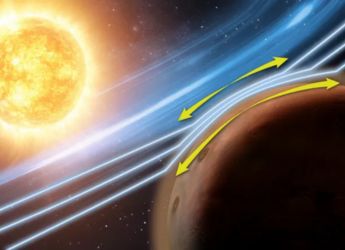
Sputtering stripped Mars' atmosphere, MAVEN confirms, revealing a key to its arid past
Click Here to Add Gadgets360 As A Trusted Source


Advertisement
Mars used to be a wetter world. Scientists have long pointed to evidence like dried-up riverbeds and ancient lake basins. For that much water to exist, Mars would have needed a thicker atmosphere — one that could hold in heat and pressure. But today, Mars is cold, dry, and barely has any air. For the first time, NASA's MAVEN spacecraft has directly observed a long-suspected process responsible for stripping away Mars' atmosphere — sputtering. Understanding when and how that atmosphere disappeared is crucial for reconstructing the planet's climate history and assessing its past potential to support life.
Sputtering
According to MAVEN's findings from a new study, sputtering is a significant mechanism in atmospheric escape. In this mechanism energetic particles from solar wind collide with Mars' upper atmosphere. These collisions, in principle, transfer enough energy to neutral atoms and help break them free from the planet's gravitational pull, flinging them into space.
"It's like doing a cannonball in a pool," Shannon Curry, the principal investigator of the MAVEN mission at the University of Colorado Boulder who led the new study, said in a statement. "The cannonball, in this case, is the heavy ions crashing into the atmosphere really fast and splashing neutral atoms and molecules out."
Using nine years of data, scientists created detailed maps of argon. The study also revealed that sputtering happens at a rate four times higher than previous models predicted, and intensifies during solar storms.
This suggests the process was far more extreme billions of years ago, when the young sun was more active and Mars had already lost its magnetic field. Without magnetic protection, the planet's atmosphere was vulnerable to relentless solar wind. This accelerated the loss of atmosphere and leading to the disappearance of surface water.
Comments
Get your daily dose of tech news, reviews, and insights, in under 80 characters on Gadgets 360 Turbo. Connect with fellow tech lovers on our Forum. Follow us on X, Facebook, WhatsApp, Threads and Google News for instant updates. Catch all the action on our YouTube channel.
Related Stories



Advertisement
Follow Us




-
03:41
[Sponsored] Samsung Galaxy Z Fold8: How It Fits Into an Actor’s Busy Day | Camera, Multitasking & More -
09:53
iPhone 18 Goes On Sale In India: Huge Crowds, Long Queues At Apple Stores -
06:32
Google Pixel 11 Pro XL Review: The Most Exciting Pixel Yet? | 120X Zoom + Tensor G6 -
05:20
Samsung Galaxy Watch Ultra 2 Review: Is This the Best Android Smartwatch? -
07:01
Samsung Galaxy Z Fold 8 Review: Is This the Best Foldable Phone?
-
Trump-Xi की मुलाकात से महंगे होंगे फोन या घटेंगे दाम?
-
Flipkart Big Billion Days: इन 6 स्मार्टफोन पर सेल से पहले मिल रही है डील
-
Bank Strike 2026: 28 से 30 सितंबर तक बैंक हड़ताल, क्या UPI और ATM चलेंगे?
-
Xiaomi Pad 9 और Pad 9 Pro हुए लॉन्च; पावरफुल प्रोसेसर, 11,000mAh बैटरी और 144Hz डिस्प्ले का मिलेगा कॉम्बो
-
Vivo S2 FE के भारत में लॉन्च की तैयारी, 10,000mAh हो सकती है बैटरी
Advertisement
Popular on Gadgets
- Samsung Galaxy S26 Ultra
- Motorola Razr Fold
- ChatGPT
- OPPO Find N6
- Mobiles Under Rs. 40,000
- Vivo X300 Ultra
- Asus Zenbook S14
- iQOO 15
- Vivo X300 Pro
- Lenovo Yoga Slim 7i Aura Edition
- iQOO 15R
- Vivo X Fold 5
- Sony PlayStation 5
- HP OmniPad 12
- OnePlus Nord CE 6 Lite
- OnePlus Pad 4
- OPPO F33 Pro 5G
- Cryptocurrency
- HP OmniBook Ultra 14 (2026)
- iPhone 17
- Eureka Forbes AP 355 Room Air Purifier
- Latest Mobile Phones
- Compare Phones
Latest Gadgets
- Mivi One 5G
- Xiaomi 18 Pro Max
- Motorola Signature 27
- OPPO Find X10 E
- OnePlus N6 Lite 4G
- Ai+ Nova 2 Power 5G
- Lava Virat Curve 5G
- Lava Bold N4 Pro 5G
- Lenovo LOQ 15AHP11
- Lenovo Legion 5a (2026)
- Xiaomi Pad 9 Pro
- Xiaomi Pad 9
- Amazfit T-Rex Dual Solar
- OPPO Watch S2
- Haier M70 Mini LED 65-inch
- Xiaomi TV FX Mini LED 65
- Acer Predator Atlas 8
- Asus ROG Ally
- Blue Star 1.5 Ton 5 Star Inverter Split AC (IE518ZNURS)
- Blue Star 2 Ton 3 Star Inverter Window AC (WIE324L)

- About Us
- Sitemaps
- Feedback
- Archives
- Contact Us
- RSS
- Advertise
- Career
- Privacy Policy
- Ethics
- Editorial Policy
- Terms & Conditions
- Complaint Redressal
Download Our Apps
Available in Hindi
© Copyright Red Pixels Ventures Limited 2026. All rights reserved.