-
 Hubble Telescope Detects Wake of Betelgeuse’s Hidden Companion Star, Confirming Long-Held Theory9 January 2026
 -
NASA Telescopes Capture First-Ever Companion Star Orbiting Massive Red Supergiant Betelgeuse26 October 2025
-
Astronomers Solve Betelgeuse’s 6-Year Dimming Mystery by Spotting Secret Companion Star23 July 2025
-
Supernovas May Have Triggered Deadly Ancient Climate Shifts, and They Could Happen Again18 June 2025
-
Supergiant Star Betelgeuse Might Have a Hidden Companion Star, New Study Claims23 October 2024
- Home
- Science
- Science News
- Betelgeuse and the Crab Nebula Reveal Stellar Death and Rebirth in Multi Telescope Views
Betelgeuse and the Crab Nebula Reveal Stellar Death and Rebirth in Multi-Telescope Views
Betelgeuse and the Crab Nebula show how stars die, explode, and enrich the universe with heavy elements.
Written by Gadgets 360 Staff | Updated: 21 December 2025 19:34 IST
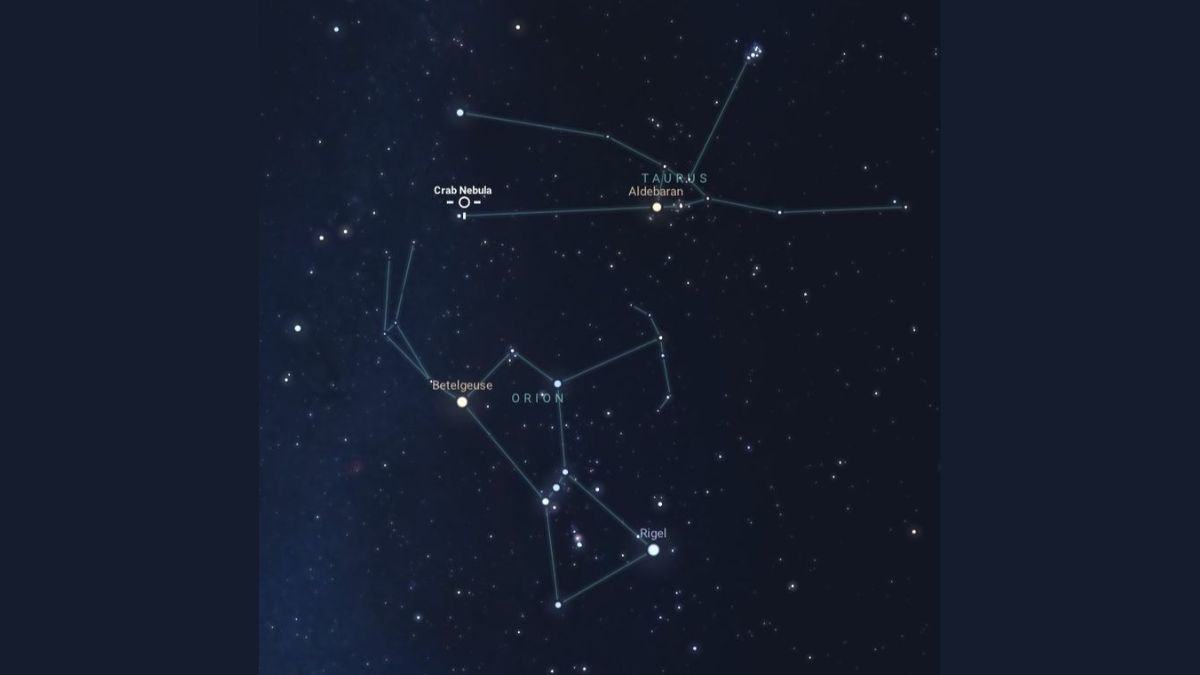
Photo Credit: NASA
The Crab Nebula composite shows expanding gas filaments from a supernova across multiple wavelengths.
Click Here to Add Gadgets360 As A Trusted Source


Advertisement
The red supergiant in Orion, Betelgeuse, raised questions with its unprecedented dimming late last year over when it might explode as a supernova. Astronomers don't know for sure when that event will happen, but they can look very far into the future by studying an exploded star called the Crab Nebula, documented in 1054. The profuse, spindly gas clouds of the Crab Nebula that are seen in a composite image combining five telescopes at radio, infrared, visible, ultraviolet, and X-ray wavelengths demonstrate how dying stars spray heavy elements like iron, passing on increased richness to space and giving birth to new stars.
Crab Nebula and Betelgeuse Reveal How Massive Stars End and Enrich the Cosmos
According to a NASA report, the Crab Nebula image is constructed from the data of the Very Large Array, Spitzer, Hubble, XMM-Newton, and Chandra observatories. Observations have revealed not only a spinning neutron star and filaments formed in the supernova explosion, but also show that 642 light-years away, the impending supernova Betelgeuse can be used to study massive stellar evolution.
By analyzing stars like Betelgeuse and the Crab Nebula, it becomes clear how supernovae spread elements, as well as filaments that trigger new star formations.
Betelgeuse and Crab Nebula Offer Insights into Stellar Life Cycles and Cosmic Evolution
Betelgeuse and the Crab Nebula are a natural laboratory for investigating the life cycle of stars and designing models of massive star evolution.
This multi-telescope view underscores the power of combining information from across the electromagnetic spectrum to piece together the full story of stellar death and rebirth, from surface changes to explosive remnants expanding across space.
Comments
Get your daily dose of tech news, reviews, and insights, in under 80 characters on Gadgets 360 Turbo. Connect with fellow tech lovers on our Forum. Follow us on X, Facebook, WhatsApp, Threads and Google News for instant updates. Catch all the action on our YouTube channel.
Related Stories





Advertisement
Follow Us




-
09:53
iPhone 18 Goes On Sale In India: Huge Crowds, Long Queues At Apple Stores -
06:32
Google Pixel 11 Pro XL Review: The Most Exciting Pixel Yet? | 120X Zoom + Tensor G6 -
05:20
Samsung Galaxy Watch Ultra 2 Review: Is This the Best Android Smartwatch? -
07:01
Samsung Galaxy Z Fold 8 Review: Is This the Best Foldable Phone? -
06:39
Samsung Galaxy Z Fold8 Ultra Review: Cameras, Battery, Performance Tested
-
10 मिनट में घर पहुंचेंगे iPhone 18 Pro, Pro Max: सेल हुई शुरू
-
Lava ने लॉन्च किया 6000mAh बैटरी वाला Bold N4 Pro 5G
-
itel Zeno 300 भारत में होगा लॉन्च, मिलेगी 6,000mAh बैटरी और डुअल कैमरा
-
Motorola Signature 27 होगा 22 सितंबर को पेश, 200MP दो कैमरा के साथ, टीजर जारी
-
Ai+ Pulse 2 FE जल्द होगा भारत में लॉन्च, 4 कलर के होंगे ऑप्शन
Advertisement
Popular on Gadgets
- Samsung Galaxy S26 Ultra
- Motorola Razr Fold
- ChatGPT
- OPPO Find N6
- Mobiles Under Rs. 40,000
- Vivo X300 Ultra
- Asus Zenbook S14
- iQOO 15
- Vivo X300 Pro
- Lenovo Yoga Slim 7i Aura Edition
- iQOO 15R
- Vivo X Fold 5
- Sony PlayStation 5
- HP OmniPad 12
- OnePlus Nord CE 6 Lite
- OnePlus Pad 4
- OPPO F33 Pro 5G
- Cryptocurrency
- HP OmniBook Ultra 14 (2026)
- iPhone 17
- Eureka Forbes AP 355 Room Air Purifier
- Latest Mobile Phones
- Compare Phones
Latest Gadgets
- Lava Bold N4 Pro 5G
- Samsung Galaxy A08
- Itel Muzik 450L
- OPPO K14 Lite
- Samsung Galaxy A18 4G
- iPhone Duo
- OPPO A7 Pro
- Huawei Mate XT 2 Ultimate Design
- Asus Vivobook S14 (S5452MA)
- Acer Aspire G 3D 16
- Xiaomi Pad 9 Pro
- Xiaomi Pad 9
- Apple Watch Ultra 4
- Apple Watch Series 12
- Haier M70 Mini LED 65-inch
- Xiaomi TV FX Mini LED 65
- Acer Predator Atlas 8
- Asus ROG Ally
- Blue Star 1.5 Ton 5 Star Inverter Split AC (IE518ZNURS)
- Blue Star 2 Ton 3 Star Inverter Window AC (WIE324L)

- About Us
- Sitemaps
- Feedback
- Archives
- Contact Us
- RSS
- Advertise
- Career
- Privacy Policy
- Ethics
- Editorial Policy
- Terms & Conditions
- Complaint Redressal
Download Our Apps
Available in Hindi
© Copyright Red Pixels Ventures Limited 2026. All rights reserved.