-
 Total Solar Eclipse Today: How to Watch Live Online, Timings, Safety Tips, and More12 August 2026
 -
Rocket Lab Sends Up Test Satellites for Europe’s Next-Gen Navigation System5 April 2026
-
James Webb Telescope Maps Uranus in 3D for the First Time; Data Reveals Hidden Storms, Methane Clouds25 February 2026
-
Unique Inside-Out Planetary System Reveals Unexpected Rocky World on the Outer Edge13 February 2026
-
AI Identifies More Than 1,300 Unusual Objects in Hubble Space Telescope Images3 February 2026
- Home
- Science
- Science News
- ESA Reveals City Size ‘Cosmic Butterfly’ Crater on Mars Containing Signs of Ancient Water
ESA Reveals City-Size ‘Cosmic Butterfly’ Crater on Mars Containing Signs of Ancient Water
ESA images reveal a city-sized butterfly crater on Mars with smooth wings likely formed by ancient water.
Written by Gadgets 360 Staff | Updated: 17 December 2025 21:30 IST
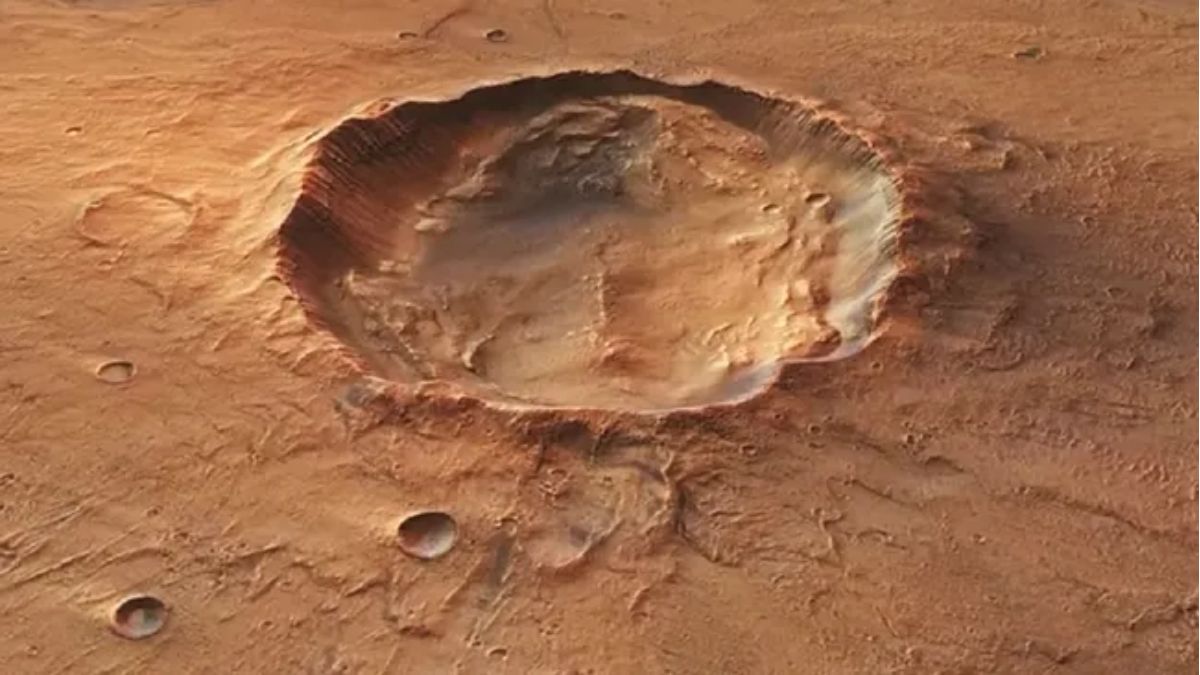
Photo Credit: ESA
Mars’ butterfly crater shows smooth, water-influenced wings across the Red Planet’s northern lowlands
Click Here to Add Gadgets360 As A Trusted Source


Advertisement
A city-size “cosmic butterfly” crater on Mars can now be seen in stunning detail from the European Space Agency (ESA), providing a new perspective of the Red Planet's watery past. The feature, located in the region of Idaeus Fossae, is approximately 12.4 miles (20 kilometers) from east to west and 9.3 miles (15 km) north to south; it is almost as big as Manhattan. Created by an asteroid, the crater is smooth, with wing-like outcrops against its uneven center shaped like a walnut. ESA's Mars Express orbiter, which has surveyed the planet since 2003, digitally reconstructed the crater for this detailed view.
ESA Reveals How “Butterfly” Craters on Mars Reveal Impact Dynamics and Subsurface Ice History
According to an ESA report, the smooth wings may result from a layer of buried Martian ice melted by the impact and mixed with debris to form fluidised terrain. Unlike the usual craters that one would find on Earth, which are rounded and nearly circular, this asymmetrical crater was created when the asteroid impacted at an oblique angle, dispersing debris to its north and south differently. Scientists say studying such butterfly craters can reveal the angle, force, and history of ancient impacts, as well as conditions beneath the Martian surface at the time.
ESA observed a similar elongated butterfly crater in Mars' southern highlands in 2006; comparing these structures reveals impacts, ice interaction, and Mars' geologic and hydrologic history.
Mars' “Animal-Shaped” Features Reveal Surface Processes and Ice Distribution, Highlighting Pareidolia and Impact History Insights
The findings summarise “animal-shaped” formations on Mars, including rocks resembling turtles and corals, and cracks shaped like the outline of a spider, which can be attributed to pareidolia, with implications for processes on the surface and ice distribution.
Researchers say that ongoing imaging of Mars' northern and southern lowlands may reveal more butterfly craters, which could in turn assist in charting the Red Planet's impact history and the influence of water on its surface over billions of years.
Comments
Get your daily dose of tech news, reviews, and insights, in under 80 characters on Gadgets 360 Turbo. Connect with fellow tech lovers on our Forum. Follow us on X, Facebook, WhatsApp, Threads and Google News for instant updates. Catch all the action on our YouTube channel.
Further reading:
ESA, Mars, butterfly crater, Mars Express, Idaeus Fossae, asteroid impact, Martian water
Related Stories



Advertisement
Follow Us




-
05:20
Samsung Galaxy Watch Ultra 2 Review: Is This the Best Android Smartwatch? -
07:01
Samsung Galaxy Z Fold 8 Review: Is This the Best Foldable Phone? -
06:39
Samsung Galaxy Z Fold8 Ultra Review: Cameras, Battery, Performance Tested -
04:33
[Sponsored] JBL Live 780NC: Great Sound, Perfect Comfort, Smart ANC & 80-Hour Battery -
12:04
[Partner Content] OPPO Reno16 Series Deep Dive: Built for Creators?
Advertisement
Popular on Gadgets
- Samsung Galaxy S26 Ultra
- Motorola Razr Fold
- ChatGPT
- OPPO Find N6
- Mobiles Under Rs. 40,000
- Vivo X300 Ultra
- Asus Zenbook S14
- iQOO 15
- Vivo X300 Pro
- Lenovo Yoga Slim 7i Aura Edition
- iQOO 15R
- Vivo X Fold 5
- Sony PlayStation 5
- HP OmniPad 12
- OnePlus Nord CE 6 Lite
- OnePlus Pad 4
- OPPO F33 Pro 5G
- Cryptocurrency
- HP OmniBook Ultra 14 (2026)
- iPhone 17
- Eureka Forbes AP 355 Room Air Purifier
- Latest Mobile Phones
- Compare Phones
Latest Gadgets
- iPhone Duo
- OPPO A7 Pro
- Huawei Mate XT 2 Ultimate Design
- Realme 16 Pro Harry Potter Edition
- Samsung Galaxy A07s
- Huawei Pura X View
- Tecno Camon Slim 5G
- iQOO Z11xa
- Acer Aspire G 3D 16
- Acer Swift Air 16 (2026)
- Xiaomi Pad 9 Pro
- Xiaomi Pad 9
- Apple Watch Ultra 4
- Apple Watch Series 12
- Haier M70 Mini LED 65-inch
- Xiaomi TV FX Mini LED 65
- Acer Predator Atlas 8
- Asus ROG Ally
- Blue Star 1.5 Ton 5 Star Inverter Split AC (IE518ZNURS)
- Blue Star 2 Ton 3 Star Inverter Window AC (WIE324L)

- About Us
- Sitemaps
- Feedback
- Archives
- Contact Us
- RSS
- Advertise
- Career
- Privacy Policy
- Ethics
- Editorial Policy
- Terms & Conditions
- Complaint Redressal
Download Our Apps
Available in Hindi
© Copyright Red Pixels Ventures Limited 2026. All rights reserved.