
-
 Scientists Reveal Why Jupiter and Saturn’s Polar Weather Looks So Different23 January 2026
 -
NASA’s Juno Probe Faces Silence as Mission Ends Amid Government Shutdown7 October 2025
-
Researchers Discover New Plasma Wave in Jupiter’s Auroral Skies25 August 2025
-
NASA Engineers Rescue JunoCam with Deep-Space Heating Hack24 July 2025
-
Juno Mission Sheds Light on Jupiter’s Storms and Volcanic Activity on Io2 May 2025
- Home
- Science
- Science News
- Nasa's Juno Spacecraft Adjusts Flight Path for Date With Jupiter
Nasa's Juno Spacecraft Adjusts Flight Path for Date With Jupiter
By Indo-Asian News Service | Updated: 4 February 2016 17:58 IST
Click Here to Add Gadgets360 As A Trusted Source

Advertisement
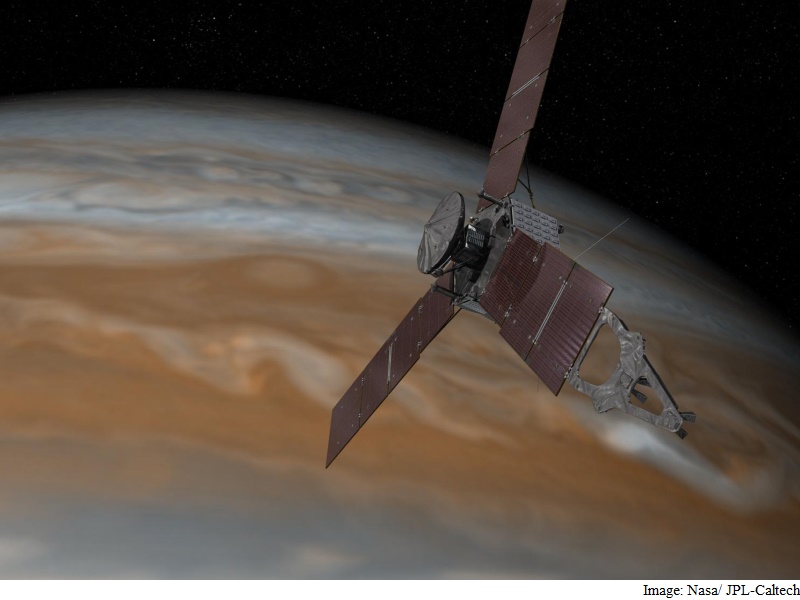
Set to arrive at Jupiter this year to study the giant planet from an elliptical, polar orbit, Nasa's solar-powered Juno spacecraft successfully executed a manoeuvre to adjust its flight path on Wednesday.
"This is the first of two trajectory adjustments that fine tune Juno's orbit around the Sun, perfecting our rendezvous with Jupiter on July 4," said Scott Bolton, Juno principal investigator at the Southwest Research Institute in San Antonio.
The Juno spacecraft's thrusters consumed about 0.6kg of fuel during the burn and changed the spacecraft's speed by 0.31 metres per second.
At the time of the manoeuvre, Juno was about 82 million kilometres from Jupiter and approximately 684 million kilometres from Earth.
The next trajectory correction manoeuvre is scheduled on May 31.
Launched on August 5, 2011, thee spacecraft will orbit the Jovian world 33 times, skimming to within 5,000 kilometres above the planet's cloud tops every 14 days.
During the flybys, Juno will probe beneath the obscuring cloud cover of Jupiter and study its aurorae to learn more about the planet's origins, structure, atmosphere and magnetosphere.
Last month, Nasa announced its Juno spacecraft had broken the record to become humanity's most distant solar-powered emissary, achieving the milestone when it was about 793 million km from the Sun.
Juno is the first solar-powered spacecraft designed to operate at such a great distance from the Sun.
The four-ton Juno spacecraft carries three 30-foot-long solar arrays festooned with 18,698 individual solar cells.
Comments
Get your daily dose of tech news, reviews, and insights, in under 80 characters on Gadgets 360 Turbo. Connect with fellow tech lovers on our Forum. Follow us on X, Facebook, WhatsApp, Threads and Google News for instant updates. Catch all the action on our YouTube channel.
Related Stories




Advertisement
Follow Us




-
![[Sponsored] LG NANO 4K UHD AI TV NU885: Gemini Search, Dolby Atmos & 5 Years of Updates](https://www.gadgets360.com/static/desktop/images/spacer.png)
04:17
[Sponsored] LG NANO 4K UHD AI TV NU885: Gemini Search, Dolby Atmos & 5 Years of Updates -
00:57
[Sponsored] Samsung Galaxy Z Fold8 My Fan Cam in Action: Find the Moment, Then Share It -
01:41
[Sponsored] What Do You Need To Know Before Your Next Run? | Samsung Galaxy Watch Ultra2 -
01:32
[Sponsored] Big Day Tomorrow? Prep Today | Samsung Galaxy Watch Ultra2 -
04:37
[Sponsored]: CP PLUS CarKam CP-F89B: 4K Dashcam With Rear Camera, GPS & Emergency Recording
Advertisement
Popular on Gadgets
- Samsung Galaxy S26 Ultra
- Motorola Razr Fold
- ChatGPT
- OPPO Find N6
- Mobiles Under Rs. 40,000
- Vivo X300 Ultra
- Asus Zenbook S14
- iQOO 15
- Vivo X300 Pro
- Lenovo Yoga Slim 7i Aura Edition
- iQOO 15R
- Vivo X Fold 5
- Sony PlayStation 5
- HP OmniPad 12
- OnePlus Nord CE 6 Lite
- OnePlus Pad 4
- OPPO F33 Pro 5G
- Cryptocurrency
- HP OmniBook Ultra 14 (2026)
- iPhone 17
- Eureka Forbes AP 355 Room Air Purifier
- Latest Mobile Phones
- Compare Phones
Latest Gadgets
- Samsung Galaxy F70 5G
- Tecno Spark 50S 5G
- Vivo Y600s Pro
- Vivo Y32 (2026)
- Infinix Smart 20 HD
- Vivo V80
- Vivo S2 FE
- Vivo Y600K Turbo
- HP ZBook Ultra G3a
- Dell Pro Rugged 14
- Amazon Alexa Tablet 8
- Amazon Alexa Tablet 11
- Amazfit T-Rex Dual Solar
- OPPO Watch S2
- Toshiba 65-Inch 4K Ultra HD Smart Mini LED QLED TV (65Z670SP)
- Haier M70 Mini LED 65-inch
- Acer Predator Atlas 8
- Asus ROG Ally
- Blue Star 1.5 Ton 5 Star Inverter Split AC (IE518ZNURS)
- Blue Star 2 Ton 3 Star Inverter Window AC (WIE324L)

- About Us
- Sitemaps
- Feedback
- Archives
- Contact Us
- RSS
- Advertise
- Career
- Privacy Policy
- Ethics
- Editorial Policy
- Terms & Conditions
- Complaint Redressal
Download Our Apps
Available in Hindi
© Copyright Red Pixels Ventures Limited 2026. All rights reserved.