
-
 Total Solar Eclipse Today: How to Watch Live Online, Timings, Safety Tips, and More12 August 2026
 -
JWST Watches HD 80606 bExoplanet Heat Up by 1,100 Degrees in Hours19 June 2026
-
Chandra Captures Sharpest-Ever X-Ray View of M87 Black Hole Jet18 June 2026
-
Astrophotographer Captures Giant Human-Shaped Solar Prominence8 June 2026
-
Blue Origin’s New Glenn Rocket Explodes During Pre-Launch Test in Florida29 May 2026
- Home
- Science
- Science News
- Nasa's SOFIA Helps Find Missing Link Between Supernovae and Planet Formation
Nasa's SOFIA Helps Find Missing Link Between Supernovae and Planet Formation
By Indo-Asian News Service | Updated: 20 March 2015 12:07 IST
Click Here to Add Gadgets360 As A Trusted Source

Advertisement
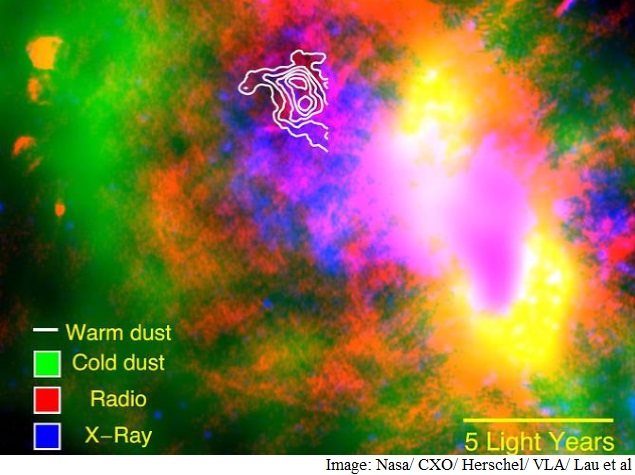
Using Nasa's Stratospheric Observatory for Infrared Astronomy (SOFIA), an international scientific team has discovered that supernovae are capable of producing a substantial amount of the material from which planets like Earth can be formed.
"Our observations reveal a particular cloud produced by a supernova explosion 10,000 years ago contains enough dust to make 7,000 Earths," said Ryan Lau of Cornell University in Ithaca, New York, in a paper that appeared in the journal Science.
The research team used SOFIA to take detailed infrared images of an interstellar dust cloud known as Supernova Remnant Sagittarius A East, or SNR Sgr A East.
The team used SOFIA data to estimate the total mass of dust in the cloud from the intensity of its emission.
Astronomers already had evidence that a supernova's outward-moving shock wave can produce significant amounts of dust.
"The dust survived the later onslaught of shock waves from the supernova explosion, and is now flowing into the interstellar medium where it can become part of the 'seed material' for new stars and planets," Lau added.
These results also reveal the possibility that the vast amount of dust observed in distant young galaxies may have been made by supernova explosions of early massive stars, as no other known mechanism could have produced nearly as much dust.
SOFIA is a heavily modified Boeing 747 jetliner that carries a telescope with an effective diameter of 2.5 metres at altitudes of 12 to 14 km.
Comments
Get your daily dose of tech news, reviews, and insights, in under 80 characters on Gadgets 360 Turbo. Connect with fellow tech lovers on our Forum. Follow us on X, Facebook, WhatsApp, Threads and Google News for instant updates. Catch all the action on our YouTube channel.
Related Stories


Advertisement
Follow Us




-
![[Sponsored] Galaxy Tab S10 Lite for Students: Notes, Solve Math and More](https://www.gadgets360.com/static/desktop/images/spacer.png)
01:15
[Sponsored] Galaxy Tab S10 Lite for Students: Notes, Solve Math and More -
04:17
[Sponsored] LG NANO 4K UHD AI TV NU885: Gemini Search, Dolby Atmos & 5 Years of Updates -
00:57
[Sponsored] Samsung Galaxy Z Fold8 My Fan Cam in Action: Find the Moment, Then Share It -
01:41
[Sponsored] What Do You Need To Know Before Your Next Run? | Samsung Galaxy Watch Ultra2 -
01:32
[Sponsored] Big Day Tomorrow? Prep Today | Samsung Galaxy Watch Ultra2
-
X पर वीडियो पोस्ट करके जीतें 2.83 लाख रुपये, किकस्टार्ट बोनस शुरू, जानें
-
6500mAh बैटरी वाला फोन Amazon Sale में ₹15 हजार से भी सस्ता हुआ
-
Oura Ring 5 लॉन्च, हेल्थ और मेडिकेशन दोनों की ट्रैकिंग, 7 दिन चलेगी बैटरी
-
Vivo Y600 होगा 30 अक्टूबर को लॉन्च, 10,000mAh की मिलेगी बैटरी
-
Oppo Find X10 Pro Max ग्लोबल मार्केट में लॉन्च, 200MP तीन कैमरा, 7150mAh बैटरी फीचर्स
Advertisement
Popular on Gadgets
- Samsung Galaxy S26 Ultra
- Motorola Razr Fold
- ChatGPT
- OPPO Find N6
- Mobiles Under Rs. 40,000
- Vivo X300 Ultra
- Asus Zenbook S14
- iQOO 15
- Vivo X300 Pro
- Lenovo Yoga Slim 7i Aura Edition
- iQOO 15R
- Vivo X Fold 5
- Sony PlayStation 5
- HP OmniPad 12
- OnePlus Nord CE 6 Lite
- OnePlus Pad 4
- OPPO F33 Pro 5G
- Cryptocurrency
- HP OmniBook Ultra 14 (2026)
- iPhone 17
- Eureka Forbes AP 355 Room Air Purifier
- Latest Mobile Phones
- Compare Phones
Latest Gadgets
- Lava Aura Curve
- Poco X8s
- Samsung Galaxy F70 5G
- Tecno Spark 50S 5G
- Vivo Y600s Pro
- Vivo Y32 (2026)
- Infinix Smart 20 HD
- Vivo V80
- HP ZBook Ultra G3a
- Dell Pro Rugged 14
- Amazon Alexa Tablet 8
- Amazon Alexa Tablet 11
- Pebble Qore 2
- Amazfit T-Rex Dual Solar
- Toshiba 65-Inch 4K Ultra HD Smart Mini LED QLED TV (65Z670SP)
- Haier M70 Mini LED 65-inch
- Acer Predator Atlas 8
- Asus ROG Ally
- Blue Star 1.5 Ton 5 Star Inverter Split AC (IE518ZNURS)
- Blue Star 2 Ton 3 Star Inverter Window AC (WIE324L)

- About Us
- Sitemaps
- Feedback
- Archives
- Contact Us
- RSS
- Advertise
- Career
- Privacy Policy
- Ethics
- Editorial Policy
- Terms & Conditions
- Complaint Redressal
Download Our Apps
Available in Hindi
© Copyright Red Pixels Ventures Limited 2026. All rights reserved.