-
 Ramani Kalyanam Now Streaming Online: What You Need to Know14 June 2026
 -
Tik Tik Tik OTT Release: Where to Watch Jayam Ravi’s Tamil Sci-Fi Thriller Online8 June 2026
-
Sun Unleashes Triple Solar Flare Blast, Triggering G3 Geomagnetic Storm Alert4 June 2026
-
Faces Out on OTT: Know Where to Stream This Psychological Thriller Film Online30 May 2026
-
Faces OTT Release Date: When and Where to Watch the Psychological Thriller Online?29 May 2026
- Home
- Science
- Science News
- Astrophotographer Captures Giant Human Shaped Solar Prominence
Astrophotographer Captures Giant Human-Shaped Solar Prominence
A backyard astrophotographer in Arizona captured an extraordinary solar prominence that appeared like a giant figure standing above the Sun.
Written by Gadgets 360 Staff | Updated: 8 June 2026 22:41 IST
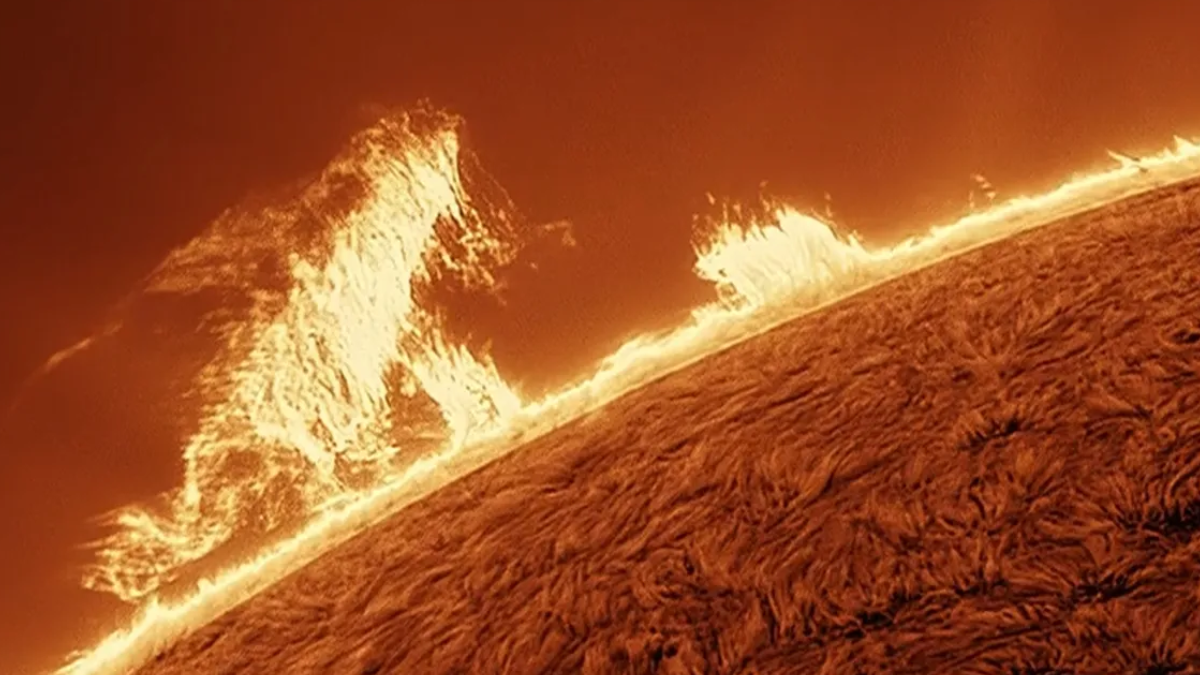
Photo Credit: Mark Johnston
A still image from Johnston's 25-second timelapse, which represents.
Click Here to Add Gadgets360 As A Trusted Source


Advertisement
Arizona-based astrophotographer Mark Johnston aimed his telescope at the horizon in a Scottsdale backyard garden on May 31, 2026, but saw a sight never seen before. Pointing a hydrogen-alpha filter towards the sun's edge, he managed to record a giant cloud of plasma that looked like a giant standing still, rising from the sun's limb. Earlier, on May 22, an entirely different prominence ejected large quantities of matter into space in a phenomenon called coronal rain.
Magnetism Runs the Show
According to NASA, solar prominences are these massive plasma formations, sort of cooler and more packed than the nearby corona, and they just hang there above the sun because the sun's magnetic field is keeping them up. You can spot them as bright, glowing archways along the edge limb, while on the brighter solar disk, they show up more like dark ribbons, usually called filaments. Johnston said the whole “wind-swept” feeling in the plasma's movement is kind of misleading, because the ionised hydrogen is really being carried along unseen magnetic field strands, and gravity, well, it only plays a smaller part in the story.
No Fire, Just Physics
Contrary to appearances, Johnston is quick to dispel the myth that there is actually a flame burning on the sun. The sun's surface is filled with hydrogen plasma, which lights up due to being extremely hot rather than burning – like a stove's surface burning bright red without undergoing any actual combustion. The images were captured using a telescope with a hydrogen-alpha filter on a 160mm refractor, allowing him to record the unique 656.3 nanometer wavelength of hydrogen emission. Regular telescopes can see nothing at all. These observations are especially useful during solar maxima, when eruptions become more frequent.
Comments
Get your daily dose of tech news, reviews, and insights, in under 80 characters on Gadgets 360 Turbo. Connect with fellow tech lovers on our Forum. Follow us on X, Facebook, WhatsApp, Threads and Google News for instant updates. Catch all the action on our YouTube channel.
Further reading:
Sun, Solar Prominence, Solar Physics, Space Weather, Astrophotography, Mark Johnston, Solar Maximum, NASA, Hydrogen Alpha, Plasma, Solar Activity, Astronomy, Space Science, Sunspot Cycle, Solar Observation
Related Stories






Advertisement
Follow Us




-
01:15
[Sponsored] Galaxy Tab S10 Lite for Students: Notes, Solve Math and More -
04:17
[Sponsored] LG NANO 4K UHD AI TV NU885: Gemini Search, Dolby Atmos & 5 Years of Updates -
00:57
[Sponsored] Samsung Galaxy Z Fold8 My Fan Cam in Action: Find the Moment, Then Share It -
01:41
[Sponsored] What Do You Need To Know Before Your Next Run? | Samsung Galaxy Watch Ultra2 -
01:32
[Sponsored] Big Day Tomorrow? Prep Today | Samsung Galaxy Watch Ultra2
-
NVIDIA के सीईओ ने पेश किए माइक्रोडक रोबोट, AI से चलते हैं, क्या काम आएंगे
-
iPhone Duo को बीच से खोला, फोल्डेबल डिस्प्ले से हटाया कवर, फिर क्या दिखा?
-
1 जनवरी से फोन में बिना सिम नहीं चलेगा WhatsApp, सिम बाइडिंग हुआ अनिवार्य
-
Oppo Reno 17 सीरीज के लॉन्च की तैयारी, NBTC पर हुई लिस्टिंग
-
Amazon Great Indian Sale 2026 में ₹35 हजार रेंज में मिल रहे iQOO, Samsung, OnePlus धांसू फोन, 8000mAh तक बैटरी
Advertisement
Popular on Gadgets
- Samsung Galaxy S26 Ultra
- Motorola Razr Fold
- ChatGPT
- OPPO Find N6
- Mobiles Under Rs. 40,000
- Vivo X300 Ultra
- Asus Zenbook S14
- iQOO 15
- Vivo X300 Pro
- Lenovo Yoga Slim 7i Aura Edition
- iQOO 15R
- Vivo X Fold 5
- Sony PlayStation 5
- HP OmniPad 12
- OnePlus Nord CE 6 Lite
- OnePlus Pad 4
- OPPO F33 Pro 5G
- Cryptocurrency
- HP OmniBook Ultra 14 (2026)
- iPhone 17
- Eureka Forbes AP 355 Room Air Purifier
- Latest Mobile Phones
- Compare Phones
Latest Gadgets
- HMD 2660 Flip Senior Edition
- Lava Aura Curve
- Poco X8s
- Samsung Galaxy F70 5G
- Tecno Spark 50S 5G
- Vivo Y600s Pro
- Vivo Y32 (2026)
- Infinix Smart 20 HD
- Lenovo Yoga 9n 2-in-1
- Lenovo Yoga Pro 9n
- Amazon Alexa Tablet 8
- Amazon Alexa Tablet 11
- Pebble Qore 2
- Amazfit T-Rex Dual Solar
- Toshiba 65-Inch 4K Ultra HD Smart Mini LED QLED TV (65Z670SP)
- Haier M70 Mini LED 65-inch
- Acer Predator Atlas 8
- Asus ROG Ally
- Blue Star 1.5 Ton 5 Star Inverter Split AC (IE518ZNURS)
- Blue Star 2 Ton 3 Star Inverter Window AC (WIE324L)

- About Us
- Sitemaps
- Feedback
- Archives
- Contact Us
- RSS
- Advertise
- Career
- Privacy Policy
- Ethics
- Editorial Policy
- Terms & Conditions
- Complaint Redressal
Download Our Apps
Available in Hindi
© Copyright Red Pixels Ventures Limited 2026. All rights reserved.