-
 New Study Suggests Uranus and Neptune May Contain More Rock Than Ice14 May 2026
 -
Uranus’ Outer Rings May Reveal Hidden Moons, Scientists Say24 April 2026
-
James Webb Telescope Maps Uranus in 3D for the First Time; Data Reveals Hidden Storms, Methane Clouds25 February 2026
-
Uranus and Neptune May Be Rocky Worlds Not Ice Giants, New Research Shows11 December 2025
-
James Webb Telescope Discovers Tiny New Moon Orbiting Uranus23 August 2025
- Home
- Science
- Science News
- Uranus and Neptune May Be Rock Dominated Planets, Study Suggests
Uranus and Neptune May Be Rock-Dominated Planets, Study Suggests
New simulations suggest Uranus and Neptune may contain far more rock than ice, offering fresh explanations for their unusual magnetic fields.
Written by Gadgets 360 Staff | Updated: 13 December 2025 17:00 IST
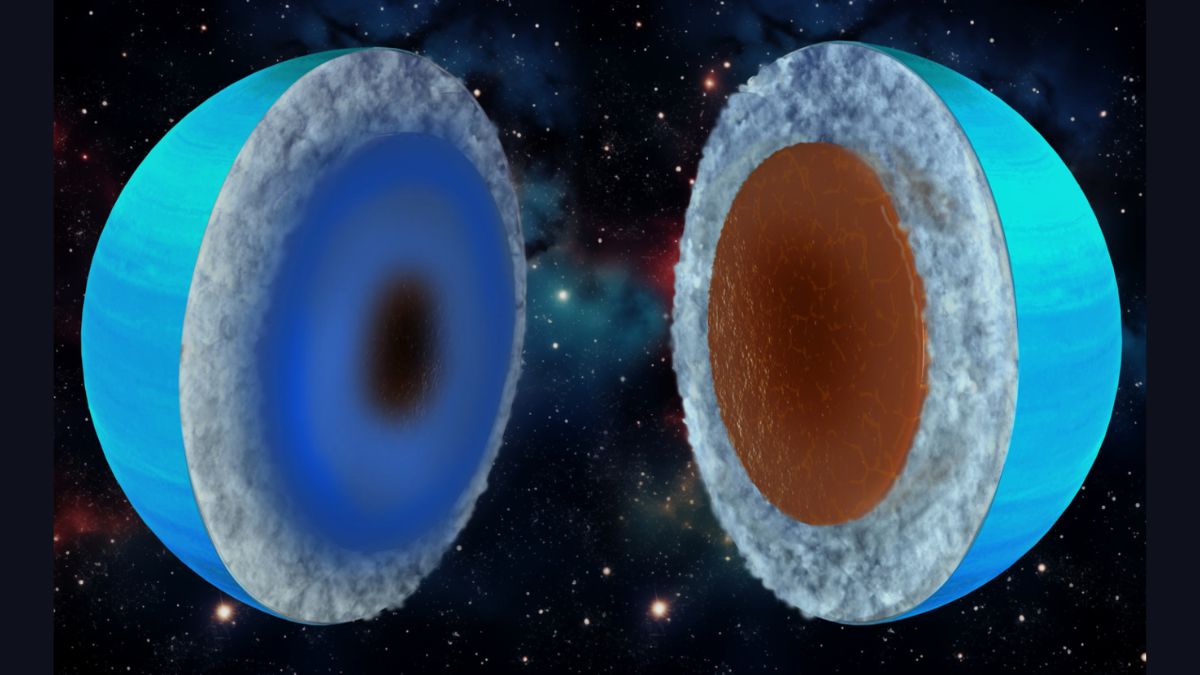
Photo Credit: Keck Institute for Space Studies / Chuck Carter
New simulations suggest Uranus and Neptune are rockier than believed
Click Here to Add Gadgets360 As A Trusted Source


Advertisement
Uranus and Neptune have long been known by scientists as ice giants because of the presumption that their interiors were rich in water. Nonetheless, recent studies by the University of Zurich find another key to this decades-old assumption. In a breakthrough study in Astronomy and Astrophysics, it has been found that these outer-world planets are possibly exceedingly rockier than we had imagined before, which has fundamentally redefined the outer solar system.
Rethinking Planetary Composition
According to the study, using an innovative simulation approach that blends physical models with observational data, researchers developed unbiased interior models for both planets. Their findings suggest that Uranus and Neptune could be dominated by rock rather than water, or contain any combination in between.
"The ice giant classification is oversimplified as Uranus and Neptune are still poorly understood," explains Luca Morf, the study's lead author. The research challenges the long-standing assumption that these planets must be ice-rich, opening new possibilities for understanding their true nature.
Solving Magnetic Field Mysteries
The paper also explains the mysterious magnetic fields of the planets. Neptune and Uranus have multi-directional magnetic poles, unlike the Earth, which is simply north-south polarised. Scientists have found that the presence of the layers of ionic water found in the planets creates these non-dipolar magnetic structures, with the field of Uranus forming beneath that of Neptune.
Although such progress was made, researchers insist that specific spacecraft are necessary to establish with a high degree of certainty whether these planets are really ice or rock giants.
Comments
Get your daily dose of tech news, reviews, and insights, in under 80 characters on Gadgets 360 Turbo. Connect with fellow tech lovers on our Forum. Follow us on X, Facebook, WhatsApp, Threads and Google News for instant updates. Catch all the action on our YouTube channel.
Related Stories




Advertisement
Follow Us




-
05:20
Samsung Galaxy Watch Ultra 2 Review: Is This the Best Android Smartwatch? -
07:01
Samsung Galaxy Z Fold 8 Review: Is This the Best Foldable Phone? -
06:39
Samsung Galaxy Z Fold8 Ultra Review: Cameras, Battery, Performance Tested -
04:33
[Sponsored] JBL Live 780NC: Great Sound, Perfect Comfort, Smart ANC & 80-Hour Battery -
12:04
[Partner Content] OPPO Reno16 Series Deep Dive: Built for Creators?
-
iPhone Duo के लिए ₹3 लाख का बजट नहीं है? ये 4 सस्ते फोल्डेबल फोन देखिए
-
सोशल मीडिया में छाया 80s AI Photo Trend, आप भी आजमाएं ये 5 Prompts
-
Motorola के 7000mAh बैटरी वाले फोन पर ₹4,500 तक की बचत
-
₹23 हजार से ज्यादा सस्ता मिल रहा 55 हजार एमआरपी वाला Vivo 5G फोन! 50MP कैमरा, 7200mAh बैटरी
-
Mivi One 5G सस्ता फोन भारत में आएगा तीन रंगों में, Android 16 सपोर्ट, 24 सितंबर को है लॉन्च
Advertisement
Popular on Gadgets
- Samsung Galaxy S26 Ultra
- Motorola Razr Fold
- ChatGPT
- OPPO Find N6
- Mobiles Under Rs. 40,000
- Vivo X300 Ultra
- Asus Zenbook S14
- iQOO 15
- Vivo X300 Pro
- Lenovo Yoga Slim 7i Aura Edition
- iQOO 15R
- Vivo X Fold 5
- Sony PlayStation 5
- HP OmniPad 12
- OnePlus Nord CE 6 Lite
- OnePlus Pad 4
- OPPO F33 Pro 5G
- Cryptocurrency
- HP OmniBook Ultra 14 (2026)
- iPhone 17
- Eureka Forbes AP 355 Room Air Purifier
- Latest Mobile Phones
- Compare Phones
Latest Gadgets
- iPhone Duo
- OPPO A7 Pro
- Huawei Mate XT 2 Ultimate Design
- Realme 16 Pro Harry Potter Edition
- Samsung Galaxy A07s
- Huawei Pura X View
- Tecno Camon Slim 5G
- iQOO Z11xa
- Acer Aspire G 3D 16
- Acer Swift Air 16 (2026)
- Infinix Xpad 30 Pro
- Lenovo Yoga Tab Gen 2
- Apple Watch Ultra 4
- Apple Watch Series 12
- Haier M70 Mini LED 65-inch
- Xiaomi TV FX Mini LED 65
- Acer Predator Atlas 8
- Asus ROG Ally
- Blue Star 1.5 Ton 5 Star Inverter Split AC (IE518ZNURS)
- Blue Star 2 Ton 3 Star Inverter Window AC (WIE324L)

- About Us
- Sitemaps
- Feedback
- Archives
- Contact Us
- RSS
- Advertise
- Career
- Privacy Policy
- Ethics
- Editorial Policy
- Terms & Conditions
- Complaint Redressal
Download Our Apps
Available in Hindi
© Copyright Red Pixels Ventures Limited 2026. All rights reserved.