-
 Interstellar Comet 3I/ATLAS Nears Earth on Dec. 19, Offering Rare Insights Into Cosmic Visitors17 December 2025
 -
NASA Hubble Space Telescope Uncovers One of the Youngest Known Blue Straggler–White Dwarf Systems11 September 2025
-
NASA Captures Striking Image of Galaxy NGC 7456, 51 Million Light-Years Away7 September 2025
-
NASA's Hubble Captures Interstellar Comet 3I/ATLAS Ahead of Close Mars Flyby4 September 2025
-
Hubble Discovers White Dwarf Merger Remnant with Unusual Carbon Signature22 August 2025
- Home
- Science
- Science News
- Hubble Observations Turn Exoplanet Into Dust; Reveal Rare Double Asteroid Impact in Nearby System
Hubble Observations Turn Exoplanet Into Dust; Reveal Rare Double Asteroid Impact in Nearby System
The unusual sightings offer a glimpse directly into destructive events that sculpt the infant solar systems.
Written by Gadgets 360 Staff | Updated: 3 January 2026 09:00 IST
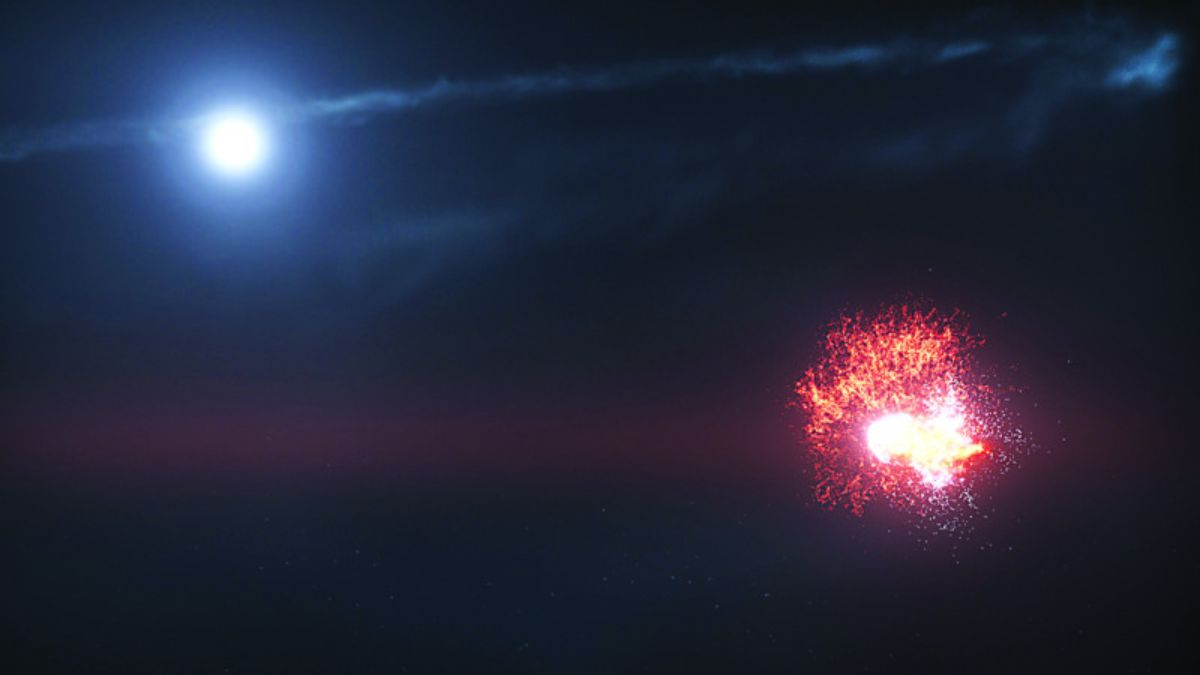
Photo Credit: NASA
Hubble spots glowing debris clouds from violent collisions in the Fomalhaut star system
Click Here to Add Gadgets360 As A Trusted Source


Advertisement
Astronomers who were monitoring a nearby star system thought they saw an exoplanet reflect light from its star until the object disappeared into darkness. The mystery deepened further when a second bright source appeared nearby, years later. Scientists, analysing decades of observations from NASA's Hubble Space Telescope, have finally unearthed the mystery, confirming that what they were not seeing planets at all. Instead, the light came from expanding clouds of dust following two head-on collisions between asteroid-sized bodies.
The unusual sightings offer a glimpse directly into destructive events that sculpt the infant solar systems.
Rare Double Collision in the Fomalhaut System
According to a Science journal report, the moving light sources were clouds of debris that resulted when giant rocks collided with other in the Fomalhaut system, about 25 light-years away. A dust-shrouded planet that turned out to be the waning emission from a colliding remnant cloud.
Researchers noted that the first object, now called Fomalhaut cs1, slowly disappeared as its dust spread out in space. When a second bright source, Fomalhaut cs2, appeared in a nearby region, it became clear that two separate impacts had occurred within just 20 years, an event expected to be extremely rare in theory.
Planet Formation Clues Revealed
The results provide scientists with a rare opportunity to observe how planets form as a result of repeated impacts and how rocks behave in the wake of violent collisions. The system's broad and massive dust belts allow such events to be observed more easily, transforming Fomalhaut into an experimental laboratory for planetary science.
The discovery warns planet searches: dust clouds can mimic planets by reflecting starlight, risking false detections as telescopes hunt worlds.
Comments
Catch the latest from the Consumer Electronics Show on Gadgets 360, at our CES 2026 hub.
Related Stories
Hubble Observations Turn Exoplanet Into Dust; Reveal Rare Double Asteroid Impact in Nearby System


Advertisement
Follow Us




-
08:02
Top OxygenOS 16 Features You Must Know: Don't Miss These OnePlus Features On Your Phone! -
10:42
[Partner Content] OPPO Find X9 Two Week Experience: Here's Why It Stands Out -
04:38
Realme Watch 5 Review: Watch This Before You Buy The Latest Realme Smartwatch -
07:03
Vivo X300 Pro Review | Best Camera Phone You Can Buy For 2026 -
04:56
Vivo X300 Review | Best Flagship of 2025? | Unbelievable Camera & Performance Test
-
नए साल पर iPhone पर आया बंपर ऑफर, सीधे मिल रहा 18 हजार का डिस्काउंट
-
CES 2026: Samsung पेश करेगी 130 इंच का बड़ा Micro RGB टीवी, जानें
-
सस्ती, सरकारी कैब बुकिंग सर्विस Bharat Taxi में क्या है अलग, यहां जानें
-
18 हजार से भी सस्ता मिल रहा Samsung Galaxy S25 5G, Amazon पर भारी छूट
-
Pebble Round 2 स्मार्टवॉच लॉन्च हुई 14 दिन की बैटरी लाइफ के साथ, जानें कीमत
Advertisement
Popular on Gadgets
- Samsung Galaxy Unpacked 2025
- ChatGPT
- Redmi Note 14 Pro+
- iPhone 16
- Apple Vision Pro
- Oneplus 12
- OnePlus Nord CE 3 Lite 5G
- iPhone 13
- Xiaomi 14 Pro
- Oppo Find N3
- Tecno Spark Go (2023)
- Realme V30
- Best Phones Under 25000
- Samsung Galaxy S24 Series
- Cryptocurrency
- iQoo 12
- Samsung Galaxy S24 Ultra
- Giottus
- Samsung Galaxy Z Flip 5
- Apple 'Scary Fast'
- Housefull 5
- GoPro Hero 12 Black Review
- Invincible Season 2
- JioGlass
- HD Ready TV
- Laptop Under 50000
- Smartwatch Under 10000
- Latest Mobile Phones
- Compare Phones
Latest Gadgets
- OPPO Reno 15 Pro Max
- Honor Win RT
- Honor Win
- Xiaomi 17 Ultra Leica Edition
- Xiaomi 17 Ultra
- Huawei Nova 15
- Huawei Nova 15 Pro
- Huawei Nova 15 Ultra
- Asus ProArt P16
- MacBook Pro 14-inch (M5, 2025)
- OPPO Pad Air 5
- Huawei MatePad 11.5 (2026)
- Xiaomi Watch 5
- Huawei Watch 10th Anniversary Edition
- Acerpure Nitro Z Series 100-inch QLED TV
- Samsung 43 Inch LED Ultra HD (4K) Smart TV (UA43UE81AFULXL)
- Asus ROG Ally
- Nintendo Switch Lite
- Haier 1.6 Ton 5 Star Inverter Split AC (HSU19G-MZAID5BN-INV)
- Haier 1.6 Ton 5 Star Inverter Split AC (HSU19G-MZAIM5BN-INV)

- About Us
- Sitemaps
- Feedback
- Archives
- Contact Us
- RSS
- Advertise
- Career
- Privacy Policy
- Ethics
- Editorial Policy
- Terms & Conditions
- Complaint Redressal
Download Our Apps
Available in Hindi
© Copyright Red Pixels Ventures Limited 2026. All rights reserved.