-
 Honor Unveils Humanoid Robot, Blade Battery Tech at MWC 2026; Robot Phone Confirmed to Launch in 20262 March 2026
 -
Honor Teases Humanoid Robot, Schedules Showcase a Day Ahead of MWC 202623 February 2026
-
Faraday Future Launches its First Series of Multipurpose AI-Powered Humanoid and Bionic Robots5 February 2026
-
Robot Drummer: Humanoid Robot Learns to Play Drums with Human-Like Precision10 August 2025
-
Meet Walker S2: The Self-Sufficient Humanoid Robot with Swappable Battery Tech28 July 2025
- Home
- Science
- Science News
- Researchers Develop Neuromorphic ‘E Skin’ to Give Humanoid Robots Pain Reflexes
Researchers Develop Neuromorphic ‘E-Skin’ to Give Humanoid Robots Pain Reflexes
The NRE-skin includes a built-in pain centre, which reacts to dangerous stimuli nearly instantly and protects the robot from damage.
Written by Gadgets 360 Staff | Updated: 3 January 2026 16:30 IST
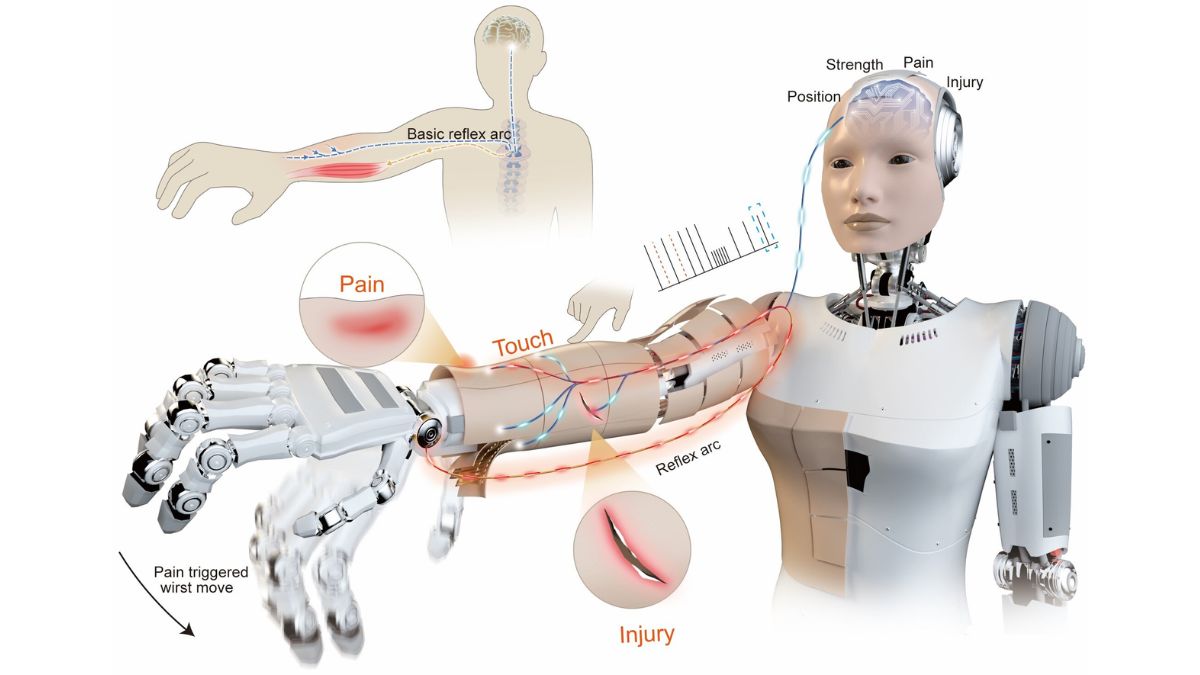
Photo Credit: Xinge Yu, City University of Hong Kong (via PNAS)
A neuromorphic robotic e-skin can convert touch into neural-like signals
Click Here to Add Gadgets360 As A Trusted Source


Advertisement
A group of researchers at the City University of Hong Kong, led by Yuyu Gao, have developed a neuromorphic robotic “e-skin” mimicking the human nervous system. The layered artificial skin converts pressure into neural-like pulses that distinguish gentle touch from painful force. It enables humanoid robots to sense contact, detect injury and trigger protective reflexes—much like a human reflex arc, paving the way to more “empathetic” robots that interact safely with people.
Active Pain Detection and Reflexes
According to the study published as part of a PNAS paper, the skin's four-layer design mimics human nerves. Under gentle contact, spike signals are routed to the central processor for interpretation. But if pressure exceeds a preset pain threshold, the skin triggers an immediate reflex by sending a high-voltage pulse directly to the motors, bypassing the CPU and causing the robot to withdraw.
In effect, the NRE-skin includes a built-in pain centre, which reacts to dangerous stimuli nearly instantly and protects the robot from damage.
Modular Design and Self-Repair
The NRE-skin has a neat feature where it can keep an eye on its own health. Each sensor sends out a regular “still here” signal, and if a patch gets cut, that signal stops, alerting the system to the damaged part. Since it can't heal itself, the skin uses magnetic modules.
When a patch is damaged, it pops off like a Lego piece and can be replaced in just seconds. The team is also aiming to enhance its sensitivity, so robots can pick up on multiple touches at once.
Comments
Get your daily dose of tech news, reviews, and insights, in under 80 characters on Gadgets 360 Turbo. Connect with fellow tech lovers on our Forum. Follow us on X, Facebook, WhatsApp, Threads and Google News for instant updates. Catch all the action on our YouTube channel.
Related Stories






Advertisement
Follow Us




-
04:37
[Sponsored]: CP PLUS CarKam CP-F89B: 4K Dashcam With Rear Camera, GPS & Emergency Recording -
04:23
[Partner Content] Your Phone Can Do WAY More Than You Think | OPPO ColorOS 16 -
01:59
Samsung Galaxy Z Fold8 Ultra: Unfold the Ultra Night -
03:24
Apple Pay Launches In India: Supported Devices, Cards And Payments Explained -
00:21
[Sponsored] Samsung Galaxy Z Fold8, Fold8 Ultra
-
Amazon Great Indian Festival Sale 2026: ₹15,999 से शुरू स्मार्टफोन डील्स
-
घर की दीवार बनेगी 120 इंच की सिनेमा स्क्रीन! Lumio Arc 7 (2026) हुआ लॉन्च
-
Amazon Great Indian Festival Sale 2026: ₹18 हजार सस्ता मिलेगा iPhone 16!
-
Oppo Find X10 Pro Max जल्द होगा भारत में लॉन्च, MediaTek Dimensity 9600 Pro चिपसेट
-
Lenovo ने लॉन्च किया AI फीचर्स वाला ThinkBook 14x लैपटॉप, आपकी पसंद के मिलेंगे फीचर्स
Advertisement
Popular on Gadgets
- Samsung Galaxy S26 Ultra
- Motorola Razr Fold
- ChatGPT
- OPPO Find N6
- Mobiles Under Rs. 40,000
- Vivo X300 Ultra
- Asus Zenbook S14
- iQOO 15
- Vivo X300 Pro
- Lenovo Yoga Slim 7i Aura Edition
- iQOO 15R
- Vivo X Fold 5
- Sony PlayStation 5
- HP OmniPad 12
- OnePlus Nord CE 6 Lite
- OnePlus Pad 4
- OPPO F33 Pro 5G
- Cryptocurrency
- HP OmniBook Ultra 14 (2026)
- iPhone 17
- Eureka Forbes AP 355 Room Air Purifier
- Latest Mobile Phones
- Compare Phones
Latest Gadgets
- Vivo Y32 (2026)
- Infinix Smart 20 HD
- Vivo V80
- Vivo S2 FE
- Vivo Y600K Turbo
- Realme P4s Lite
- Vivo S60t
- OPPO F35 5G
- Lenovo ThinkBook 14x
- Dell 14 Plus 2-in-1 (AMD Ryzen AI 7 350, 2025)
- Samsung Galaxy Tab S12+
- Samsung Galaxy Tab S12 Ultra
- Amazfit T-Rex Dual Solar
- OPPO Watch S2
- Toshiba 65-Inch 4K Ultra HD Smart Mini LED QLED TV (65Z670SP)
- Haier M70 Mini LED 65-inch
- Acer Predator Atlas 8
- Asus ROG Ally
- Blue Star 1.5 Ton 5 Star Inverter Split AC (IE518ZNURS)
- Blue Star 2 Ton 3 Star Inverter Window AC (WIE324L)

- About Us
- Sitemaps
- Feedback
- Archives
- Contact Us
- RSS
- Advertise
- Career
- Privacy Policy
- Ethics
- Editorial Policy
- Terms & Conditions
- Complaint Redressal
Download Our Apps
Available in Hindi
© Copyright Red Pixels Ventures Limited 2026. All rights reserved.