
-
 Nvidia Launches Isaac ROS 5.0 With AI Agents and Reusable Robotics Workflows23 September 2026
 -
IFA 2026: Lingverse iKairos Debuts as a Desktop Robot and Wearable AI Pendant4 September 2026
-
Honor Robot Phone Launched With Snapdragon 8 Elite Gen 5 SoC, 200-Megapixel Gimbal Camera: Price, Features12 August 2026
-
Honor Robot Phone Chipset, Battery and Other Key Features Tipped Ahead of August 12 Launch4 August 2026
-
Honor Robot Phone Camera Details, RAM and Storage Variants Teased; Pre-Orders Begin28 July 2026
- Home
- Science
- Science News
- Engineers Turn Lobster Shells Into Robot Parts That Lift, Grip and Swim
Engineers Turn Lobster Shells Into Robot Parts That Lift, Grip and Swim
Engineers have repurposed discarded lobster shells into biohybrid robotic parts, creating strong grippers and swimming fins.
Written by Gadgets 360 Staff | Updated: 6 December 2025 19:02 IST
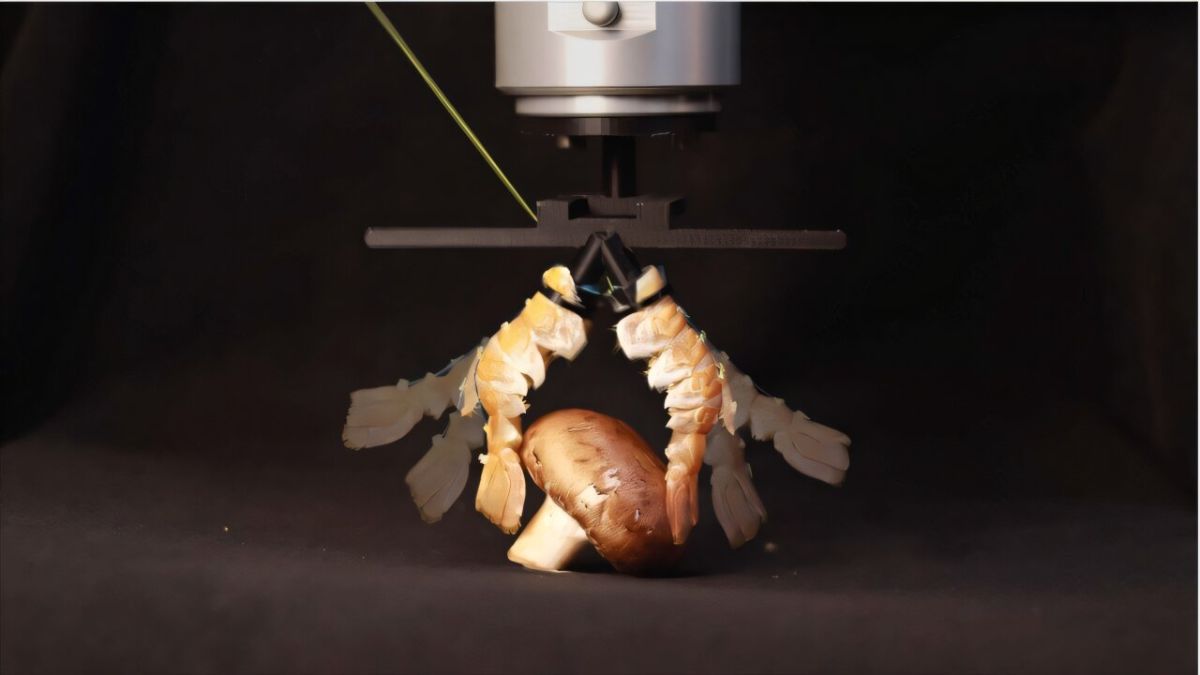
Photo Credit: CREATE Lab EPFL CC BY SA
Engineers turn shell waste into biohybrid robot grippers and fins, showing food scraps can fuel greener
Click Here to Add Gadgets360 As A Trusted Source


Advertisement
Biohybrid robots combine one hand biology with the other engineering. A single instance is that of joints for robots made out of the leftover shells of crustaceans. These external skeletons are able to move since they are a combination of both rigid and flexible. The team of engineers made the shells soft by impregnating them with polymers and then fixed the motors, thus, they created grippers which are capable of lifting heavy objects and fins which can swim by flapping. The term ‘dead matter' associated with this design is an indication of how the world's food waste can be a source of eco-friendly robots.
Designing with Crustacean Shells
According to the paper, EPFL engineers turned lobsters' discarded tail segments into robotic parts. Each crustacean shell has hard plates linked by flexible membranes, a mix of strength and flexibility. They inserted a soft elastomer into the segments, attached motors, and coated the shell in silicone for durability. In tests, one shell lifted ~500 g and two shells together grasped items from pens to tomatoes; they even served as flapping fins propelling a small robot at about 11 cm/s.
Benefits and Challenges
An eco-friendly twist is added by using waste shells, which allow the robot's synthetic components to be separated and reused, emulating a circular design. This is presented by the team as a robotics proof-of-concept for recycling food waste. However, difficulties still exist.
Two gripper "fingers" made of different tails bend unevenly because every shell is different, making control more difficult. Because of these peculiarities, bio-hybrid robots require further development before they can be used in the real world.
Comments
Get your daily dose of tech news, reviews, and insights, in under 80 characters on Gadgets 360 Turbo. Connect with fellow tech lovers on our Forum. Follow us on X, Facebook, WhatsApp, Threads and Google News for instant updates. Catch all the action on our YouTube channel.
Related Stories





Advertisement
Follow Us




-
04:17
[Sponsored] LG NANO 4K UHD AI TV NU885: Gemini Search, Dolby Atmos & 5 Years of Updates -
00:57
[Sponsored] Samsung Galaxy Z Fold8 My Fan Cam in Action: Find the Moment, Then Share It -
01:41
[Sponsored] What Do You Need To Know Before Your Next Run? | Samsung Galaxy Watch Ultra2 -
01:32
[Sponsored] Big Day Tomorrow? Prep Today | Samsung Galaxy Watch Ultra2 -
04:37
[Sponsored]: CP PLUS CarKam CP-F89B: 4K Dashcam With Rear Camera, GPS & Emergency Recording
-
iPhone 16 आज भी Amazon सेल में मिल रहा ₹15 हजार से ज्यादा सस्ता
-
OnePlus 15 को Amazon Great Indian Festival Sale में खरीदें सस्ता
-
₹2250 सस्ता मिल रहा Motorola का 7000mAh बैटरी वाला फोन! Flipkart पर ऑफर
-
Coolpad लाई पहला वाइड फोन Cool X Wide, 50MP कैमरा, 4600mAh बैटरी, प्री-ऑर्डर शुरू!
-
Realme लाई बजट फोन Realme C01, 6500mAh बैटरी के साथ!
Advertisement
Popular on Gadgets
- Samsung Galaxy S26 Ultra
- Motorola Razr Fold
- ChatGPT
- OPPO Find N6
- Mobiles Under Rs. 40,000
- Vivo X300 Ultra
- Asus Zenbook S14
- iQOO 15
- Vivo X300 Pro
- Lenovo Yoga Slim 7i Aura Edition
- iQOO 15R
- Vivo X Fold 5
- Sony PlayStation 5
- HP OmniPad 12
- OnePlus Nord CE 6 Lite
- OnePlus Pad 4
- OPPO F33 Pro 5G
- Cryptocurrency
- HP OmniBook Ultra 14 (2026)
- iPhone 17
- Eureka Forbes AP 355 Room Air Purifier
- Latest Mobile Phones
- Compare Phones
Latest Gadgets
- Samsung Galaxy F70 5G
- Tecno Spark 50S 5G
- Vivo Y600s Pro
- Vivo Y32 (2026)
- Infinix Smart 20 HD
- Vivo V80
- Vivo S2 FE
- Vivo Y600K Turbo
- HP ZBook Ultra G3a
- Dell Pro Rugged 14
- Amazon Alexa Tablet 8
- Amazon Alexa Tablet 11
- Amazfit T-Rex Dual Solar
- OPPO Watch S2
- Toshiba 65-Inch 4K Ultra HD Smart Mini LED QLED TV (65Z670SP)
- Haier M70 Mini LED 65-inch
- Acer Predator Atlas 8
- Asus ROG Ally
- Blue Star 1.5 Ton 5 Star Inverter Split AC (IE518ZNURS)
- Blue Star 2 Ton 3 Star Inverter Window AC (WIE324L)

- About Us
- Sitemaps
- Feedback
- Archives
- Contact Us
- RSS
- Advertise
- Career
- Privacy Policy
- Ethics
- Editorial Policy
- Terms & Conditions
- Complaint Redressal
Download Our Apps
Available in Hindi
© Copyright Red Pixels Ventures Limited 2026. All rights reserved.