-
 Nvidia Launches Isaac ROS 5.0 With AI Agents and Reusable Robotics Workflows23 September 2026
 -
IFA 2026: Lingverse iKairos Debuts as a Desktop Robot and Wearable AI Pendant4 September 2026
-
Honor Robot Phone Launched With Snapdragon 8 Elite Gen 5 SoC, 200-Megapixel Gimbal Camera: Price, Features12 August 2026
-
Honor Robot Phone Chipset, Battery and Other Key Features Tipped Ahead of August 12 Launch4 August 2026
-
Honor Robot Phone Camera Details, RAM and Storage Variants Teased; Pre-Orders Begin28 July 2026
- Home
- Science
- Science News
- Indian Dance Mudras May Revolutionise Robotic Hand Control, UMBC Study Shows
Indian Dance Mudras May Revolutionise Robotic Hand Control, UMBC Study Shows
A UMBC study reveals that classical Indian dance mudras provide robots with more versatile motion patterns than natural human grasps.
Written by Gadgets 360 Staff | Updated: 5 December 2025 22:02 IST
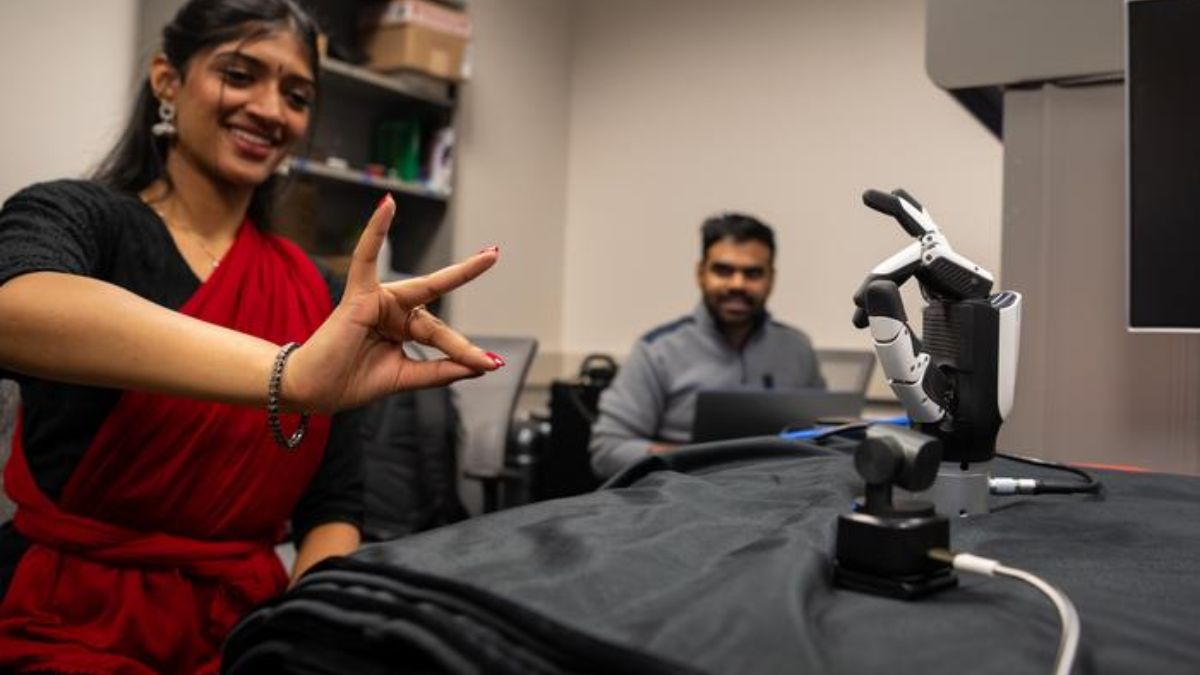
Photo Credit: Brad Ziegler/UMBC
Ashwathi Menon, UMBC Indian fusion team co-captain, demos lab technology
Click Here to Add Gadgets360 As A Trusted Source


Advertisement
Researchers are turning to classical Indian dance to teach robots how to use their hands with greater dexterity. A new study from the University of Maryland, Baltimore County (UMBC) shows that the structured hand-gestures, or mudras, found in traditions such as Bharatanatyam can provide robots with a richer and more adaptable movement “alphabet” than those derived solely from natural human grasps. The findings suggest that artistic movement systems may unlock new pathways for robotic precision.
Dance-Derived Synergies for Robotic Dexterity
According to the study, the researchers analysed a set of everyday human grasps and compared them with 30 classical mudras, breaking each into underlying motion patterns known as synergies. While both sets could be reduced to six core synergies, the mudra-based combinations proved far more versatile.
The dance-derived synergies performed better than those produced by routine grasps when tested on reconstructing hand shapes from American Sign Language, suggesting a wider expressive range. Scientists argue that this reflects how classical dance codifies movement in a systematic, “super-human” form, offering robots more nuanced control templates.
Expanding Applications for Human–Robot Interaction
The group is currently endeavouring to design these synergies into robotic hands and humanoid systems instructions. The possible uses will be assistive robots that can perform delicate household operations, service robots that may demand expressive motions, and better control of the prosthetic hands.
The strategy can also endorse the rehabilitation devices based on gesture recognition. The researchers are ultimately hoping that with the combination of engineering and the systems of artistic knowledge, one day the robots will be able to handle the finely-tuned movements of the hands, small things and even read the signs with more fluidity and cultural relevance.
Comments
Get your daily dose of tech news, reviews, and insights, in under 80 characters on Gadgets 360 Turbo. Connect with fellow tech lovers on our Forum. Follow us on X, Facebook, WhatsApp, Threads and Google News for instant updates. Catch all the action on our YouTube channel.
Related Stories




Advertisement
Follow Us




-
04:17
[Sponsored] LG NANO 4K UHD AI TV NU885: Gemini Search, Dolby Atmos & 5 Years of Updates -
00:57
[Sponsored] Samsung Galaxy Z Fold8 My Fan Cam in Action: Find the Moment, Then Share It -
01:41
[Sponsored] What Do You Need To Know Before Your Next Run? | Samsung Galaxy Watch Ultra2 -
01:32
[Sponsored] Big Day Tomorrow? Prep Today | Samsung Galaxy Watch Ultra2 -
04:37
[Sponsored]: CP PLUS CarKam CP-F89B: 4K Dashcam With Rear Camera, GPS & Emergency Recording
-
iPhone 16 आज भी Amazon सेल में मिल रहा ₹15 हजार से ज्यादा सस्ता
-
OnePlus 15 को Amazon Great Indian Festival Sale में खरीदें सस्ता
-
₹2250 सस्ता मिल रहा Motorola का 7000mAh बैटरी वाला फोन! Flipkart पर ऑफर
-
HMD Vibe 2 Max बजट फोन लॉन्च होगा 108MP कैमरा, 6,000mAh बैटरी फीचर के साथ!
-
₹18999 में मिल रहा Moto G Max फोन! 7000mAh बैटरी, Flipkart सेल में ऑफर
Advertisement
Popular on Gadgets
- Samsung Galaxy S26 Ultra
- Motorola Razr Fold
- ChatGPT
- OPPO Find N6
- Mobiles Under Rs. 40,000
- Vivo X300 Ultra
- Asus Zenbook S14
- iQOO 15
- Vivo X300 Pro
- Lenovo Yoga Slim 7i Aura Edition
- iQOO 15R
- Vivo X Fold 5
- Sony PlayStation 5
- HP OmniPad 12
- OnePlus Nord CE 6 Lite
- OnePlus Pad 4
- OPPO F33 Pro 5G
- Cryptocurrency
- HP OmniBook Ultra 14 (2026)
- iPhone 17
- Eureka Forbes AP 355 Room Air Purifier
- Latest Mobile Phones
- Compare Phones
Latest Gadgets
- Samsung Galaxy F70 5G
- Tecno Spark 50S 5G
- Vivo Y600s Pro
- Vivo Y32 (2026)
- Infinix Smart 20 HD
- Vivo V80
- Vivo S2 FE
- Vivo Y600K Turbo
- HP ZBook Ultra G3a
- Dell Pro Rugged 14
- Amazon Alexa Tablet 8
- Amazon Alexa Tablet 11
- Amazfit T-Rex Dual Solar
- OPPO Watch S2
- Toshiba 65-Inch 4K Ultra HD Smart Mini LED QLED TV (65Z670SP)
- Haier M70 Mini LED 65-inch
- Acer Predator Atlas 8
- Asus ROG Ally
- Blue Star 1.5 Ton 5 Star Inverter Split AC (IE518ZNURS)
- Blue Star 2 Ton 3 Star Inverter Window AC (WIE324L)

- About Us
- Sitemaps
- Feedback
- Archives
- Contact Us
- RSS
- Advertise
- Career
- Privacy Policy
- Ethics
- Editorial Policy
- Terms & Conditions
- Complaint Redressal
Download Our Apps
Available in Hindi
© Copyright Red Pixels Ventures Limited 2026. All rights reserved.