-
 Starlink Constellation Crosses 10,600 Satellites After Latest SpaceX Launch12 June 2026
 -
SpaceX Launches 24 More Starlink Satellites, Nears 10,500 in Orbit20 May 2026
-
Falcon 9 Launches 45 Satellites in Major Global Rideshare Mission4 May 2026
-
Blue Origin Reuses New Glenn Booster for First Time in Historic Launch20 April 2026
-
SpaceX Falcon 9 Launches Cygnus XL for NASA ISS Resupply Mission13 April 2026
- Home
- Science
- Science News
- Isro to Look at Possibility of Recovering Rocket Stage
Isro to Look at Possibility of Recovering Rocket Stage
By Indo-Asian News Service | Updated: 23 May 2016 15:27 IST
Click Here to Add Gadgets360 As A Trusted Source

Advertisement
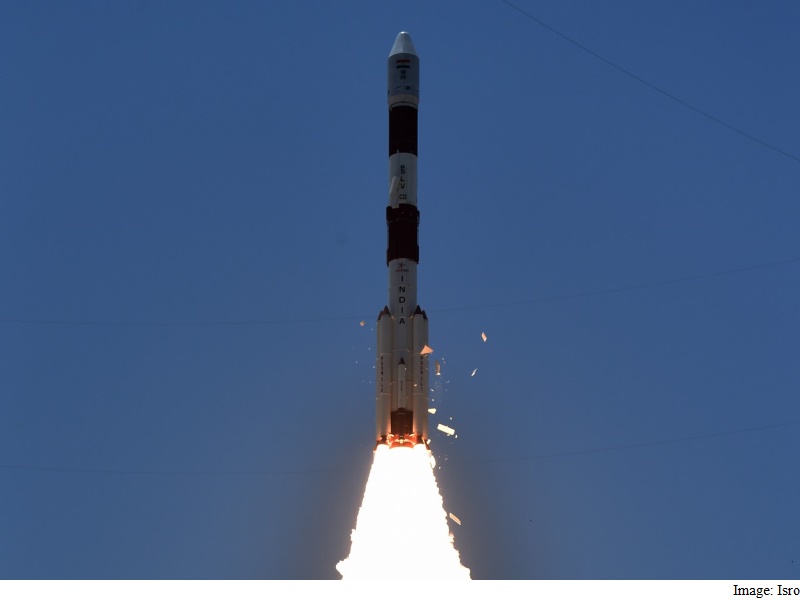
The Indian space agency is planning to look at the possibility of reusing its rocket stages after a launch by making them re-enter atmosphere and land at a specified location, a senior official said.
"We are also looking at that programme," K.Sivan, director, Vikram Sarabhai Space Centre (VSSC) told IANS on the phone from Sriharikota in Andhra Pradesh.
The VSSC is a division of Indian Space Research Organisation (Isro).
Referring to US-based aerospace company SpaceX's attempts in this regard, Sivan said Isro too is planning like that.
SpaceX, with its two rockets - Falcon 9 and Falcon Heavy - offers satellite launch services.
A rocket stage comprises the engine, fuel and other systems.
The stages constitute the bulk of a rocket's cost and a saving on that will reduce the launch cost.
For instance, India's polar satellite launch vehicle (PSLV) is a four-stage rocket. It also has six booster engines strapped on the first stage.
The rocket is an expendable one, that is, nothing is recovered once it is launched.
So, recovering for instance the first PSLV stage means making it re-enter the atmosphere safely after it puts the other three stages up.
The outer shell of the stage should have sufficient heat-resistant materials. The stage should also be programmed to land at a specified location, preferably at the launch pad itself.
Sivan said recovery of the stage and using it again is completely different from the reusable launch vehicle (RLV).
He said developing a full-fledged RLV will take quite some time.
"We have to develop various technologies before finalising the specifications for our own RLV," Sivan said.
On May 23, Isro successfully took the first step in developing a RLV by successfully testing an aircraft like winged structure.
Called RLV-Technology Demonstrator HEX 01 mission, the winged structure which sat atop a rocket was released into the space at above 70km from the earth.
The winged structure returned and landed in the Bay of Bengal as originally planned.
However, the future of India's RLV depends on factors like its economic viability as compared to conventional expendable rockets; development of a powerful engine/stage to power that vehicle and also availability of funding for the project.
Meanwhile, Isro will soon be testing its air breathing engine.
Air-breathing engines use atmospheric oxygen and burn it with the stored on-board fuel to generate the onward thrust.
Conventional rockets carry both oxygen and chemical fuel on board.
"We will soon be testing - may be this June - our air breathing engine fitted to a sounding rocket," Sivan said.
Comments
Get your daily dose of tech news, reviews, and insights, in under 80 characters on Gadgets 360 Turbo. Connect with fellow tech lovers on our Forum. Follow us on X, Facebook, WhatsApp, Threads and Google News for instant updates. Catch all the action on our YouTube channel.
Related Stories





Advertisement
Follow Us




-

05:20
Samsung Galaxy Watch Ultra 2 Review: Is This the Best Android Smartwatch? -
07:01
Samsung Galaxy Z Fold 8 Review: Is This the Best Foldable Phone? -
06:39
Samsung Galaxy Z Fold8 Ultra Review: Cameras, Battery, Performance Tested -
04:33
[Sponsored] JBL Live 780NC: Great Sound, Perfect Comfort, Smart ANC & 80-Hour Battery -
12:04
[Partner Content] OPPO Reno16 Series Deep Dive: Built for Creators?
Advertisement
Popular on Gadgets
- Samsung Galaxy S26 Ultra
- Motorola Razr Fold
- ChatGPT
- OPPO Find N6
- Mobiles Under Rs. 40,000
- Vivo X300 Ultra
- Asus Zenbook S14
- iQOO 15
- Vivo X300 Pro
- Lenovo Yoga Slim 7i Aura Edition
- iQOO 15R
- Vivo X Fold 5
- Sony PlayStation 5
- HP OmniPad 12
- OnePlus Nord CE 6 Lite
- OnePlus Pad 4
- OPPO F33 Pro 5G
- Cryptocurrency
- HP OmniBook Ultra 14 (2026)
- iPhone 17
- Eureka Forbes AP 355 Room Air Purifier
- Latest Mobile Phones
- Compare Phones
Latest Gadgets
- iPhone Duo
- OPPO A7 Pro
- Huawei Mate XT 2 Ultimate Design
- Realme 16 Pro Harry Potter Edition
- Samsung Galaxy A07s
- Huawei Pura X View
- Tecno Camon Slim 5G
- iQOO Z11xa
- Acer Aspire G 3D 16
- Acer Swift Air 16 (2026)
- Infinix Xpad 30 Pro
- Lenovo Yoga Tab Gen 2
- Apple Watch Ultra 4
- Apple Watch Series 12
- Haier M70 Mini LED 65-inch
- Xiaomi TV FX Mini LED 65
- Acer Predator Atlas 8
- Asus ROG Ally
- Blue Star 1.5 Ton 5 Star Inverter Split AC (IE518ZNURS)
- Blue Star 2 Ton 3 Star Inverter Window AC (WIE324L)

- About Us
- Sitemaps
- Feedback
- Archives
- Contact Us
- RSS
- Advertise
- Career
- Privacy Policy
- Ethics
- Editorial Policy
- Terms & Conditions
- Complaint Redressal
Download Our Apps
Available in Hindi
© Copyright Red Pixels Ventures Limited 2026. All rights reserved.