-
 JWST Reveals Salt Clouds in the Atmosphere of the ‘Pink Planet’ GJ 504b21 June 2026
 -
JWST Watches HD 80606 bExoplanet Heat Up by 1,100 Degrees in Hours19 June 2026
-
Scientists May Have Solved the Missing Sulfur Mystery in Star-Forming Clouds16 June 2026
-
Astronomers Discover Why Massive Galaxies Died Early in the Universe13 June 2026
-
JWST Reveals the True Identity of Mysterious Little Red Dots11 June 2026
- Home
- Science
- Science News
- James Webb Space Telescope Weighs Most Distant Dormant Black Hole Ever Detected
James Webb Space Telescope Weighs Most Distant Dormant Black Hole Ever Detected
Astronomers have measured the most distant dormant black hole ever discovered using the James Webb Space Telescope.
Written by Gadgets 360 Staff | Updated: 9 June 2026 21:05 IST
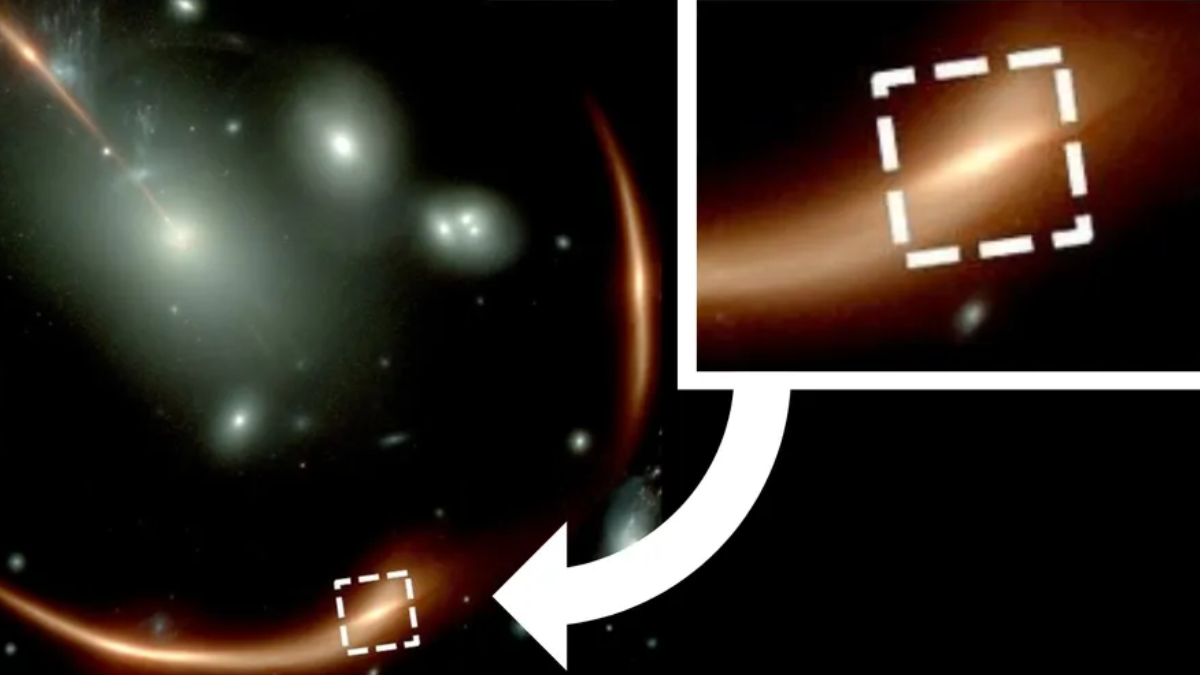
Photo Credit: NASA
The lensed galaxy MRG-M013 which the JWST used to weigh a distant supermassive black hole.
Click Here to Add Gadgets360 As A Trusted Source


Advertisement
For the first time, astronomers have used the James Webb Space Telescope (JWST) to “weigh” a dormant supermassive black hole over 10 billion light-years away, and yes this shatters the stellar dynamics distance record by about 15-fold. Hidden quietly at the core of galaxy MRG-M0138, the cosmic giant clocks in at roughly six billion solar masses, giving a very rare look into the universe during a time when it was only a quarter of its current age.
Silenced by Its Own Past
Published in Science (June 4, 2026), the study is led by Andrew Newman of Carnegie Science with senior author UCL's Richard Ellis. Observing MRG-M0138 at cosmological redshift 1.95—when the universe was roughly three billion years old—Newman's team found both the black hole and its host galaxy fully dormant: no new stars forming and no material accreting. They attribute this twin quiescence to an earlier quasar phase in which the black hole's explosive growth expelled the gas needed for star formation, rapidly starving the galaxy while silencing its central engine.
Gravity as a Telescope
A sleeping black hole does not radiate any energy and can be identified solely through its gravitational attraction of nearby stars. Scientists employed stellar dynamics analysis involving the velocities of stars in the vicinity of the core of MRG-M0138. This would have been extremely difficult from such an enormous distance, but a galaxy cluster between us and the galaxy acted as a gravitational lens, magnifying the image by a factor of 30. Finally, the stellar kinematics were observed using the NIRSpec Integral Field Spectrograph of JWST, reaching a distance unprecedentedly 15 times farther than before.
Comments
Get your daily dose of tech news, reviews, and insights, in under 80 characters on Gadgets 360 Turbo. Connect with fellow tech lovers on our Forum. Follow us on X, Facebook, WhatsApp, Threads and Google News for instant updates. Catch all the action on our YouTube channel.
Further reading:
JWST, James Webb Space Telescope, Black Hole, Supermassive Black Hole, MRG-M0138, Galaxy Evolution, Astronomy, Astrophysics, Early Universe, Gravitational Lensing, NIRSpec, Carnegie Science, Richard Ellis, Andrew Newman, Space Science
Related Stories


Advertisement
Follow Us




-
01:15
[Sponsored] Galaxy Tab S10 Lite for Students: Notes, Solve Math and More -
04:17
[Sponsored] LG NANO 4K UHD AI TV NU885: Gemini Search, Dolby Atmos & 5 Years of Updates -
00:57
[Sponsored] Samsung Galaxy Z Fold8 My Fan Cam in Action: Find the Moment, Then Share It -
01:41
[Sponsored] What Do You Need To Know Before Your Next Run? | Samsung Galaxy Watch Ultra2 -
01:32
[Sponsored] Big Day Tomorrow? Prep Today | Samsung Galaxy Watch Ultra2
-
NVIDIA के सीईओ ने पेश किए माइक्रोडक रोबोट, AI से चलते हैं, क्या काम आएंगे
-
iPhone Duo को बीच से खोला, फोल्डेबल डिस्प्ले से हटाया कवर, फिर क्या दिखा?
-
1 जनवरी से फोन में बिना सिम नहीं चलेगा WhatsApp, सिम बाइडिंग हुआ अनिवार्य
-
Oppo Reno 17 सीरीज के लॉन्च की तैयारी, NBTC पर हुई लिस्टिंग
-
Oppo Find X10 ग्लोबल मार्केट में लॉन्च, 200MP दो कैमरा, 7150mAh बैटरी जैसे फीचर्स
Advertisement
Popular on Gadgets
- Samsung Galaxy S26 Ultra
- Motorola Razr Fold
- ChatGPT
- OPPO Find N6
- Mobiles Under Rs. 40,000
- Vivo X300 Ultra
- Asus Zenbook S14
- iQOO 15
- Vivo X300 Pro
- Lenovo Yoga Slim 7i Aura Edition
- iQOO 15R
- Vivo X Fold 5
- Sony PlayStation 5
- HP OmniPad 12
- OnePlus Nord CE 6 Lite
- OnePlus Pad 4
- OPPO F33 Pro 5G
- Cryptocurrency
- HP OmniBook Ultra 14 (2026)
- iPhone 17
- Eureka Forbes AP 355 Room Air Purifier
- Latest Mobile Phones
- Compare Phones
Latest Gadgets
- HMD 2660 Flip Senior Edition
- Lava Aura Curve
- Poco X8s
- Samsung Galaxy F70 5G
- Tecno Spark 50S 5G
- Vivo Y600s Pro
- Vivo Y32 (2026)
- Infinix Smart 20 HD
- Lenovo Yoga 9n 2-in-1
- Lenovo Yoga Pro 9n
- Amazon Alexa Tablet 8
- Amazon Alexa Tablet 11
- Pebble Qore 2
- Amazfit T-Rex Dual Solar
- Toshiba 65-Inch 4K Ultra HD Smart Mini LED QLED TV (65Z670SP)
- Haier M70 Mini LED 65-inch
- Acer Predator Atlas 8
- Asus ROG Ally
- Blue Star 1.5 Ton 5 Star Inverter Split AC (IE518ZNURS)
- Blue Star 2 Ton 3 Star Inverter Window AC (WIE324L)

- About Us
- Sitemaps
- Feedback
- Archives
- Contact Us
- RSS
- Advertise
- Career
- Privacy Policy
- Ethics
- Editorial Policy
- Terms & Conditions
- Complaint Redressal
Download Our Apps
Available in Hindi
© Copyright Red Pixels Ventures Limited 2026. All rights reserved.