-
 IceCube Traces High-Energy Neutrino to Distant Starburst Galaxy20 June 2026
 -
Most Powerful Neutrino Ever Detected May Have Come From a Blazar30 May 2026
-
Impossible Neutrino Detected on Earth May Come From an Exploding Primordial Black Hole6 February 2026
-
Dark Matter May Interact with Cosmic Ghost Particles, Hinting at a Fundamental Breakthrough8 January 2026
-
Scientists Rule Out Elusive Sterile Neutrino After 10-Year Hunt, Shaking Particle Physics19 December 2025
- Home
- Science
- Science News
- Ultra High Energy Neutrino Detected Beneath Mediterranean Sea Baffles Scientists
Ultra-High-Energy Neutrino Detected Beneath Mediterranean Sea Baffles Scientists
Scientists are investigating a record-breaking neutrino detected beneath the Mediterranean Sea, carrying energy far beyond known limits. A new study suggests it may have originated from the explosive death of a primordial black hole formed shortly after the Big Bang.
Written by Gadgets 360 Staff | Updated: 10 April 2026 21:53 IST
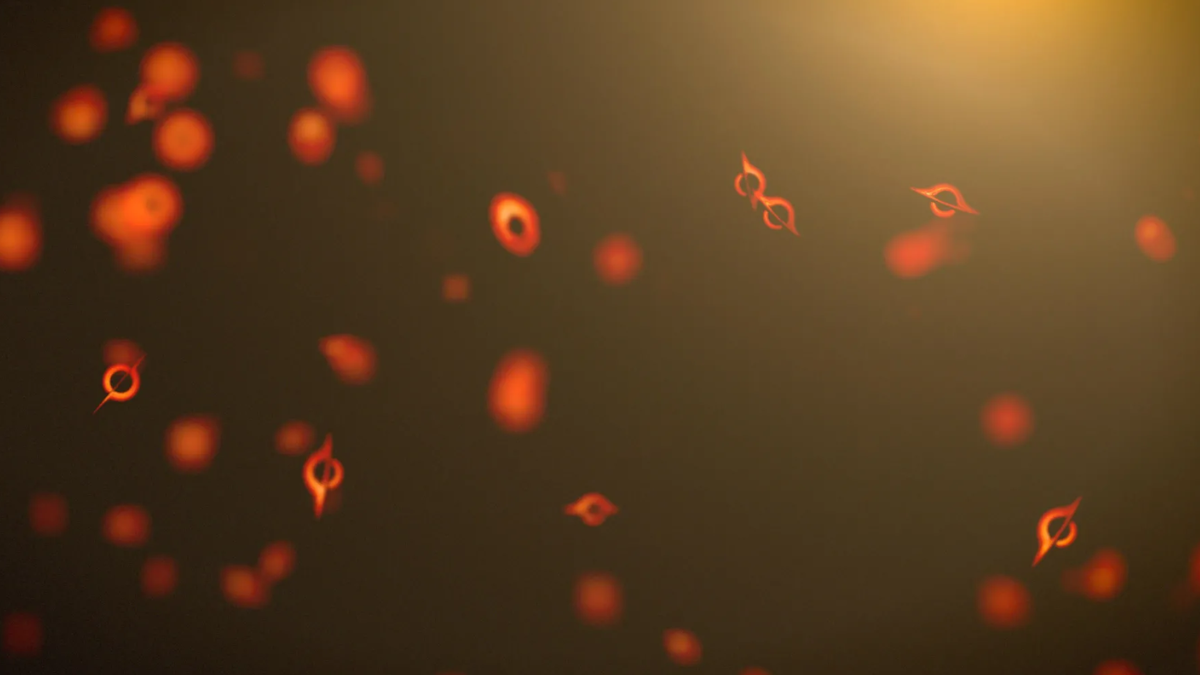
Photo Credit: NASA
This artist’s concept takes approach to imagining small primordial black holes.
Click Here to Add Gadgets360 As A Trusted Source


Advertisement
In February 2023, a subatomic "ghost particle" slammed into a detector beneath the Mediterranean Sea, carrying energy so extreme it defied explanation. The neutrino contained 100000 times more energy than the most powerful particle which the Large Hadron Collider, the world's strongest accelerator, has ever generated. No known cosmic process can generate that kind of power. Physical scientists at the University of Massachusetts Amherst believe they have discovered a solution that could change our entire understanding of the cosmos.
A Big Bang Relic Behind the Impossible Particle
According to a recently ppublished study in Physical Review Letters, a collaboration of researchers at UMass Amherst has found that the neutrino resulted from an explosion of a primordial black hole – a cosmic phenomenon which is considered to have formed during the early moments after the formation of the universe. Unlike the black holes formed from collapsed stars, PBHs are considerably smaller and lighter. In the proposed scenario, it becomes clear that with the loss of mass via Hawking radiation, the temperature and the number of particles emitted increase, leading to an explosion.
The "Dark Charge" That Solves the Puzzle
The other important question was that not a single particle of this kind was found in another large experiment known as IceCube, and not only that, but it has never found a particle of any such energy. They postulate that the black holes with a dark charge (interacting via the dark electron) would prevent the emission of all the particles in those energies at which IceCube could detect them, but permit the emission of those particles at higher energies, such as the one KM3NeT could detect when it detected one of its particles.
Comments
Get your daily dose of tech news, reviews, and insights, in under 80 characters on Gadgets 360 Turbo. Connect with fellow tech lovers on our Forum. Follow us on X, Facebook, WhatsApp, Threads and Google News for instant updates. Catch all the action on our YouTube channel.
Further reading:
Neutrinos, primordial black holes, dark matter, KM3NeT, astrophysics, IceCube, particle physics, cosmology
Related Stories


Advertisement
Follow Us




-
04:37
[Sponsored]: CP PLUS CarKam CP-F89B: 4K Dashcam With Rear Camera, GPS & Emergency Recording -
04:23
[Partner Content] Your Phone Can Do WAY More Than You Think | OPPO ColorOS 16 -
01:59
Samsung Galaxy Z Fold8 Ultra: Unfold the Ultra Night -
03:24
Apple Pay Launches In India: Supported Devices, Cards And Payments Explained -
00:21
[Sponsored] Samsung Galaxy Z Fold8, Fold8 Ultra
-
Amazon Great Indian Festival Sale 2026: ₹40 हजार वाले फोन पर जबरदस्त छूट
-
Amazon Great Indian Festival: ₹51 हजार सस्ता मिल रहा Samsung फ्लैगशिप फोन
-
Flipkart Big Billion Days Sale 2026: iPhone 15 पर बंपर डील!
-
Oppo K14 Plus की भारत में शुरू हुई बिक्री, जानें प्राइस, ऑफर्स
-
Flipkart Big Billion Days Sale 2026 हुई शुरू, Plus और Black मेंबर्स के लिए स्मार्टफोन से इलेक्ट्रॉनिक तक 80% ड
Advertisement
Popular on Gadgets
- Samsung Galaxy S26 Ultra
- Motorola Razr Fold
- ChatGPT
- OPPO Find N6
- Mobiles Under Rs. 40,000
- Vivo X300 Ultra
- Asus Zenbook S14
- iQOO 15
- Vivo X300 Pro
- Lenovo Yoga Slim 7i Aura Edition
- iQOO 15R
- Vivo X Fold 5
- Sony PlayStation 5
- HP OmniPad 12
- OnePlus Nord CE 6 Lite
- OnePlus Pad 4
- OPPO F33 Pro 5G
- Cryptocurrency
- HP OmniBook Ultra 14 (2026)
- iPhone 17
- Eureka Forbes AP 355 Room Air Purifier
- Latest Mobile Phones
- Compare Phones
Latest Gadgets
- Vivo Y32 (2026)
- Infinix Smart 20 HD
- Vivo V80
- Vivo S2 FE
- Vivo Y600K Turbo
- Realme P4s Lite
- Vivo S60t
- OPPO F35 5G
- Lenovo ThinkBook 14x
- Dell 14 Plus 2-in-1 (AMD Ryzen AI 7 350, 2025)
- Samsung Galaxy Tab S12+
- Samsung Galaxy Tab S12 Ultra
- Amazfit T-Rex Dual Solar
- OPPO Watch S2
- Toshiba 65-Inch 4K Ultra HD Smart Mini LED QLED TV (65Z670SP)
- Haier M70 Mini LED 65-inch
- Acer Predator Atlas 8
- Asus ROG Ally
- Blue Star 1.5 Ton 5 Star Inverter Split AC (IE518ZNURS)
- Blue Star 2 Ton 3 Star Inverter Window AC (WIE324L)

- About Us
- Sitemaps
- Feedback
- Archives
- Contact Us
- RSS
- Advertise
- Career
- Privacy Policy
- Ethics
- Editorial Policy
- Terms & Conditions
- Complaint Redressal
Download Our Apps
Available in Hindi
© Copyright Red Pixels Ventures Limited 2026. All rights reserved.