-
 New Study Suggests Uranus and Neptune May Contain More Rock Than Ice14 May 2026
 -
Astronomers Capture Two Giant Planets Forming Around Young Star WISPIT 226 March 2026
-
Kepler-51 Super-Puff Planets Baffle Scientists as JWST Finds No Atmosphere Clues21 March 2026
-
Scientists Discover High-Density Rocky Planet in LHS 1903 System That Defies Conventional Formation Models18 February 2026
-
Unique Inside-Out Planetary System Reveals Unexpected Rocky World on the Outer Edge13 February 2026
- Home
- Science
- Science News
- Scientists Identify 45 Earth Like Planets Beyond Our Solar System
Scientists Identify 45 Earth-Like Planets Beyond Our Solar System
Scientists have identified 45 rocky exoplanets in habitable zones where liquid water could exist.
Written by Gadgets 360 Staff | Updated: 6 April 2026 17:05 IST
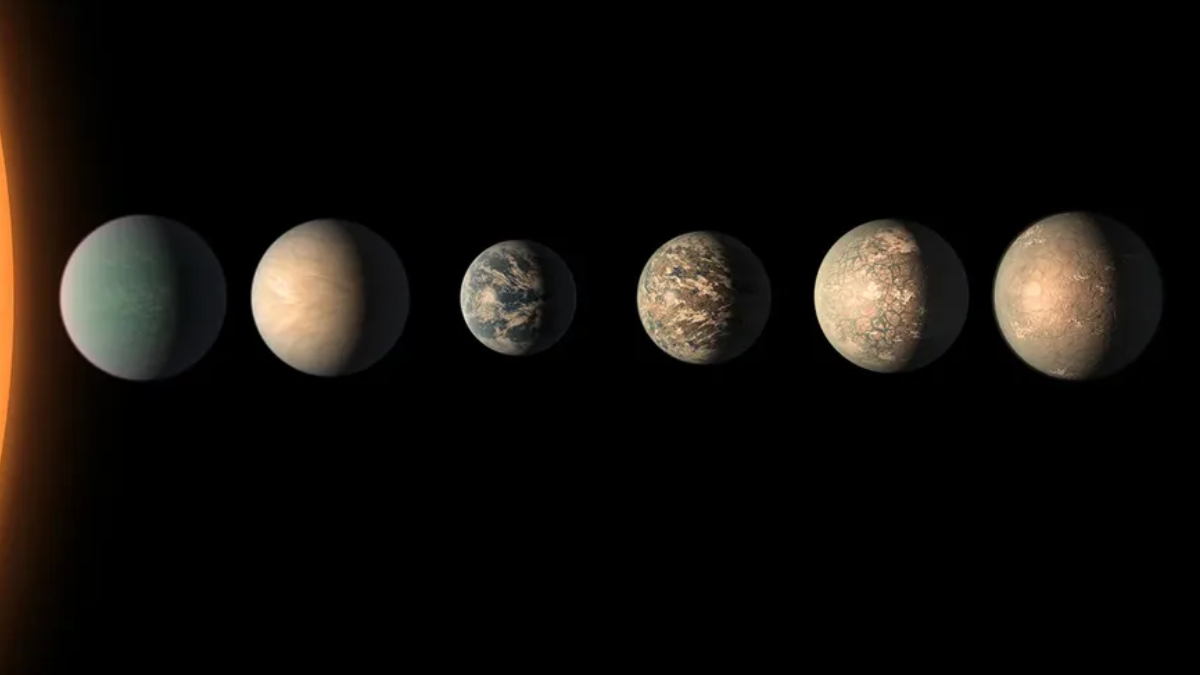
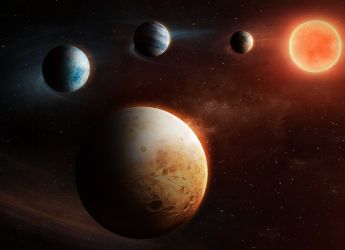
Photo Credit: NASA
An artist's interpretation of the TRAPPIST-1 planetary system.
Click Here to Add Gadgets360 As A Trusted Source


Advertisement
Scientists have long understood that thousands of planets exist beyond our solar system; however, knowing that a world exists is not the same as knowing whether it can sustain life. That has all changed thanks to a team of researchers led by Professor Lisa Kaltenegger of Cornell University's Carl Sagan Institute. By poring through information regarding more than 6,000 planets that exist outside of our own solar system, researchers found 45 planets that are considered rocky and are located in their star's habitable zone.
How Scientists Narrowed the Search
According to the study, the team used information from the now-defunct ESA Gaia space mission and NASA's Exoplanet Archive to determine how much energy each planet receives from its star, a critical factor for liquid water to exist on its surface. While our planet is in the habitable zone, Venus and Mars are at the inner and outer limits, respectively. When these limits are applied to other star systems, the team got 45 candidates in the broad habitable zone, with 24 in a narrower range.
The Best Targets and What Comes Next
Among the notable ones are the TRAPPIST-1 planets that orbit a red dwarf star located 40 light-years away. Study co-author Gillis Lowry has focused on two Earth-like candidates: TRAPPIST-1 e and TOI-715 b, which is a super-Earth located in a conservative habitable zone. Another notable one is Proxima Centauri b and LHS 1140 b.
These candidates are being scanned using next-generation observatories such as James Webb, Extremely Large Telescope, and Habitable Worlds Observatory. While being located in the habitable zone does not necessarily mean that life exists there, it is where we have to begin.
Comments
Get your daily dose of tech news, reviews, and insights, in under 80 characters on Gadgets 360 Turbo. Connect with fellow tech lovers on our Forum. Follow us on X, Facebook, WhatsApp, Threads and Google News for instant updates. Catch all the action on our YouTube channel.
Related Stories


Advertisement
Follow Us




-
03:23
iPhone Fold Leaks & Rumors 2026 | Apple's Foldable iPhone Launch, Price & Specs Revealed -
04:12
Samsung Galaxy A37 Review: Camera, Gaming & Battery Tested! -
14:16
[Partner Content] OPPO F33 Pro 5G Explained: Built for the Big Moments -
05:21
Poco X8 Pro Max Review | Is This the Ultimate Budget Beast? -
04:16
OnePlus Nord 6 Review | Full Honest Review, Camera Test, Performance & Battery
Advertisement
Popular on Gadgets
- Samsung Galaxy S26 Ultra
- Motorola Razr Fold
- ChatGPT
- OPPO Find N6
- Mobiles Under Rs. 40,000
- Vivo X300 Ultra
- Asus Zenbook S14
- iQOO 15
- Vivo X300 Pro
- Lenovo Yoga Slim 7i Aura Edition
- iQOO 15R
- Vivo X Fold 5
- Sony PlayStation 5
- HP OmniPad 12
- OnePlus Nord CE 6 Lite
- OnePlus Pad 4
- OPPO F33 Pro 5G
- Cryptocurrency
- HP OmniBook Ultra 14 (2026)
- iPhone 17
- Eureka Forbes AP 355 Room Air Purifier
- Latest Mobile Phones
- Compare Phones
Latest Gadgets
- Red Magic 11S Pro+
- Red Magic 11S Pro
- Vivo Y60
- Sony Xperia 1 VIII
- Itel Zeno 200
- OnePlus Nord CE 6 Lite
- OnePlus Nord CE 6
- Honor Play 70C
- Dell 14S
- Dell 16S
- Huawei MatePad Pro Max
- HP OmniPad 12
- Garmin Forerunner 170
- Garmin Forerunner 70
- Lumio Vision 9 (2026)
- Lumio Vision 7 (2026)
- Asus ROG Ally
- Nintendo Switch Lite
- Blue Star 1.5 Ton 5 Star Inverter Split AC (IA518ZXUS)
- Blue Star 1.5 Ton 3 Star Inverter Split AC (IA318ZXU)

- About Us
- Sitemaps
- Feedback
- Archives
- Contact Us
- RSS
- Advertise
- Career
- Privacy Policy
- Ethics
- Editorial Policy
- Terms & Conditions
- Complaint Redressal
Download Our Apps
Available in Hindi
© Copyright Red Pixels Ventures Limited 2026. All rights reserved.