- Home
- Science
- Science News
- Kepler 51 Super Puff Planets Baffle Scientists as JWST Finds No Atmosphere Clues
Kepler-51 Super-Puff Planets Baffle Scientists as JWST Finds No Atmosphere Clues
Astronomers are baffled by Kepler-51’s “super-puff” planets—giant worlds as light as cotton candy. Despite expectations, the James Webb Space Telescope failed to detect their atmospheric signatures, likely due to thick haze.
Written by Gadgets 360 Staff | Updated: 21 March 2026 21:00 IST
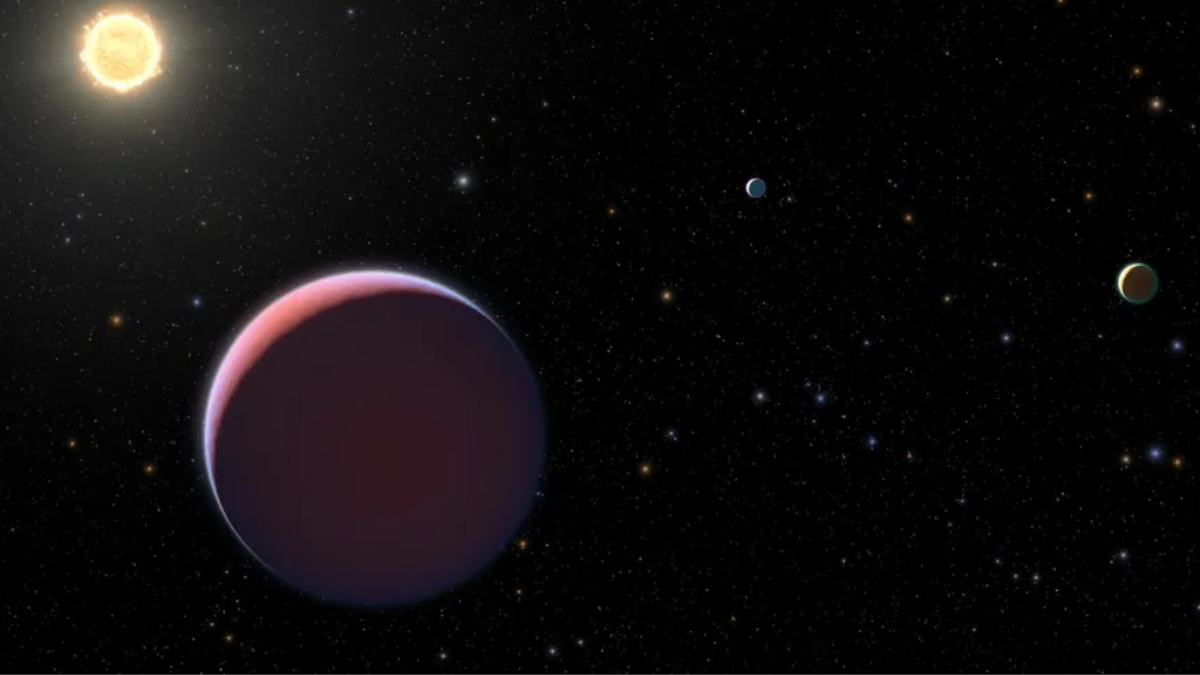
Photo Credit: NASA
An artist's impression of the Kepler-51 system.
Click Here to Add Gadgets360 As A Trusted Source


Advertisement
Some planets defy everything we know about how worlds are built. The Kepler-51 system, located 2,615 light-years away, contains three so-called "super-puff" exoplanets — worlds roughly the size of Saturn but so astonishingly lightweight that their density is comparable to cotton candy. Discovered by NASA's Kepler Space Telescope, these bizarre worlds have now stumped even the most powerful observatory ever launched.
Planets So Light They Should Not Exist
According to the new research, the three planets, 51b, c, and d, each have a radius seven to ten times that of Earth, but their masses are only 3.7 to 5.6 times that of Earth. Saturn, which has a similar size to the three new planets, has a mass 95 times that of Earth. According to planet formation theory, gas giants form by first forming dense and massive cores, which then gravitationally attract gas from the surroundings. However, the three new planets have small cores and enormous atmospheres, which cannot be explained by any known theory. Moreover, the three planets are closer to their star than Venus in our solar system.
A Haze Too Thick for Webb to See Through
Astronomers had hoped the James Webb Space Telescope's Near Infrared Spectrometer would finally solve the mystery by detecting the chemical signature of the atmosphere of Kepler-51d. When a planet passes in front of its star, the light passing through the atmosphere leaves behind the "signature" of the molecules. However, the JWST did not detect anything. It is now thought that a haze of hydrocarbons, perhaps similar to the haze of Titan, the moon of Saturn, is obscuring the view. Scientists are now waiting to see the atmospheric signature of the sister planet 51b.
Comments
Get your daily dose of tech news, reviews, and insights, in under 80 characters on Gadgets 360 Turbo. Connect with fellow tech lovers on our Forum. Follow us on X, Facebook, WhatsApp, Threads and Google News for instant updates. Catch all the action on our YouTube channel.
Further reading:
Kepler-51, exoplanets, NASA, JWST, Planet Formation, astronmy, exoplanet atmospheres, Kepler mission, hydrocarbon haze


Advertisement
Follow Us




-
09:53
iPhone 18 Goes On Sale In India: Huge Crowds, Long Queues At Apple Stores -
06:32
Google Pixel 11 Pro XL Review: The Most Exciting Pixel Yet? | 120X Zoom + Tensor G6 -
05:20
Samsung Galaxy Watch Ultra 2 Review: Is This the Best Android Smartwatch? -
07:01
Samsung Galaxy Z Fold 8 Review: Is This the Best Foldable Phone? -
06:39
Samsung Galaxy Z Fold8 Ultra Review: Cameras, Battery, Performance Tested
-
₹36 हजार में लॉन्च हुआ AI सपोर्ट वाला Primebook 3 Max लैपटॉप
-
15 अक्टूबर से UPI पर बदल जाएंगे ये नियम, यहां जानें 7 बड़ी बातें
-
Redmi Note 17 Pro की सेल शुरू, ₹5000 डिस्काउंट पर खरीदने का मौका
-
Vivo लेटेस्ट फोन Vivo V80 भारत में होने जा रहा लॉन्च, 50MP तीन कैमरा, बड़ी बैटरी के साथ!
-
iPhone खरीदने का मौका! Apple ने बढ़ाए दाम, लेकिन Refurbished iPhone 15, 16 और 17 मिल रहे सस्ते
Advertisement
Popular on Gadgets
- Samsung Galaxy S26 Ultra
- Motorola Razr Fold
- ChatGPT
- OPPO Find N6
- Mobiles Under Rs. 40,000
- Vivo X300 Ultra
- Asus Zenbook S14
- iQOO 15
- Vivo X300 Pro
- Lenovo Yoga Slim 7i Aura Edition
- iQOO 15R
- Vivo X Fold 5
- Sony PlayStation 5
- HP OmniPad 12
- OnePlus Nord CE 6 Lite
- OnePlus Pad 4
- OPPO F33 Pro 5G
- Cryptocurrency
- HP OmniBook Ultra 14 (2026)
- iPhone 17
- Eureka Forbes AP 355 Room Air Purifier
- Latest Mobile Phones
- Compare Phones
Latest Gadgets
- Samsung Galaxy A08
- Itel Muzik 450L
- OPPO K14 Lite
- Samsung Galaxy A18 4G
- iPhone Duo
- OPPO A7 Pro
- Huawei Mate XT 2 Ultimate Design
- Realme 16 Pro Harry Potter Edition
- Asus Vivobook S14 (S5452MA)
- Acer Aspire G 3D 16
- Xiaomi Pad 9 Pro
- Xiaomi Pad 9
- Apple Watch Ultra 4
- Apple Watch Series 12
- Haier M70 Mini LED 65-inch
- Xiaomi TV FX Mini LED 65
- Acer Predator Atlas 8
- Asus ROG Ally
- Blue Star 1.5 Ton 5 Star Inverter Split AC (IE518ZNURS)
- Blue Star 2 Ton 3 Star Inverter Window AC (WIE324L)

- About Us
- Sitemaps
- Feedback
- Archives
- Contact Us
- RSS
- Advertise
- Career
- Privacy Policy
- Ethics
- Editorial Policy
- Terms & Conditions
- Complaint Redressal
Download Our Apps
Available in Hindi
© Copyright Red Pixels Ventures Limited 2026. All rights reserved.