-
 Uranus’ Outer Rings May Reveal Hidden Moons, Scientists Say24 April 2026
 -
James Webb Telescope Maps Uranus in 3D for the First Time; Data Reveals Hidden Storms, Methane Clouds25 February 2026
-
Uranus and Neptune May Be Rock-Dominated Planets, Study Suggests13 December 2025
-
Uranus and Neptune May Be Rocky Worlds Not Ice Giants, New Research Shows11 December 2025
-
James Webb Telescope Discovers Tiny New Moon Orbiting Uranus23 August 2025
- Home
- Science
- Science News
- New Study Suggests Uranus and Neptune May Contain More Rock Than Ice
New Study Suggests Uranus and Neptune May Contain More Rock Than Ice
A new study published in Astronomy and Astrophysics suggests Uranus and Neptune may contain much more rock than ice beneath their thick atmospheres. Researchers found evidence of silicate-rich interiors and fewer icy materials than previously believed.
Written by Gadgets 360 Staff | Updated: 14 May 2026 20:29 IST
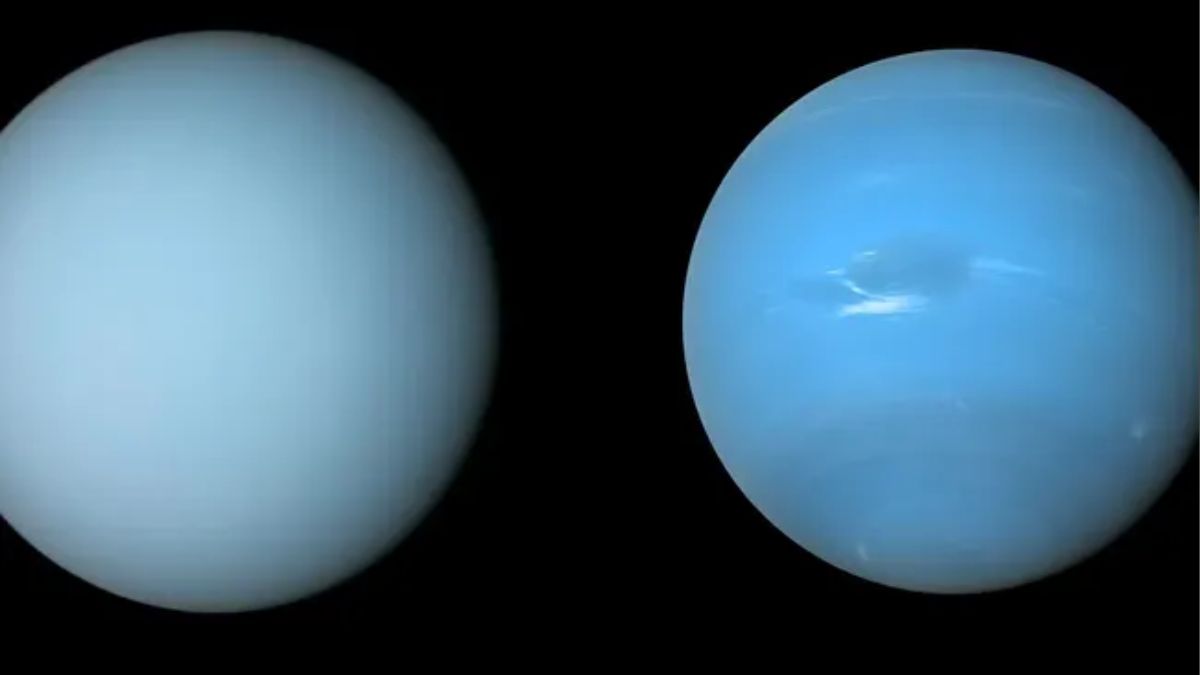
Photo Credit: JPL-CALTECH / BJÖRN JÓNSSON / NASA
Uranus and Neptune have been classified as "ice giants," the solar system's two most distant planets.
Click Here to Add Gadgets360 As A Trusted Source


Advertisement
In the past, Uranus and Neptune have been classified as "ice giants," the solar system's two most distant planets, which we thought of as being made up primarily of water, ammonia, and methane ices under large atmospheric layers. But a report that came out in May 2026 in the journal Astronomy and Astrophysics is turning that idea on its head, which puts forth that, in fact, both planets may contain much more rock than ice, thus it may rewrite a basic tenet of planetary science.
What the Research Found
In the study, the research team, directed by Yamila Miguel from the Netherlands Institute for Space Research, created a model that showed the inner components of two planets. The research found that Uranus and Neptune's outermost layers contained rocks and gases while lacking ice. Silicate clouds developed in the atmosphere because of the temperature, which transformed into solid matter and caused rocks to form. The research found that heavy-element rocks existed in the study area at an average rate of 60 percent.
Rethinking Planetary Classification
This research idea was based on the recent discovery that trans-Neptunian objects, or objects orbiting around Neptune, are not as icy as people first thought, leading them to wonder if Uranus and Neptune have similar properties. The consequences are massive: Miguel suggests the planets should actually be reclassified, with "minor giants" being a more accurate classification for the planets. Another study from 2025, performed by the University of Zurich, questioned the popular "ice giant" hypothesis and suggested that the structure of both planets is less icy than originally thought. The planets have ice within them; however, it has been agreed upon that they are much less icy than believed before.
Comments
Get your daily dose of tech news, reviews, and insights, in under 80 characters on Gadgets 360 Turbo. Connect with fellow tech lovers on our Forum. Follow us on X, Facebook, WhatsApp, Threads and Google News for instant updates. Catch all the action on our YouTube channel.
Further reading:
Uranus, Neptune, ice giants, Planetary Science, Astronomy, Solar system, Exoplanets, Astronomy and Astrophysics, Space Research, planetary formation
Related Stories





Advertisement
Follow Us




-
00:21
[Sponsored] Samsung Galaxy Z Fold8, Fold8 Ultra -
03:41
[Sponsored] Samsung Galaxy Z Fold8: How It Fits Into an Actor’s Busy Day | Camera, Multitasking & More -
09:53
iPhone 18 Goes On Sale In India: Huge Crowds, Long Queues At Apple Stores -
06:32
Google Pixel 11 Pro XL Review: The Most Exciting Pixel Yet? | 120X Zoom + Tensor G6 -
05:20
Samsung Galaxy Watch Ultra 2 Review: Is This the Best Android Smartwatch?
-
Amazon Great Indian Festival: सेल से पहले 6 मोबाइल पर Early Bird Deals
-
Vivo Y600i हुआ लॉन्च; 8000mAh बैटरी और ड्रॉप प्रोटेक्शन के साथ आया फोन
-
लैपटॉप की बैटरी हेल्थ ऐसे करें चेक, नहीं होगा नुकसान
-
Nothing Phone (4a), Phone (4b) भारत में नए 6GB रैम वेरिएंट में हुए लॉन्च, जानें कीमत
-
Motorola Signature Flipkart सेल में ₹3 हजार सस्ता खरीदें, 50MP तीन कैमरा वाला फोन
Advertisement
Popular on Gadgets
- Samsung Galaxy S26 Ultra
- Motorola Razr Fold
- ChatGPT
- OPPO Find N6
- Mobiles Under Rs. 40,000
- Vivo X300 Ultra
- Asus Zenbook S14
- iQOO 15
- Vivo X300 Pro
- Lenovo Yoga Slim 7i Aura Edition
- iQOO 15R
- Vivo X Fold 5
- Sony PlayStation 5
- HP OmniPad 12
- OnePlus Nord CE 6 Lite
- OnePlus Pad 4
- OPPO F33 Pro 5G
- Cryptocurrency
- HP OmniBook Ultra 14 (2026)
- iPhone 17
- Eureka Forbes AP 355 Room Air Purifier
- Latest Mobile Phones
- Compare Phones
Latest Gadgets
- Vivo Y600i
- Mivi One 5G
- Xiaomi 18 Pro Max
- Motorola Signature 27
- OPPO Find X10 E
- OnePlus N6 Lite 4G
- Ai+ Nova 2 Power 5G
- Lava Virat Curve 5G
- Microsoft Surface Laptop, 13-inch (2nd Edition)
- Lenovo LOQ 15AHP11
- Microsoft Surface Pro, 12-inch (2nd Edition)
- Xiaomi Pad 9 Pro
- Amazfit T-Rex Dual Solar
- OPPO Watch S2
- Haier M70 Mini LED 65-inch
- Xiaomi TV FX Mini LED 65
- Acer Predator Atlas 8
- Asus ROG Ally
- Blue Star 1.5 Ton 5 Star Inverter Split AC (IE518ZNURS)
- Blue Star 2 Ton 3 Star Inverter Window AC (WIE324L)

- About Us
- Sitemaps
- Feedback
- Archives
- Contact Us
- RSS
- Advertise
- Career
- Privacy Policy
- Ethics
- Editorial Policy
- Terms & Conditions
- Complaint Redressal
Download Our Apps
Available in Hindi
© Copyright Red Pixels Ventures Limited 2026. All rights reserved.