-
 Hubble Telescope Captures Comet Reversing Its Rotation for the First Time27 March 2026
 -
Hubble and Euclid Reveal Stunning New View of Cat’s Eye Nebula13 March 2026
-
NASA's Hubble Images Show Binary Stars Can Shape the Evolution of Star Clusters8 March 2026
-
Astronomers Find ‘Impossible’ Galaxy ACDG-2 With Virtually No Stars and a Massive Dark Matter Core20 February 2026
-
Hubble Reveals Dramatic Final Moments of a Sun-Like Star in the Egg Nebula12 February 2026
- Home
- Science
- Science News
- NASA’s Hubble Captures Rare Pre Planetary Transformation as Twin Beams of Light Pierce the Cosmic Dust
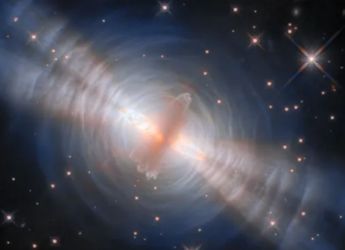
NASA’s Hubble Captures Rare Pre-Planetary Transformation as Twin Beams of Light Pierce the Cosmic Dust
Scientists say the twin beams of light are moving polar lobes pushing through older rings of material sculpted into webs of faintly curving arcs.
Written by Gadgets 360 Staff | Updated: 15 February 2026 18:37 IST
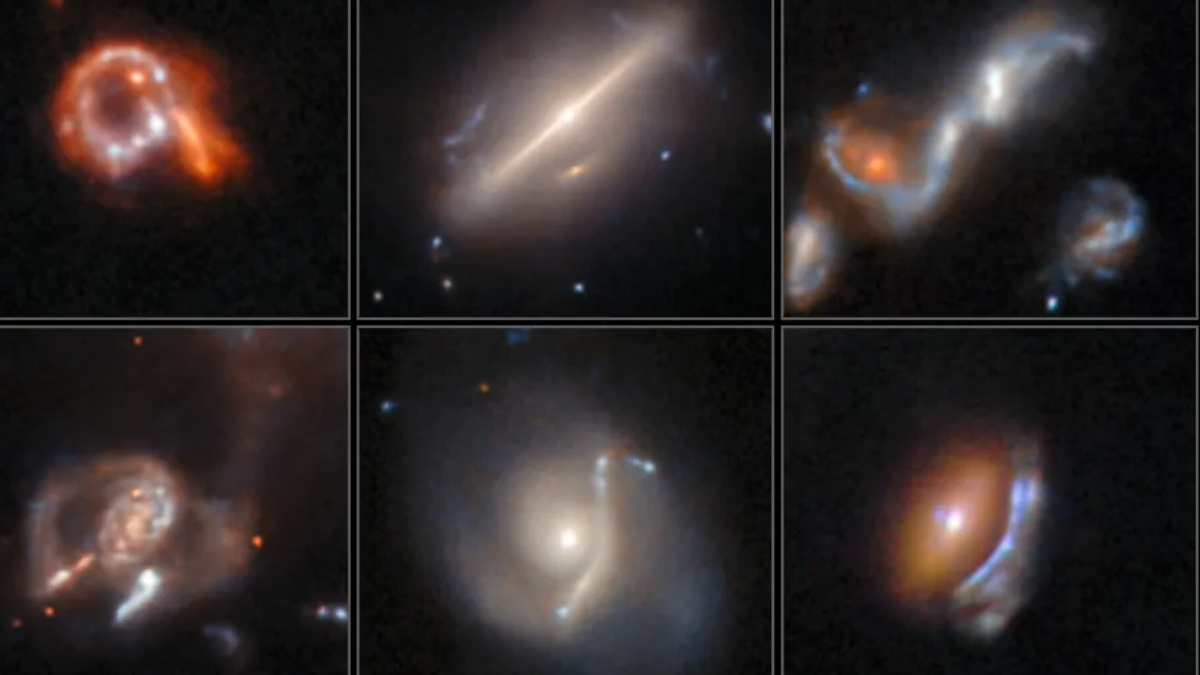
Photo Credit: NASA, ESA, Bruce Balick
Hubble image shows twin beams from a hidden star shaping the dusty Egg Nebula
Click Here to Add Gadgets360 As A Trusted Source


Advertisement
Twin beams of light burst from the dusty Egg Nebula, revealing a rare stage in the final chapter of a Sun-like star's life. Located in the constellation Cygnus, about 1,000 light-years away, the nebula conceals an aging but extremely dense star. Bright beams "squirt" through small openings, carving out hot, smoky lobes and creating ripple-like arcs in the surrounding cloud. This provides scientists with an unusually clear view of how stars like our own Sun eventually shed their outer layers on their way to becoming planetary nebulae.
Youngest Pre-Planetary Egg Nebula
According to a NASA and ESA observation report, the Egg Nebula is the youngest and nearest preplanetary nebula known, composed of light reflected from a central star that still lies hidden within thick dust.
Scientists say the twin beams of light are swiftly moving polar lobes pushing through older rings of material sculpted into webs of faintly curving arcs. The symmetrical patterns suggest the influence of unseen companion stars shaping the outflow of gas and dust. It has been suggested that gravitational interactions inside the dense disk may be guiding the structure of the glowing cloud.
Short-Lived Dust Ejection Phase
The dying star is thought to have ejected the dusty disk within a few hundred years, an extremely short period in cosmic terms. At this point in its life, the nebula reflects starlight instead of lighting up from hot gas, which will occur later once the core has emerged fully.
For decades, Hubble's observations of arcs, lobes, and dust spawned by these controlled outbursts have revealed that they later seeded new star systems.
Comments
Get your daily dose of tech news, reviews, and insights, in under 80 characters on Gadgets 360 Turbo. Connect with fellow tech lovers on our Forum. Follow us on X, Facebook, WhatsApp, Threads and Google News for instant updates. Catch all the action on our YouTube channel.
Related Stories
NASA’s Hubble Captures Rare Pre-Planetary Transformation as Twin Beams of Light Pierce the Cosmic Dust


Advertisement
Follow Us




-
05:05
Goboult Mustang Racer Smartwatch Review: Should You Get This Mustang Smartwatch? -
04:58
OnePlus Nord Buds 4 Pro Review: Specs, Sound Quality, ANC, and Battery Backup Tested -
02:29
[Sponsored] Samsung Galaxy S26 Ultra First Look: AI Smartphone for Creators, Gaming & Productivity -
04:25
Vivo X200T Review - Full Camera, Gaming & Battery Test | Worth Buying? -
28:31
The Future of Productivity: Logitech's Anatoliy Polyanker On AI, Hybrid Work, And India's Tech Boom
-
200 मेगापिक्सल कैमरा, 7000mAh बैटरी के साथ Vivo V70 FE लॉन्च, जानें सबकुछ
-
Redmi Note 15 SE भारत में लेटेस्ट AI फीचर्स, 5800mAh बैटरी के साथ लॉन्च
-
5100mAh बैटरी, 50MP कैमरा वाला Pixel फोन हुआ 4700 रुपये सस्ता
-
Ola की इलेक्ट्रिक मोटरसाइकिल Roadster X+ पर भारी डिस्काउंट, प्राइस में हुई 60,000 रुपये की कमी
-
Truecaller पर अपना अकाउंट कैसे करें डिलीट, ऐसे अनलिस्ट होगा फोन नंबर
Advertisement
Popular on Gadgets
- Samsung Galaxy Unpacked 2026
- iPhone 17 Pro Max
- ChatGPT
- iOS 26
- Laptop Under 50000
- Smartwatch Under 10000
- Apple Vision Pro
- Oneplus 12
- OnePlus Nord CE 3 Lite 5G
- iPhone 13
- Xiaomi 14 Pro
- Oppo Find N3
- Tecno Spark Go (2023)
- Realme V30
- Best Phones Under 25000
- Samsung Galaxy S24 Series
- Cryptocurrency
- iQoo 12
- Samsung Galaxy S24 Ultra
- Giottus
- Samsung Galaxy Z Flip 5
- Apple 'Scary Fast'
- Housefull 5
- GoPro Hero 12 Black Review
- Invincible Season 2
- JioGlass
- HD Ready TV
- Latest Mobile Phones
- Compare Phones
Latest Gadgets
- Honor Play 80
- Nord 6
- Honor X80i
- Honor Play 80 Pro
- Redmi Note 15 SE 5G
- Redmi A7 Pro
- OPPO K15 Pro
- OPPO K15 Pro+
- Xiaomi Book Pro 14
- MacBook Neo
- Vivo Pad 6 Pro
- Lenovo Legion Y700 Gen 5
- boAt Valour Watch 1R
- Xiaomi Watch S5
- Xiaomi QLED TV X Pro 75
- Haier H5E Series
- Asus ROG Ally
- Nintendo Switch Lite
- Haier 1.6 Ton 5 Star Inverter Split AC (HSU19G-MZAID5BN-INV)
- Haier 1.6 Ton 5 Star Inverter Split AC (HSU19G-MZAIM5BN-INV)

- About Us
- Sitemaps
- Feedback
- Archives
- Contact Us
- RSS
- Advertise
- Career
- Privacy Policy
- Ethics
- Editorial Policy
- Terms & Conditions
- Complaint Redressal
Download Our Apps
Available in Hindi
© Copyright Red Pixels Ventures Limited 2026. All rights reserved.