-
 Total Solar Eclipse Today: How to Watch Live Online, Timings, Safety Tips, and More12 August 2026
 -
JWST Watches HD 80606 bExoplanet Heat Up by 1,100 Degrees in Hours19 June 2026
-
Chandra Captures Sharpest-Ever X-Ray View of M87 Black Hole Jet18 June 2026
-
Astrophotographer Captures Giant Human-Shaped Solar Prominence8 June 2026
-
Blue Origin’s New Glenn Rocket Explodes During Pre-Launch Test in Florida29 May 2026
- Home
- Science
- Science News
- NASA Successfully Tests Drag Reducing Laminar Flow Wing in Flight
NASA Successfully Tests Drag-Reducing Laminar-Flow Wing in Flight
NASA has successfully flown its 40-inch CATNLF laminar-flow wing model aboard an F-15B at Armstrong Flight Research Center.
Written by Gadgets 360 Staff | Updated: 12 February 2026 22:22 IST
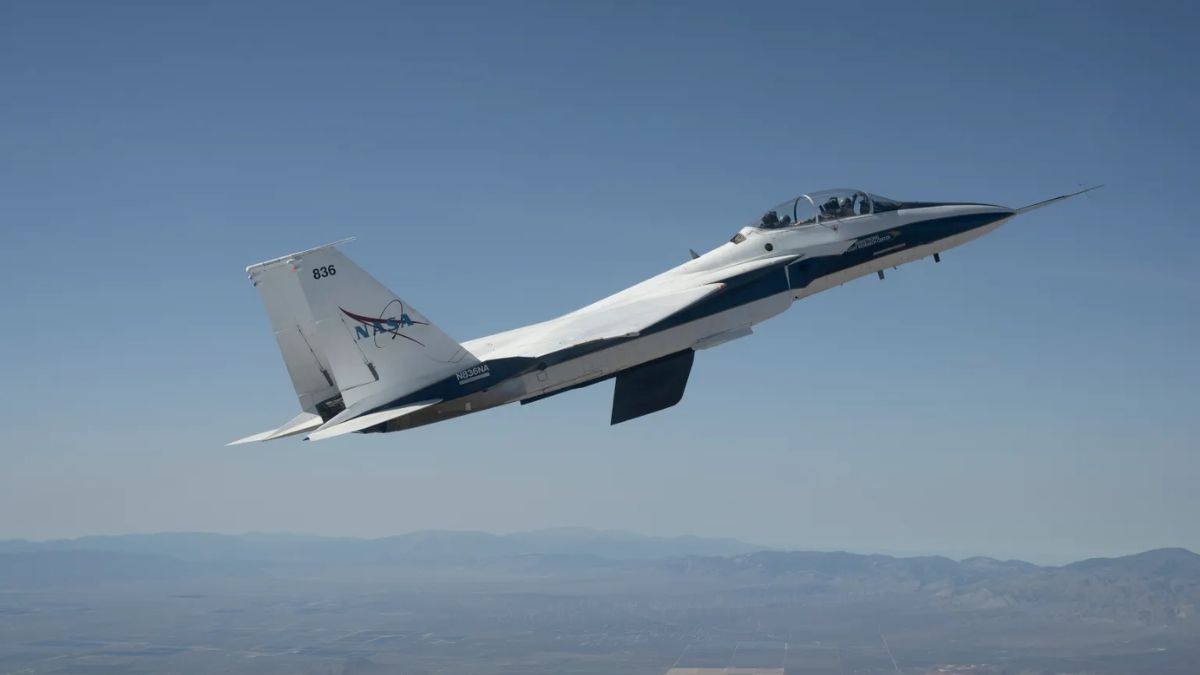
Photo Credit: NASA/Carla Thomas
NASA’s Crossflow Attenuated Natural Laminar Flow scale-model wing flies for the first time on a NASA F-15
Click Here to Add Gadgets360 As A Trusted Source


Advertisement
NASA succeeded in flying for the first time a model wing designed to support laminar flow and reduce drag for aircraft. The model wing, called "40-inch CATNLF wing mounted on a NASA F-15B aircraft at the Armstrong Flight Research Center in late January 2026," was designed to attach safely to the aeroplane. This is a milestone in the pursuit of increasing the efficiency of aircraft in the future.
Flight Test Validates Laminar-Flow Wing Design
According to NASA, in a January 12 ground taxi test, the CATNLF wing model reached about 144 mph, demonstrating its readiness for flight. On Jan. 29, 2026, an F-15B carried the 40-inch (3-foot) CATNLF wing at NASA's Armstrong Flight Research Center. The 75-minute flight allowed pilots to perform turns and gentle climbs to verify the new wing did not disrupt handling. Michelle Banchy, the research principal investigator for CATNLF, said it was “incredible to see CATNLF fly” after all the preparation. NASA noted this was the first of up to 15 planned flights in the program.
Laminar-Flow Wing Research and Benefits
A smooth flow of air over a wing, known as laminar flow, reduces drag and saves fuel. In 2014 and 2017, NASA research projects indicated that when CATNLF features are integrated onto the wing of a large commercial airliner, 10 percent of the fuel used can be saved. Langley tests have demonstrated that the design preserves laminar flow on a swept wing, and the CATNLF concept was created by NASA aeronautical researchers. According to Mike Frederick, who spearheaded the research at NASA, even a modest increase in efficiency can lead to great improvements for the airline industry in terms of birdies saved. This flight is a success for bringing laminar flow wing tech to other flights.
Comments
Get your daily dose of tech news, reviews, and insights, in under 80 characters on Gadgets 360 Turbo. Connect with fellow tech lovers on our Forum. Follow us on X, Facebook, WhatsApp, Threads and Google News for instant updates. Catch all the action on our YouTube channel.
Further reading:
NASA, laminar flow, CATNLF, F-15B, Aerodynamics, aircraft efficiency, fuel savings, Armstrong Flight Research Center, aviation technology
Related Stories







Advertisement
Follow Us




-
00:21
[Sponsored] Samsung Galaxy Z Fold8, Fold8 Ultra -
03:41
[Sponsored] Samsung Galaxy Z Fold8: How It Fits Into an Actor’s Busy Day | Camera, Multitasking & More -
09:53
iPhone 18 Goes On Sale In India: Huge Crowds, Long Queues At Apple Stores -
06:32
Google Pixel 11 Pro XL Review: The Most Exciting Pixel Yet? | 120X Zoom + Tensor G6 -
05:20
Samsung Galaxy Watch Ultra 2 Review: Is This the Best Android Smartwatch?
Advertisement
Popular on Gadgets
- Samsung Galaxy S26 Ultra
- Motorola Razr Fold
- ChatGPT
- OPPO Find N6
- Mobiles Under Rs. 40,000
- Vivo X300 Ultra
- Asus Zenbook S14
- iQOO 15
- Vivo X300 Pro
- Lenovo Yoga Slim 7i Aura Edition
- iQOO 15R
- Vivo X Fold 5
- Sony PlayStation 5
- HP OmniPad 12
- OnePlus Nord CE 6 Lite
- OnePlus Pad 4
- OPPO F33 Pro 5G
- Cryptocurrency
- HP OmniBook Ultra 14 (2026)
- iPhone 17
- Eureka Forbes AP 355 Room Air Purifier
- Latest Mobile Phones
- Compare Phones
Latest Gadgets
- OPPO Reno 16t
- Itel Zeno 300
- Vivo Y600i
- Mivi One 5G
- Xiaomi 18 Pro Max
- Motorola Signature 27
- OPPO Find X10 E
- OnePlus N6 Lite 4G
- Microsoft Surface Laptop, 13-inch (2nd Edition)
- Lenovo LOQ 15AHP11
- Microsoft Surface Pro, 12-inch (2nd Edition)
- Xiaomi Pad 9 Pro
- Amazfit T-Rex Dual Solar
- OPPO Watch S2
- Toshiba 65-Inch 4K Ultra HD Smart Mini LED QLED TV (65Z670SP)
- Haier M70 Mini LED 65-inch
- Acer Predator Atlas 8
- Asus ROG Ally
- Blue Star 1.5 Ton 5 Star Inverter Split AC (IE518ZNURS)
- Blue Star 2 Ton 3 Star Inverter Window AC (WIE324L)

- About Us
- Sitemaps
- Feedback
- Archives
- Contact Us
- RSS
- Advertise
- Career
- Privacy Policy
- Ethics
- Editorial Policy
- Terms & Conditions
- Complaint Redressal
Download Our Apps
Available in Hindi
© Copyright Red Pixels Ventures Limited 2026. All rights reserved.