
-
 Rare Interstellar Object 3I/ATLAS Fails Alien Test, Scientists Say1 January 2026
 -
James Webb Detects Carbon Dioxide–Dominated Coma in Interstellar Object 3I/ATLAS27 August 2025
-
Hubble Captures First Images of Ancient Interstellar Visitor Comet 3I/ATLAS28 July 2025
-
New Interstellar Object 3I/ATLAS Could Reveal Secrets of Distant Worlds12 July 2025
-
Alpha Centauri May Have Sent Millions of Asteroids into the Solar System7 March 2025
- Home
- Science
- Science News
- A Visitor from Another Star: Interstellar Comet Reveals Alien Origins
A Visitor from Another Star: Interstellar Comet Reveals Alien Origins
Scientists studying 3I/ATLAS have detected unusually high levels of heavy water, indicating it formed in an extremely cold environment far beyond our solar system. As only the third known interstellar object, it provides a rare opportunity to study material from another star system.
Written by Gadgets 360 Staff | Updated: 26 April 2026 17:13 IST
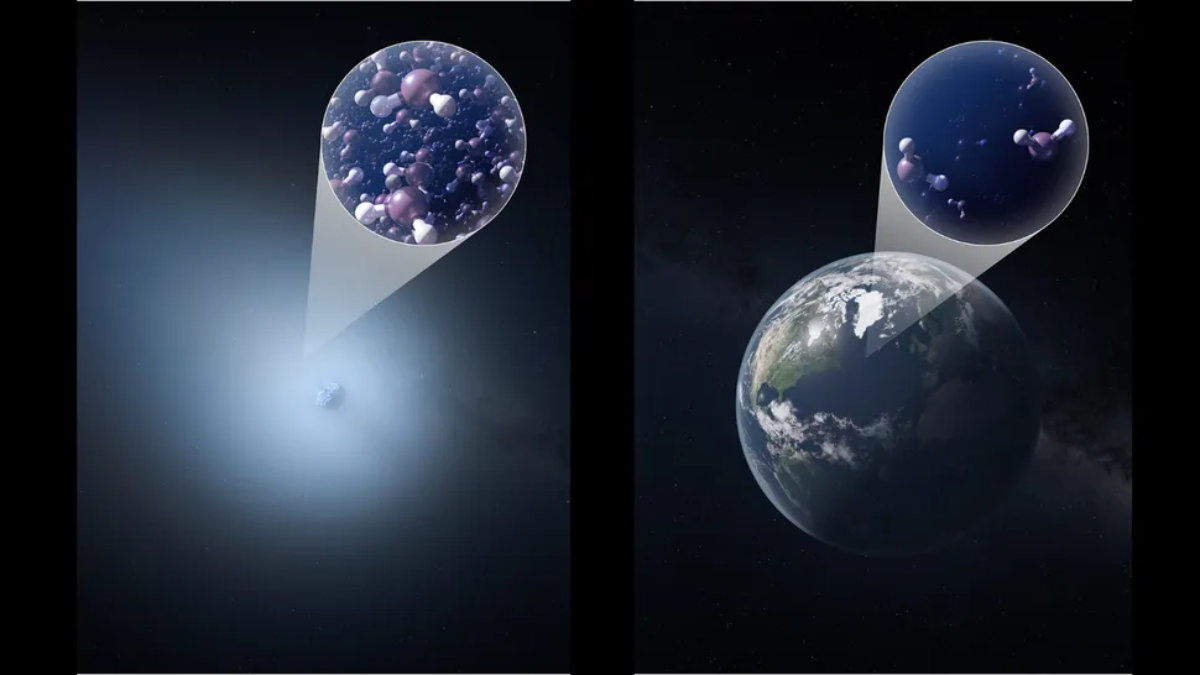
Photo Credit: NASA
An illustration comparing the water content of 3I/ATLAS to that of Earth.
Click Here to Add Gadgets360 As A Trusted Source


Advertisement
An interstellar intruder has been discovered that will change everything we know about how planets form in the galaxy. The comet 3I/ATLAS, which belongs to an exclusive group of three known interstellar objects that entered our solar system, was first observed on July 1 2025, through the ATLAS telescope, which received funding from NASA and operates from Chile. Scientists identified the object as an extraterrestrial space body because it moved at a speed of 137000 miles per hour.
A Frozen Fossil from a Frigid World
An April 23, 2026, study published in Nature Astronomy by Luis E. Salazar Manzano et al. from the University of Michigan utilized the ALMA array to record the very first detection of "semi-heavy" water, or deuterated water, in any interstellar body. The comet contains around 30 times as much heavy water as solar system comets and 40 times as much as the Earth's oceans. As this enrichment is observed only at temperatures below 30 Kelvin (–406°F), the results indicate that the comet originated in an exceedingly cold star system compared to ours.
Messages from a Distant World
3I/ATLAS is the latest addition to the small group of comets that have hailed from beyond our Solar System. While previous examples have not revealed their composition, 3I/ATLAS represents the first interstellar comet whose D/H ratio was measured, an analysis that goes back to its birth in a distant star system that could be so old that it might not even exist anymore. “Every interstellar object is carrying information about its own history,” explains co-author Teresa Paneque-Carreño. With telescopes such as ALMA, scientists can finally study the chemistry of distant planetary cradles.
Comments
Get your daily dose of tech news, reviews, and insights, in under 80 characters on Gadgets 360 Turbo. Connect with fellow tech lovers on our Forum. Follow us on X, Facebook, WhatsApp, Threads and Google News for instant updates. Catch all the action on our YouTube channel.
Further reading:
interstellar objects, 3I/ATLAS, comets, ALMA, astrophysics, planetary formation, heavy water, deuterium, astronomy, solar system, exoplanetary science
Related Stories





Advertisement
Follow Us




-
01:42
[Sponsored] Galaxy Watch9 for Everyday Health Insights | Smarter Wellness Choices -
01:15
[Sponsored] Galaxy Tab S10 Lite for Students: Notes, Solve Math and More -
04:17
[Sponsored] LG NANO 4K UHD AI TV NU885: Gemini Search, Dolby Atmos & 5 Years of Updates -
00:57
[Sponsored] Samsung Galaxy Z Fold8 My Fan Cam in Action: Find the Moment, Then Share It -
01:41
[Sponsored] What Do You Need To Know Before Your Next Run? | Samsung Galaxy Watch Ultra2
-
NVIDIA के सीईओ ने पेश किए माइक्रोडक रोबोट, AI से चलते हैं, क्या काम आएंगे
-
iPhone Duo को बीच से खोला, फोल्डेबल डिस्प्ले से हटाया कवर, फिर क्या दिखा?
-
1 जनवरी से फोन में बिना सिम नहीं चलेगा WhatsApp, सिम बाइडिंग हुआ अनिवार्य
-
Amazon Sale में ₹15 हजार सस्ता हो गया Redmi का 50MP AI कैमरा, 6000mAh बैटरी वाला फोन!
-
Oppo ला रही नया अफॉर्डेबल टैबलेट, 45W फास्ट चार्जिंग फीचर से होगा लैस!
Advertisement
Popular on Gadgets
- Samsung Galaxy S26 Ultra
- Motorola Razr Fold
- ChatGPT
- OPPO Find N6
- Mobiles Under Rs. 40,000
- Vivo X300 Ultra
- Asus Zenbook S14
- iQOO 15
- Vivo X300 Pro
- Lenovo Yoga Slim 7i Aura Edition
- iQOO 15R
- Vivo X Fold 5
- Sony PlayStation 5
- HP OmniPad 12
- OnePlus Nord CE 6 Lite
- OnePlus Pad 4
- OPPO F33 Pro 5G
- Cryptocurrency
- HP OmniBook Ultra 14 (2026)
- iPhone 17
- Eureka Forbes AP 355 Room Air Purifier
- Latest Mobile Phones
- Compare Phones
Latest Gadgets
- HMD 2660 Flip Senior Edition
- Lava Aura Curve
- Poco X8s
- Samsung Galaxy F70 5G
- Tecno Spark 50S 5G
- Vivo Y600s Pro
- Vivo Y32 (2026)
- Infinix Smart 20 HD
- Lenovo Yoga 9n 2-in-1
- Lenovo Yoga Pro 9n
- Amazon Alexa Tablet 8
- Amazon Alexa Tablet 11
- Pebble Qore 2
- Amazfit T-Rex Dual Solar
- Toshiba 65-Inch 4K Ultra HD Smart Mini LED QLED TV (65Z670SP)
- Haier M70 Mini LED 65-inch
- Acer Predator Atlas 8
- Asus ROG Ally
- Blue Star 1.5 Ton 5 Star Inverter Split AC (IE518ZNURS)
- Blue Star 2 Ton 3 Star Inverter Window AC (WIE324L)

- About Us
- Sitemaps
- Feedback
- Archives
- Contact Us
- RSS
- Advertise
- Career
- Privacy Policy
- Ethics
- Editorial Policy
- Terms & Conditions
- Complaint Redressal
Download Our Apps
Available in Hindi
© Copyright Red Pixels Ventures Limited 2026. All rights reserved.