- Home
- Science
- Science News
- Hubble Captures First Images of Ancient Interstellar Visitor Comet 3I/ATLAS
Hubble Captures First Images of Ancient Interstellar Visitor Comet 3I/ATLAS
Hubble captures 3I/ATLAS, the third known comet from outside the solar system, now under intense study.
Written by Gadgets 360 Staff | Updated: 28 July 2025 22:07 IST
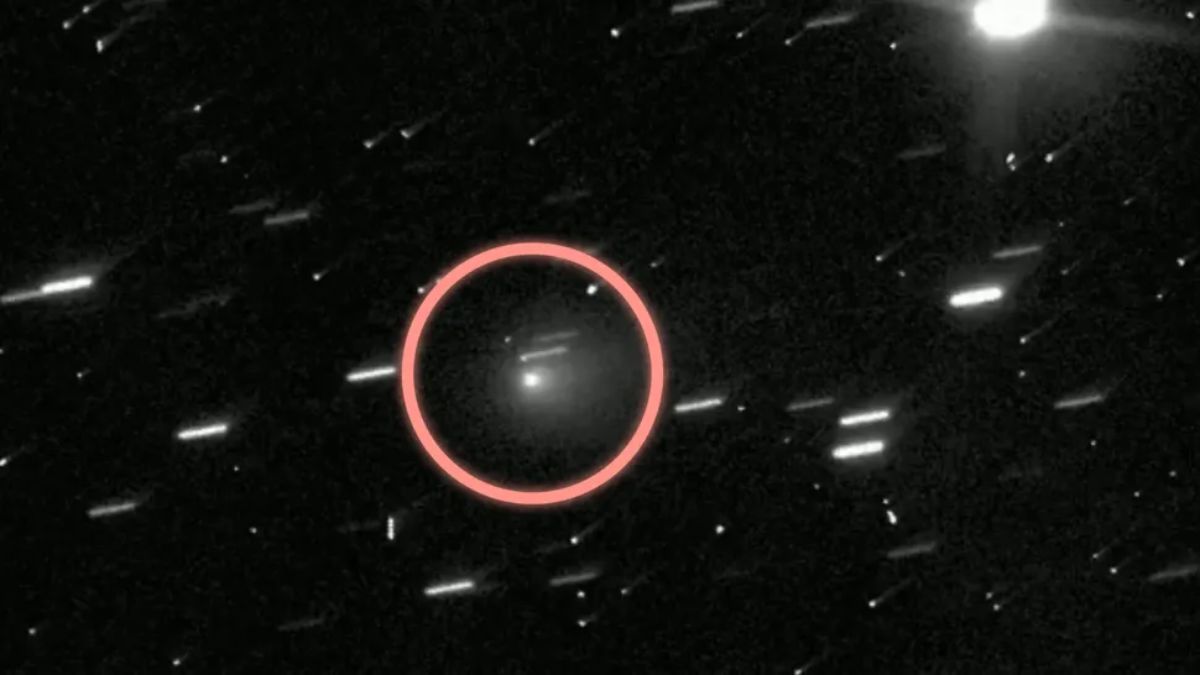
Photo Credit: NASA/ ESA/Hubble
Hubble captures interstellar comet 3I/ATLAS with bright coma and cosmic ray trails
Click Here to Add Gadgets360 As A Trusted Source


Advertisement
The Hubble Space Telescope has taken its initial shots of comet 3I/ATLAS, a comet visiting us from beyond our solar system that recently fell apart — but not before it struck a pose for the cameras. It's only the third such object ever known, after 1I/ʻOumuamua in 2017 and 2I/Borisov in 2019. The subject of numerous scientific tweets and some frantic searches by astronomers anxious to figure out just what it is — and where it came from — before it is gone into the pitch black of deep space forever, 3I/ATLAS was first sighted by the ATLAS survey telescope on July 1, 2025.
Ancient Interstellar Comet 3I/ATLAS Offers Clues to Planetary Systems Beyond Our Own
According to As per Space.com, recent studies indicate that 3I/ATLAS could be some 7 billion years old, well beyond the 4.6 billion years of our solar system. That's an indication that the comet arose in the more ancient parts of the Milky Way, which would give researchers a rare glimpse of what the early days of other planetary systems were like. Undergraduate researcher Astrafoxen first flagged the Hubble images on Bluesky, noting the comet's “nice and puffy” coma, despite interference from cosmic rays.
A newly available preprint paper has already revealed that 3I/ATLAS contains abundant water ice and a dust makeup resembling D-type asteroids—organic-rich bodies typically found in the outer solar system. Unlike ultrared trans-Neptunian objects, D-types are believed to have high carbon and silicate content, potentially shedding light on the comet's deep-space origins and volatile chemistry.
The comet 3I/ATLAS was discovered just as the Vera C. Rubin Observatory was gearing up to carry out its initial observations of the heavens, dovetailing with the LSST's expected discovery of many more interstellar objects in the coming decade.
Until then, 3I/ATLAS holds the astronomical spotlight. Its brief solar system passage offers a precious opportunity for researchers to analyse the material makeup of alien planetary systems. The Hubble images, now available for download, are expected to aid future papers as scientists continue to unravel the story of this ancient cosmic traveller.
Comments
Get your daily dose of tech news, reviews, and insights, in under 80 characters on Gadgets 360 Turbo. Connect with fellow tech lovers on our Forum. Follow us on X, Facebook, WhatsApp, Threads and Google News for instant updates. Catch all the action on our YouTube channel.
Further reading:
comet 3I/ATLAS, Hubble Space Telescope, interstellar objects, astronomy, Observatory


Advertisement
Follow Us




-
01:42
[Sponsored] Galaxy Watch9 for Everyday Health Insights | Smarter Wellness Choices -
01:15
[Sponsored] Galaxy Tab S10 Lite for Students: Notes, Solve Math and More -
04:17
[Sponsored] LG NANO 4K UHD AI TV NU885: Gemini Search, Dolby Atmos & 5 Years of Updates -
00:57
[Sponsored] Samsung Galaxy Z Fold8 My Fan Cam in Action: Find the Moment, Then Share It -
01:41
[Sponsored] What Do You Need To Know Before Your Next Run? | Samsung Galaxy Watch Ultra2
-
₹12 हजार छूट के साथ मिल रहा 48 मेगापिक्सल कैमरा वाला iPhone 17 Pro
-
धरती पर ये चीज होगी महंगी, एलन मस्क ने बताया, रोबोट के लिए बंपर डिमांड
-
आनंद महिंद्रा ने क्यों बदला UPI ऐप, बताई इस फैसले की वजह
-
Samsung Galaxy S25 Ultra Deal: Amazon की Reloaded सेल में फिर आई डील, ₹12 हजार से ज्यादा की बचत
-
iPhone 18e में मिल सकता है 6.12 इंच डिस्प्ले, 24 मेगापिक्सल का फ्रंट कैमरा
Advertisement
Popular on Gadgets
- Samsung Galaxy S26 Ultra
- Motorola Razr Fold
- ChatGPT
- OPPO Find N6
- Mobiles Under Rs. 40,000
- Vivo X300 Ultra
- Asus Zenbook S14
- iQOO 15
- Vivo X300 Pro
- Lenovo Yoga Slim 7i Aura Edition
- iQOO 15R
- Vivo X Fold 5
- Sony PlayStation 5
- HP OmniPad 12
- OnePlus Nord CE 6 Lite
- OnePlus Pad 4
- OPPO F33 Pro 5G
- Cryptocurrency
- HP OmniBook Ultra 14 (2026)
- iPhone 17
- Eureka Forbes AP 355 Room Air Purifier
- Latest Mobile Phones
- Compare Phones
Latest Gadgets
- Vivo Y600
- HMD 2660 Flip Senior Edition
- Lava Aura Curve
- Poco X8s
- Samsung Galaxy F70 5G
- Tecno Spark 50S 5G
- Vivo Y600s Pro
- Vivo Y32 (2026)
- MacBook Pro 14-Inch (M6, 2026)
- Lenovo Yoga 9n 2-in-1
- iPad mini (2026)
- Amazon Alexa Tablet 8
- Pebble Qore 2
- Amazfit T-Rex Dual Solar
- Toshiba 65-Inch 4K Ultra HD Smart Mini LED QLED TV (65Z670SP)
- Haier M70 Mini LED 65-inch
- Acer Predator Atlas 8
- Asus ROG Ally
- Blue Star 1.5 Ton 5 Star Inverter Split AC (IE518ZNURS)
- Blue Star 2 Ton 3 Star Inverter Window AC (WIE324L)

- About Us
- Sitemaps
- Feedback
- Archives
- Contact Us
- RSS
- Advertise
- Career
- Privacy Policy
- Ethics
- Editorial Policy
- Terms & Conditions
- Complaint Redressal
Download Our Apps
Available in Hindi
© Copyright Red Pixels Ventures Limited 2026. All rights reserved.