-
 Scientists Discover 77 Rare Red Quasars Hidden Behind Cosmic Dust25 May 2026
 -
SPHEREx Captures Dramatic Outburst of Interstellar Comet 3I/ATLAS11 February 2026
-
NASA’s SPHEREx Spots Interstellar Comet Flaring With Gas and Organic Molecules9 February 2026
-
NASA’s SPHEREx Telescope Delivers First Full-Sky Map, Unlocking Cosmic Secrets23 December 2025
-
NASA’s SPHEREx Telescope Begins 3D Infrared Mapping of the Universe12 May 2025
- Home
- Science
- Science News
- NASA’s SPHEREx Maps Water Ice Deposits in Cygnus X, Offering Clues to Earth’s Water
NASA’s SPHEREx Maps Water Ice Deposits in Cygnus X, Offering Clues to Earth’s Water
NASA’s SPHEREx has mapped vast interstellar ice reservoirs in Cygnus X, revealing how water and key life-forming molecules are preserved in space. These ice-rich regions, shielded by dust, may seed young planets during formation.
Written by Gadgets 360 Staff | Updated: 25 April 2026 17:09 IST
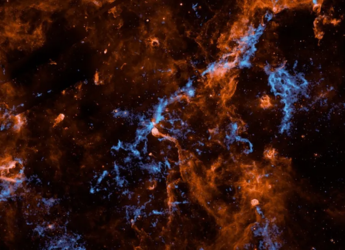
Photo Credit: NASA
The chemical signatures of water ice (shown in bright blue) and polycyclic aromatic hydrocarbons.
Click Here to Add Gadgets360 As A Trusted Source


Advertisement
From where does Earth's supply of water originate? Well, here comes an amazing answer, and this answer comes to us from outer space. NASA's SPHEREx telescope has been able to map massive ice deposits of water in Cygnus X, one of the most chaotic stellar birthing grounds in the Milky Way galaxy that lies 4,500 light-years away from us. These ice clusters, which have been named interstellar glaciers, consist of the very chemicals required for life formation.
Dust as a Cosmic Shield
The study, published in The Astrophysical Journal on April 15, 2026, was authored by astronomer Joseph Hora at Harvard-Smithsonian Center for Astrophysics. SPHEREx was sent to space in March 2025 and is currently scanning the sky in 102 infrared bands and mapping the entire sky in its first of four planned scans. SPHEREx has made observations in Cygnus X showing that the ice runs throughout the giant molecular cloud, extending further than anyone thought before. In the areas with the most ice, there are dark dust lanes made up of tiny grains, smaller than those found in cigarette smoke.
Seeding Future Worlds
This discovery could change our perspective on life beyond Earth, as the icy deposits that help preserve water out in space are believed to play a role in the creation of new star systems. As more gases and debris become bound to planets through gravitational attraction, the icy deposits fall into the newly formed planets and may supply the vital ingredients for life. The mission is scheduled to last for two years and, in that time, map the variation of the ice in our galaxy.
Comments
Get your daily dose of tech news, reviews, and insights, in under 80 characters on Gadgets 360 Turbo. Connect with fellow tech lovers on our Forum. Follow us on X, Facebook, WhatsApp, Threads and Google News for instant updates. Catch all the action on our YouTube channel.
Further reading:
SPHEREx, NASA, Cygnus X, interstellar ice, water origin, astrobiology, star formation, infrared astronomy, molecular clouds, space science
Related Stories



Advertisement
Follow Us




-
01:15
[Sponsored] Galaxy Tab S10 Lite for Students: Notes, Solve Math and More -
04:17
[Sponsored] LG NANO 4K UHD AI TV NU885: Gemini Search, Dolby Atmos & 5 Years of Updates -
00:57
[Sponsored] Samsung Galaxy Z Fold8 My Fan Cam in Action: Find the Moment, Then Share It -
01:41
[Sponsored] What Do You Need To Know Before Your Next Run? | Samsung Galaxy Watch Ultra2 -
01:32
[Sponsored] Big Day Tomorrow? Prep Today | Samsung Galaxy Watch Ultra2
Advertisement
Popular on Gadgets
- Samsung Galaxy S26 Ultra
- Motorola Razr Fold
- ChatGPT
- OPPO Find N6
- Mobiles Under Rs. 40,000
- Vivo X300 Ultra
- Asus Zenbook S14
- iQOO 15
- Vivo X300 Pro
- Lenovo Yoga Slim 7i Aura Edition
- iQOO 15R
- Vivo X Fold 5
- Sony PlayStation 5
- HP OmniPad 12
- OnePlus Nord CE 6 Lite
- OnePlus Pad 4
- OPPO F33 Pro 5G
- Cryptocurrency
- HP OmniBook Ultra 14 (2026)
- iPhone 17
- Eureka Forbes AP 355 Room Air Purifier
- Latest Mobile Phones
- Compare Phones
Latest Gadgets
- HMD 2660 Flip Senior Edition
- Lava Aura Curve
- Poco X8s
- Samsung Galaxy F70 5G
- Tecno Spark 50S 5G
- Vivo Y600s Pro
- Vivo Y32 (2026)
- Infinix Smart 20 HD
- Acer TravelLite TL44-53M-G2
- HP ZBook Ultra G3a
- Amazon Alexa Tablet 8
- Amazon Alexa Tablet 11
- Pebble Qore 2
- Amazfit T-Rex Dual Solar
- Toshiba 65-Inch 4K Ultra HD Smart Mini LED QLED TV (65Z670SP)
- Haier M70 Mini LED 65-inch
- Acer Predator Atlas 8
- Asus ROG Ally
- Blue Star 1.5 Ton 5 Star Inverter Split AC (IE518ZNURS)
- Blue Star 2 Ton 3 Star Inverter Window AC (WIE324L)

- About Us
- Sitemaps
- Feedback
- Archives
- Contact Us
- RSS
- Advertise
- Career
- Privacy Policy
- Ethics
- Editorial Policy
- Terms & Conditions
- Complaint Redressal
Download Our Apps
Available in Hindi
© Copyright Red Pixels Ventures Limited 2026. All rights reserved.