- Home
- Science
- Science News
- Hubble Telescope Captures Comet Reversing Its Rotation for the First Time
Hubble Telescope Captures Comet Reversing Its Rotation for the First Time
Astronomers have observed Comet 41P reversing its rotation for the first time, using NASA’s Hubble Space Telescope. Driven by uneven gas jets, the comet slowed, stopped, and began spinning backward.
Written by Gadgets 360 Staff | Updated: 27 March 2026 21:42 IST
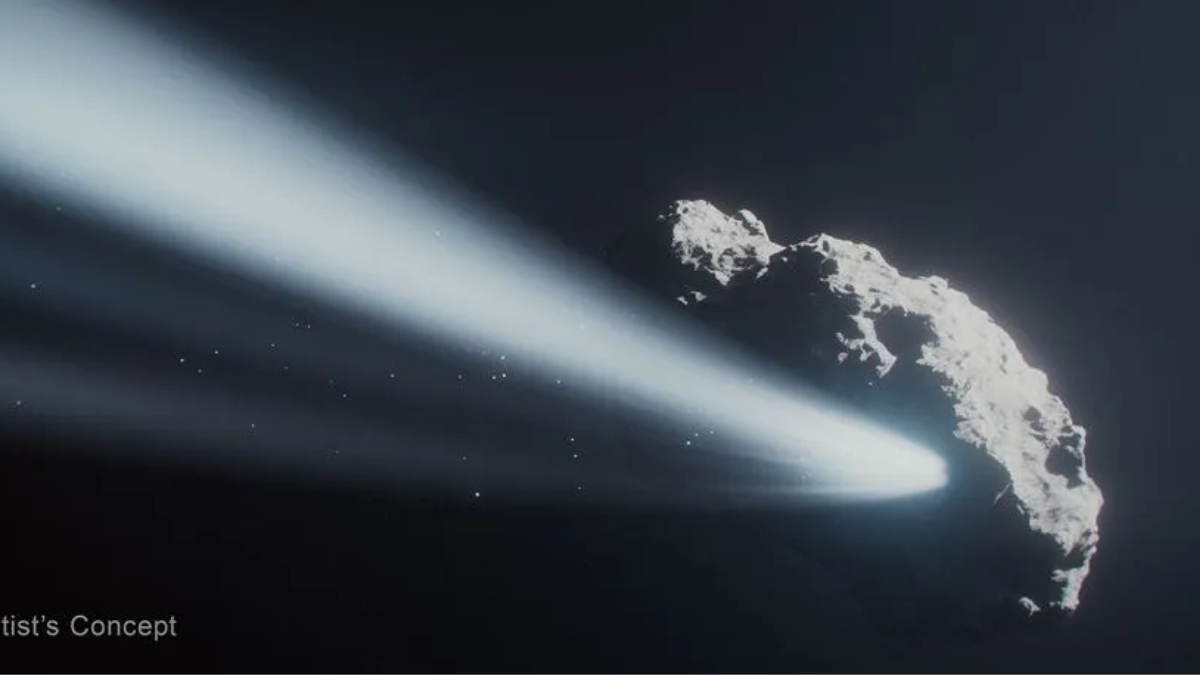
Photo Credit: NASA
An artist's impression of a jet of gas and dust blasting out from comet 41P/Tuttle–Giacobini–Kresák.
Click Here to Add Gadgets360 As A Trusted Source


Advertisement
For the first time, astronomers have witnessed a comet fully reversing its rotation. NASA's Hubble Space Telescope has recorded the behaviour of Comet 41P/Tuttle-Giacobini-Kresák during its close approach to the Sun in 2017. Planetary scientist David Jewitt of UCLA studied the Hubble observations and published his findings in The Astronomical Journal on March 26. The comet, which is a small icy body just 0.6 miles wide, significantly slowed down and came to a complete stop before reversing its rotation.
How Gas Jets Flip a Comet
According to the findings, Comet 41P's nucleus is only 0.6 miles (1 km) in diameter. This makes it highly susceptible to rotational forces. When Comet 41P approached the Sun, the Sun's warmth caused frozen ices to sublimate. This caused unbalanced gas jets that behaved like mini-thrusters. NASA's Swift Observatory detected that Comet 41P's spin slowed down three times over in May 2017. Hubble images taken in December revealed that it now rotates every 14 hours in reverse. Jewitt likened this to pushing a spinning merry-go-round in the opposite direction until it stops and reverses.
A Comet on Borrowed Time
Such a spin reversal could lead to the destruction of comet 41P. As it spins faster, centrifugal forces could overcome the weak gravity binding it together, causing it to come apart. The comet's activity has also decreased tenfold since it passed perihelion in 2001. The near-surface volatile ice is likely depleted or buried under dust. Having been in its current orbit for approximately 1,500 years, comet 41P is in its final stages. According to Jewitt, it will "very quickly self-destruct." The fact that it is an ancient relic in our solar system makes it all the more poignant.
Comments
Get your daily dose of tech news, reviews, and insights, in under 80 characters on Gadgets 360 Turbo. Connect with fellow tech lovers on our Forum. Follow us on X, Facebook, WhatsApp, Threads and Google News for instant updates. Catch all the action on our YouTube channel.
Further reading:
Comet 41P, Hubble Space Telescope, comets, NASA, astronomy, astrophysics, solar system, comet rotation, space discoveries, Planetary Science, Swift Observatory


Advertisement
Follow Us




-
00:21
[Sponsored] Samsung Galaxy Z Fold8, Fold8 Ultra -
03:41
[Sponsored] Samsung Galaxy Z Fold8: How It Fits Into an Actor’s Busy Day | Camera, Multitasking & More -
09:53
iPhone 18 Goes On Sale In India: Huge Crowds, Long Queues At Apple Stores -
06:32
Google Pixel 11 Pro XL Review: The Most Exciting Pixel Yet? | 120X Zoom + Tensor G6 -
05:20
Samsung Galaxy Watch Ultra 2 Review: Is This the Best Android Smartwatch?
-
Amazon Great Indian Festival: सेल से पहले 6 मोबाइल पर Early Bird Deals
-
Vivo Y600i हुआ लॉन्च; 8000mAh बैटरी और ड्रॉप प्रोटेक्शन के साथ आया फोन
-
लैपटॉप की बैटरी हेल्थ ऐसे करें चेक, नहीं होगा नुकसान
-
iQOO Pad Ultra में 9020mAh बैटरी कंफर्म, प्री-ऑर्डर भी शुरू
-
₹16 हजार सस्ता मिल रहा 50MP तीन कैमरा वाला Samsung 5G फोन! IP67 रेटिंग
Advertisement
Popular on Gadgets
- Samsung Galaxy S26 Ultra
- Motorola Razr Fold
- ChatGPT
- OPPO Find N6
- Mobiles Under Rs. 40,000
- Vivo X300 Ultra
- Asus Zenbook S14
- iQOO 15
- Vivo X300 Pro
- Lenovo Yoga Slim 7i Aura Edition
- iQOO 15R
- Vivo X Fold 5
- Sony PlayStation 5
- HP OmniPad 12
- OnePlus Nord CE 6 Lite
- OnePlus Pad 4
- OPPO F33 Pro 5G
- Cryptocurrency
- HP OmniBook Ultra 14 (2026)
- iPhone 17
- Eureka Forbes AP 355 Room Air Purifier
- Latest Mobile Phones
- Compare Phones
Latest Gadgets
- Vivo Y600i
- Mivi One 5G
- Xiaomi 18 Pro Max
- Motorola Signature 27
- OPPO Find X10 E
- OnePlus N6 Lite 4G
- Ai+ Nova 2 Power 5G
- Lava Virat Curve 5G
- Microsoft Surface Laptop, 13-inch (2nd Edition)
- Lenovo LOQ 15AHP11
- Microsoft Surface Pro, 12-inch (2nd Edition)
- Xiaomi Pad 9 Pro
- Amazfit T-Rex Dual Solar
- OPPO Watch S2
- Haier M70 Mini LED 65-inch
- Xiaomi TV FX Mini LED 65
- Acer Predator Atlas 8
- Asus ROG Ally
- Blue Star 1.5 Ton 5 Star Inverter Split AC (IE518ZNURS)
- Blue Star 2 Ton 3 Star Inverter Window AC (WIE324L)

- About Us
- Sitemaps
- Feedback
- Archives
- Contact Us
- RSS
- Advertise
- Career
- Privacy Policy
- Ethics
- Editorial Policy
- Terms & Conditions
- Complaint Redressal
Download Our Apps
Available in Hindi
© Copyright Red Pixels Ventures Limited 2026. All rights reserved.