-
 Sun Unleashes Triple Solar Flare Blast, Triggering G3 Geomagnetic Storm Alert4 June 2026
 -
Massive Solar Storm Reveals How Mars Is Losing Its Atmosphere19 May 2026
-
Sun Erupts with Powerful Solar Flare, Sending Plasma Toward Earth13 May 2026
-
Carrington-Level Solar Storm Could Disrupt Satellites, GPS, and Power Grids, Scientists Warn14 April 2026
-
Scientists Trace Solar Storm Origins to Hidden Layer Deep Inside the Sun28 March 2026
- Home
- Science
- Science News
- Scientists Find Evidence of Past Extreme Solar Storms, Warn of Potential Technological Catastrophe
Scientists Find Evidence of Past Extreme Solar Storms, Warn of Potential Technological Catastrophe
Recent studies reveal that past extreme solar storms could have wreaked havoc on modern technology if they occurred today.
Written by Gadgets 360 Staff | Updated: 25 September 2024 22:02 IST

Photo Credit: Pixabay/ WikiImages
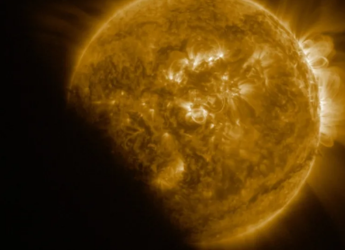
Solar storms happen when the Sun ejects charged particles into Earth's magnetic field.
Click Here to Add Gadgets360 As A Trusted Source


Advertisement
In 1859, when Charles Darwin published On the Origin of Species, the Earth experienced one of the most powerful solar storms in recorded history. Telegraph systems across Europe and North America malfunctioned, sparking fires in some places. This event, later known as the Carrington event, was preceded by the first confirmed observation of a solar flare, an intense burst of radiation from the Sun. The flare set off brilliant auroras across the skies, signalling the onset of the solar storm. While the Carrington event was intense, new research shows that even more extreme solar storms have occurred in the past.
Radiocarbon Clues from Tree Rings
Scientists have uncovered evidence of these ancient storms by studying radiocarbon levels in tree rings. Fusa Miyake, a researcher from Nagoya University, led a team that discovered abrupt spikes in radiocarbon concentrations, indicating extreme solar storms. Their findings include events such as those in AD774, AD993, and even further back in 660BC and 5259BC. These solar storms were much stronger than the Carrington event, with the most intense storm on record occurring around 14,370 years ago, near the end of the last ice age.
Impact on Modern Technology
Solar storms occur when the Sun ejects charged particles that penetrate Earth's magnetic field. These storms can disrupt our technological infrastructure, including satellites, power grids, and communication networks. The events identified in tree rings suggest that our modern world would be vulnerable to such an event. With solar storms capable of shutting down global systems, scientists are working to understand their frequency and intensity by studying ancient trees worldwide. This research not only improves radiocarbon dating but also helps us prepare for future solar storms, which could have devastating effects on today's interconnected society.
Comments
Get your daily dose of tech news, reviews, and insights, in under 80 characters on Gadgets 360 Turbo. Connect with fellow tech lovers on our Forum. Follow us on X, Facebook, WhatsApp, Threads and Google News for instant updates. Catch all the action on our YouTube channel.
Related Stories
Scientists Find Evidence of Past Extreme Solar Storms, Warn of Potential Technological Catastrophe


Advertisement
Follow Us




-
04:17
[Sponsored] LG NANO 4K UHD AI TV NU885: Gemini Search, Dolby Atmos & 5 Years of Updates -
00:57
[Sponsored] Samsung Galaxy Z Fold8 My Fan Cam in Action: Find the Moment, Then Share It -
01:41
[Sponsored] What Do You Need To Know Before Your Next Run? | Samsung Galaxy Watch Ultra2 -
01:32
[Sponsored] Big Day Tomorrow? Prep Today | Samsung Galaxy Watch Ultra2 -
04:37
[Sponsored]: CP PLUS CarKam CP-F89B: 4K Dashcam With Rear Camera, GPS & Emergency Recording
-
आ गई हवा में उड़ने वाली Tesla Roadster कार, आखिर सच हुआ फिल्मों वाला कमाल
-
रोबोट ने की लड़की से छेड़छाड़, पीछे से पकड़ा और किए गंदे इशारे, जानें
-
PS5 कहां मिलेगा सस्ता, Flipkart या Amazon, जानें सबकुछ
-
Lenovo ने सस्ता लैपटॉप ग्लोबल मार्केट में किया लॉन्च, Snapdragon X चिप से लैस
-
Vivo V80 FE जल्द होगा भारत में लॉन्च, BIS सर्टिफिकेशन में स्पॉट, 7500mAh बैटरी!
Advertisement
Popular on Gadgets
- Samsung Galaxy S26 Ultra
- Motorola Razr Fold
- ChatGPT
- OPPO Find N6
- Mobiles Under Rs. 40,000
- Vivo X300 Ultra
- Asus Zenbook S14
- iQOO 15
- Vivo X300 Pro
- Lenovo Yoga Slim 7i Aura Edition
- iQOO 15R
- Vivo X Fold 5
- Sony PlayStation 5
- HP OmniPad 12
- OnePlus Nord CE 6 Lite
- OnePlus Pad 4
- OPPO F33 Pro 5G
- Cryptocurrency
- HP OmniBook Ultra 14 (2026)
- iPhone 17
- Eureka Forbes AP 355 Room Air Purifier
- Latest Mobile Phones
- Compare Phones
Latest Gadgets
- Tecno Spark 50S 5G
- Vivo Y600s Pro
- Vivo Y32 (2026)
- Infinix Smart 20 HD
- Vivo V80
- Vivo S2 FE
- Vivo Y600K Turbo
- Realme P4s Lite
- HP ZBook Ultra G3a
- Dell Pro Rugged 14
- Amazon Alexa Tablet 8
- Amazon Alexa Tablet 11
- Amazfit T-Rex Dual Solar
- OPPO Watch S2
- Toshiba 65-Inch 4K Ultra HD Smart Mini LED QLED TV (65Z670SP)
- Haier M70 Mini LED 65-inch
- Acer Predator Atlas 8
- Asus ROG Ally
- Blue Star 1.5 Ton 5 Star Inverter Split AC (IE518ZNURS)
- Blue Star 2 Ton 3 Star Inverter Window AC (WIE324L)

- About Us
- Sitemaps
- Feedback
- Archives
- Contact Us
- RSS
- Advertise
- Career
- Privacy Policy
- Ethics
- Editorial Policy
- Terms & Conditions
- Complaint Redressal
Download Our Apps
Available in Hindi
© Copyright Red Pixels Ventures Limited 2026. All rights reserved.