

-
 ViewSonic India Bets Big on LED Displays as It Expands Beyond Monitors17 October 2026
 -
Samsung Announces Festive Offers on Vision AI TVs in India With Free Soundbars, Cashback Benefits14 October 2026
-
Apple TV 4K (4th Generation), HomePod Mini 2 Launched in India With Siri AI: Price, Specifications13 October 2026
-
Amazon Great Indian Festival 2026: Top Deals on 75-Inch and More Smart TVs From Sony, TCL and Samsung12 October 2026
-
Apple HomeView Smart Hub, New Apple TV 4K and HomePod mini Launch Timeline Leaks12 October 2026
- Home
- Tv
- Tv Sponsored
- How AI Is Empowering the Future of TVs In Your Living Room
Sponsored Content
How AI Is Empowering the Future of TVs In Your Living Room
By Sponsored Content | Updated: 9 June 2026 17:49 IST
Click Here to Add Gadgets360 As A Trusted Source

For years, “smart TV” upgrades mostly followed a predictable script. Faster apps, slightly cleaner menus, maybe a voice assistant that worked well enough to set a timer but not much else. AI, meanwhile, stayed largely in the background, doing invisible things like improving picture processing or sharpening low-resolution content.
In 2026, TV brands are no longer treating AI as yet another background feature. They are trying to turn it into the centre of the user experience itself. And among the companies leaning hardest into that shift is LG, particularly with its latest OLED lineup led by the G6 series.
- Your TV suddenly starts lagging after two years. Would you replace it or add a streaming stick?
- Unpopular opinion: Is buying a huge TV more important than buying a better-quality screen?
- Has anyone switched from a regular LED TV to OLED and felt the difference was smaller than expected?
- You can upgrade only one thing on your TV: sound, brightness or refresh rate. What are you choosing?
- What's one TV feature you would happily give up to get a better screen?
The interesting part is not that LG is adding AI features. Every premium TV brand is doing that now. The bigger question is whether AI on televisions can move beyond marketing language and start solving actual living-room problems. Based on LG's current direction, the company seems convinced that the future of TVs will depend less on how many apps they support and more on how naturally they understand people.
TVs Are Becoming More Personal Than Shared
The modern television occupies a strange position in the home. It is still the biggest shared screen in most households, but the way people use it has become deeply individual.
One person wants sports highlights. Another jumps between YouTube and OTT apps. Someone else uses the TV primarily for gaming. And then there is the familiar household ritual where nobody can remember which profile, app or watchlist holds the movie they were halfway through last week.
This is exactly the kind of fragmented experience AI is supposed to simplify.
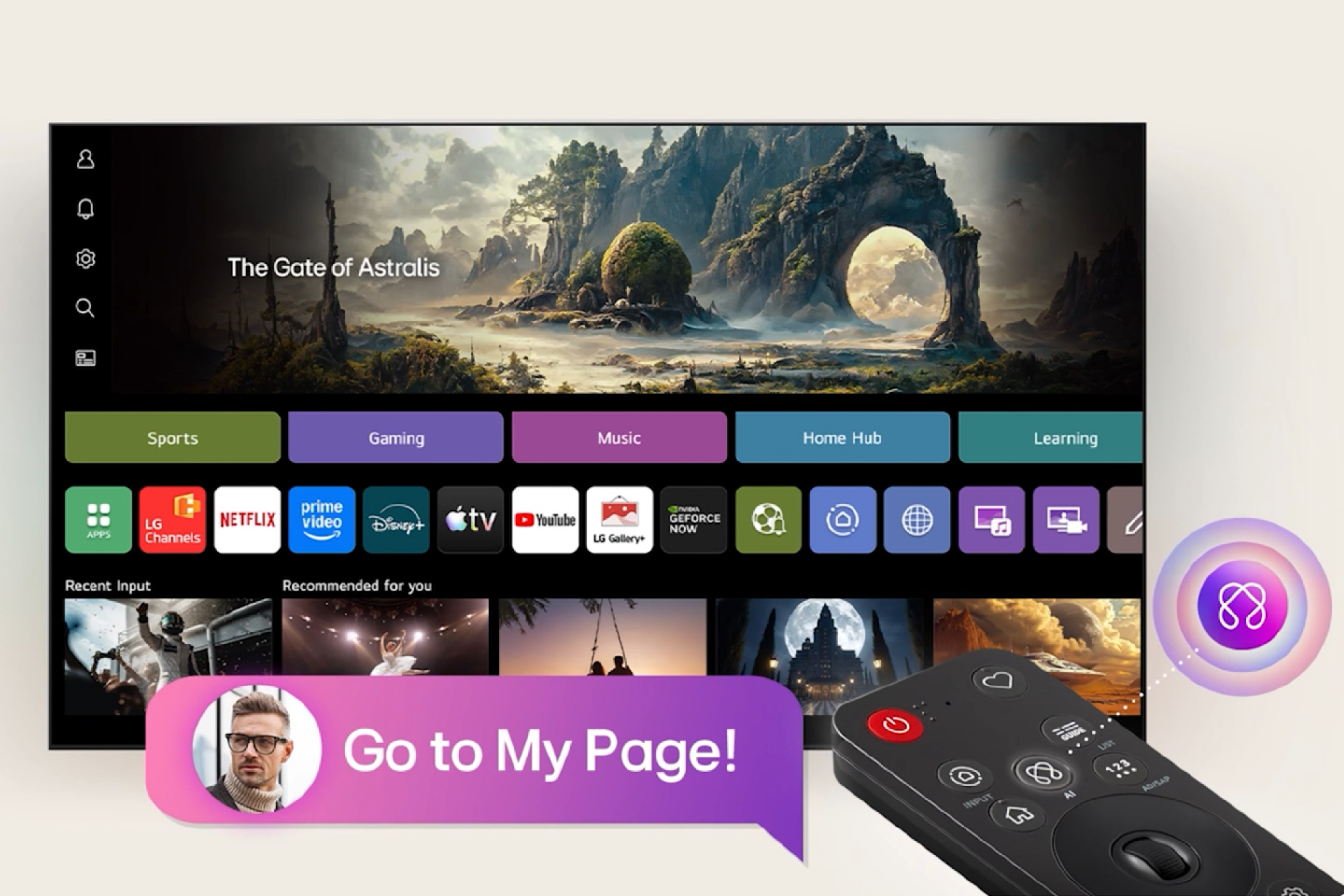
LG's newer OLED TVs, including the G6 and C6 series, introduce features like AI Voice ID, AI Agent and personalised “My Page” experiences that aim to make the interface adapt to individual users rather than treating everyone in the house the same. The TV can recognise different voices and surface customised recommendations, shortcuts and settings based on who is interacting with it.
That may sound like a small convenience feature, but it reflects a broader shift in how TV software is evolving. The interface is no longer just a launcher for apps. It is slowly becoming a personalised content layer.
Your Remote Is No Longer the Main Interface
One of the more noticeable changes happening in premium TVs is the reduced dependence on traditional navigation. Nobody really enjoys typing movie names one letter at a time with a remote control. AI is being positioned as the workaround.
LG's Multi AI Search integrates Google Gemini and Microsoft Copilot into the TV experience, with the idea being that users can search more naturally instead of navigating through endless menus. Rather than forcing people to think like software, the TV is increasingly being designed to respond more like a conversation.
The AI Magic Remote fits into that same philosophy. Instead of adding complexity, LG appears to be trying to reduce friction. The objective is straightforward: less hunting through settings, fewer clicks, and faster access to content.
This matters because televisions today are no longer simple displays connected to cable boxes. They sit at the intersection of streaming platforms, gaming services, live sports, YouTube, smart home ecosystems and increasingly, cloud-based content discovery. The more complicated the ecosystem becomes, the more valuable a clean interface starts to feel.
AI Picture Processing Has Quietly Become the Core of Premium TVs
For all the attention around AI assistants and search, the biggest AI-driven improvements on televisions still happen behind the scenes.
Picture processing remains one of the most important differentiators in high-end TVs, especially in OLED models. LG's latest OLED lineup uses the α11 AI Processor 4K Gen 3 in the G6 series, where AI is handling tasks like upscaling, scene analysis, brightness optimisation and dynamic picture refinement in real time.
The important thing here is not just raw brightness or sharper visuals. It is consistency.
A premium TV today has to handle wildly different types of content. One moment it is streaming a dark, cinematic thriller. The next it is showing a brightly lit cricket match or a compressed YouTube livestream. AI processing is increasingly responsible for making those transitions feel seamless rather than jarring.
LG's AI Picture Pro and AI Sound Pro systems are designed around that idea. Instead of forcing users to constantly tweak settings manually, the TV attempts to optimise itself based on the type of content being shown.
The best AI features on TVs are often the ones viewers stop noticing entirely. If the image looks balanced, dialogue sounds clearer and motion feels smooth without constant adjustment, the system is effectively doing its job.
Gaming Is Pushing TV AI Further Than Streaming Ever Did
Gaming has quietly become one of the biggest reasons premium TV technology is evolving so quickly.
Unlike films or TV shows, games are interactive and highly responsive to latency, refresh rates and motion handling. That makes gaming one of the toughest real-world stress tests for a television.
LG's OLED TVs have leaned heavily into that space with support for features like 165Hz VRR on select models, NVIDIA G-Sync, AMD FreeSync Premium and Xbox cloud gaming integration. But AI is playing a role here too.
Modern TV processors are now expected to dynamically manage picture quality, reduce latency, optimise motion and preserve responsiveness simultaneously. That balancing act becomes especially important during fast-paced gameplay where visual smoothness matters as much as raw image quality.
AI on TVs Is Also Becoming a Longevity Story
One of the more practical ways AI is influencing televisions has less to do with flashy features and more to do with long-term usability.
TV buyers today expect premium televisions to last for years, both physically and software-wise. LG's webOS Re:New program, which promises up to five years of platform upgrades, reflects how important ongoing software support has become in the premium segment.
That shift matters because televisions now age more like connected devices than traditional appliances. The quality of the interface, app ecosystem and AI functionality may end up mattering just as much as the panel itself after a few years of ownership.
In many ways, this is the first generation of TVs being designed with the assumption that software experiences will continuously evolve after purchase.
The Future TV May Feel Less Like Hardware and More Like Software
There was a time when buying a television mostly meant choosing a screen size and panel type. That decision has become far more layered now.
Picture quality still matters enormously, especially on premium OLED models like LG's G6 and C6 series. But increasingly, companies are competing on how intelligently the TV behaves once it is switched on.
That is why the AI conversation around televisions is changing. The goal is no longer just sharper images or louder sound. It is about reducing friction across the entire entertainment experience.
Comments
Get your daily dose of tech news, reviews, and insights, in under 80 characters on Gadgets 360 Turbo. Connect with fellow tech lovers on our Forum. Follow us on X, Facebook, WhatsApp, Threads and Google News for instant updates. Catch all the action on our YouTube channel.
Further reading:
TV
Related Stories



Follow Us




-
![[Sponsored] Galaxy Tab S10 Lite for Students: Notes, Solve Math and More](https://www.gadgets360.com/static/desktop/images/spacer.png)
01:15
[Sponsored] Galaxy Tab S10 Lite for Students: Notes, Solve Math and More -
04:17
[Sponsored] LG NANO 4K UHD AI TV NU885: Gemini Search, Dolby Atmos & 5 Years of Updates -
00:57
[Sponsored] Samsung Galaxy Z Fold8 My Fan Cam in Action: Find the Moment, Then Share It -
01:41
[Sponsored] What Do You Need To Know Before Your Next Run? | Samsung Galaxy Watch Ultra2 -
01:32
[Sponsored] Big Day Tomorrow? Prep Today | Samsung Galaxy Watch Ultra2
-
X पर वीडियो पोस्ट करके जीतें 2.83 लाख रुपये, किकस्टार्ट बोनस शुरू, जानें
-
6500mAh बैटरी वाला फोन Amazon Sale में ₹15 हजार से भी सस्ता हुआ
-
Oura Ring 5 लॉन्च, हेल्थ और मेडिकेशन दोनों की ट्रैकिंग, 7 दिन चलेगी बैटरी
-
Vivo Y600 होगा 30 अक्टूबर को लॉन्च, 10,000mAh की मिलेगी बैटरी
-
Maruti Suzuki की e-Vitara को जापान की सेफ्टी रेटिंग में मिले 4-स्टार
Popular on Gadgets
- Samsung Galaxy S26 Ultra
- Motorola Razr Fold
- ChatGPT
- OPPO Find N6
- Mobiles Under Rs. 40,000
- Vivo X300 Ultra
- Asus Zenbook S14
- iQOO 15
- Vivo X300 Pro
- Lenovo Yoga Slim 7i Aura Edition
- iQOO 15R
- Vivo X Fold 5
- Sony PlayStation 5
- HP OmniPad 12
- OnePlus Nord CE 6 Lite
- OnePlus Pad 4
- OPPO F33 Pro 5G
- Cryptocurrency
- HP OmniBook Ultra 14 (2026)
- iPhone 17
- Eureka Forbes AP 355 Room Air Purifier
- Latest Mobile Phones
- Compare Phones
Latest Gadgets
- HMD 2660 Flip Senior Edition
- Lava Aura Curve
- Poco X8s
- Samsung Galaxy F70 5G
- Tecno Spark 50S 5G
- Vivo Y600s Pro
- Vivo Y32 (2026)
- Infinix Smart 20 HD
- Acer TravelLite TL44-53M-G2
- HP ZBook Ultra G3a
- Amazon Alexa Tablet 8
- Amazon Alexa Tablet 11
- Pebble Qore 2
- Amazfit T-Rex Dual Solar
- Toshiba 65-Inch 4K Ultra HD Smart Mini LED QLED TV (65Z670SP)
- Haier M70 Mini LED 65-inch
- Acer Predator Atlas 8
- Asus ROG Ally
- Blue Star 1.5 Ton 5 Star Inverter Split AC (IE518ZNURS)
- Blue Star 2 Ton 3 Star Inverter Window AC (WIE324L)

- About Us
- Sitemaps
- Feedback
- Archives
- Contact Us
- RSS
- Advertise
- Career
- Privacy Policy
- Ethics
- Editorial Policy
- Terms & Conditions
- Complaint Redressal
Download Our Apps
Available in Hindi
© Copyright Red Pixels Ventures Limited 2026. All rights reserved.