-
 Edward Snowden Believes Bitcoin, Crypto Is Better Suited to Payments Than Investment13 June 2022
 -
Edward Snowden Cautions Investors Against Dogecoin Clones Like Shiba Inu1 November 2021
-
Edward Snowden Says CBDC a 'Cryptofascist Currency' Designed to Put Governments at Centre of Every Transaction12 October 2021
-
Edward Snowden Says China’s Crypto Crackdown Made Bitcoin Stronger5 October 2021
-
After ExpressVPN CIO Named in UAE Surveillance Scandal; Edward Snowden Says Stop Using It18 September 2021
- Home
- Internet
- Internet News
- US Court to Hear Appeals Over Keeping US Demands for Telecom Records Secret
US Court to Hear Appeals Over Keeping US Demands for Telecom Records Secret
By Reuters | Updated: 8 October 2014 13:17 IST
Click Here to Add Gadgets360 As A Trusted Source

Advertisement
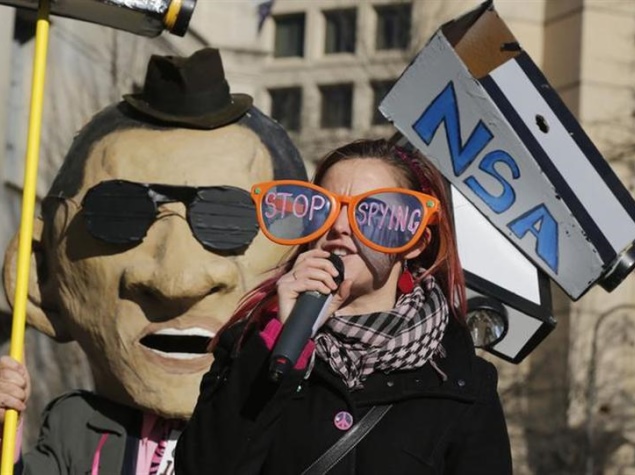
A U.S. appeals court is set to hear arguments on Wednesday on whether the Federal Bureau of Investigation can force Internet and telecommunications firms to turn over customer records without revealing the government's demands.
A lower court judge in San Francisco previously ruled such gag orders were unconstitutional in a lawsuit filed by an undisclosed telecom company. The government's appeal of that decision will be heard by the 9th U.S. Circuit Court of Appeals.
Tech companies have sought to clarify their relationships with U.S. law enforcement and spying agencies, especially after revelations by former National Security Agency contractor Edward Snowden that outlined the depth of U.S. spying capabilities.
Twitter, for instance, sued the U.S. Department of Justice on Tuesday following months of fruitless negotiations over how much information the company could disclose about government surveillance.
In the case at the 9th Circuit, the plaintiff telecom company says the FBI's gag orders surrounding so-called "national security letters" represent an "unprecedented grant of authority" and violate the First Amendment.
The government, meanwhile, calls such secrecy "vital" in national security cases because public disclosure could interfere with the probe or endanger someone's physical safety.
Tech companies including Google Inc, Microsoft Corp and Facebook Inc filed legal arguments against the government in the case.
The government may not "foist a gag order upon the involuntary recipient of an NSL," the companies wrote, "let alone prohibit the recipient from even reporting periodically the aggregate number of such demands that it receives."
The case will be heard by Judges Sandra Ikuta, N.R. Smith and Mary Murguia. Ikuta and Smith were both nominated by President George W. Bush, and Murguia was a President Barack Obama nominee.
The case in the 9th Circuit is Under Seal vs. Eric Holder Jr., 13-1597.
© Thomson Reuters 2014
Comments
Get your daily dose of tech news, reviews, and insights, in under 80 characters on Gadgets 360 Turbo. Connect with fellow tech lovers on our Forum. Follow us on X, Facebook, WhatsApp, Threads and Google News for instant updates. Catch all the action on our YouTube channel.
Further reading:
Edward Snowden, Internet, Google, Facebook, Twitter, National Security Agency, NSA, Microsoft
Related Stories





Advertisement
Follow Us




-
![[Sponsored] Galaxy Tab S10 Lite for Students: Notes, Solve Math and More](https://www.gadgets360.com/static/desktop/images/spacer.png)
01:15
[Sponsored] Galaxy Tab S10 Lite for Students: Notes, Solve Math and More -
04:17
[Sponsored] LG NANO 4K UHD AI TV NU885: Gemini Search, Dolby Atmos & 5 Years of Updates -
00:57
[Sponsored] Samsung Galaxy Z Fold8 My Fan Cam in Action: Find the Moment, Then Share It -
01:41
[Sponsored] What Do You Need To Know Before Your Next Run? | Samsung Galaxy Watch Ultra2 -
01:32
[Sponsored] Big Day Tomorrow? Prep Today | Samsung Galaxy Watch Ultra2
Advertisement
Popular on Gadgets
- Samsung Galaxy S26 Ultra
- Motorola Razr Fold
- ChatGPT
- OPPO Find N6
- Mobiles Under Rs. 40,000
- Vivo X300 Ultra
- Asus Zenbook S14
- iQOO 15
- Vivo X300 Pro
- Lenovo Yoga Slim 7i Aura Edition
- iQOO 15R
- Vivo X Fold 5
- Sony PlayStation 5
- HP OmniPad 12
- OnePlus Nord CE 6 Lite
- OnePlus Pad 4
- OPPO F33 Pro 5G
- Cryptocurrency
- HP OmniBook Ultra 14 (2026)
- iPhone 17
- Eureka Forbes AP 355 Room Air Purifier
- Latest Mobile Phones
- Compare Phones
Latest Gadgets
- Lava Aura Curve
- Poco X8s
- Samsung Galaxy F70 5G
- Tecno Spark 50S 5G
- Vivo Y600s Pro
- Vivo Y32 (2026)
- Infinix Smart 20 HD
- Vivo V80
- HP ZBook Ultra G3a
- Dell Pro Rugged 14
- Amazon Alexa Tablet 8
- Amazon Alexa Tablet 11
- Pebble Qore 2
- Amazfit T-Rex Dual Solar
- Toshiba 65-Inch 4K Ultra HD Smart Mini LED QLED TV (65Z670SP)
- Haier M70 Mini LED 65-inch
- Acer Predator Atlas 8
- Asus ROG Ally
- Blue Star 1.5 Ton 5 Star Inverter Split AC (IE518ZNURS)
- Blue Star 2 Ton 3 Star Inverter Window AC (WIE324L)

- About Us
- Sitemaps
- Feedback
- Archives
- Contact Us
- RSS
- Advertise
- Career
- Privacy Policy
- Ethics
- Editorial Policy
- Terms & Conditions
- Complaint Redressal
Download Our Apps
Available in Hindi
© Copyright Red Pixels Ventures Limited 2026. All rights reserved.