-
 New Black Hole Study Suggests Singularities May Not Exist24 May 2026
 -
Scientists Reconsider Dark Matter Theory Amid Growing Cosmological Mysteries7 May 2026
-
Ultra-High-Energy Neutrino Detected Beneath Mediterranean Sea Baffles Scientists10 April 2026
-
Andromeda XXXVI Discovery Sheds Light on Dark Matter Rich Dwarf Galaxies9 April 2026
-
New Data From COSINE-100, ANAIS-112 Disputes DAMA Dark Matter Results8 April 2026
- Home
- Science
- Science News
- Astronomers Discover Two Galaxies That Appear to Lack Dark Matter
Astronomers Discover Two Galaxies That Appear to Lack Dark Matter
Astronomers have discovered two unusual galaxies in the Fornax Cluster that appear to contain almost no dark matter.
Written by Gadgets 360 Staff | Updated: 10 June 2026 20:15 IST
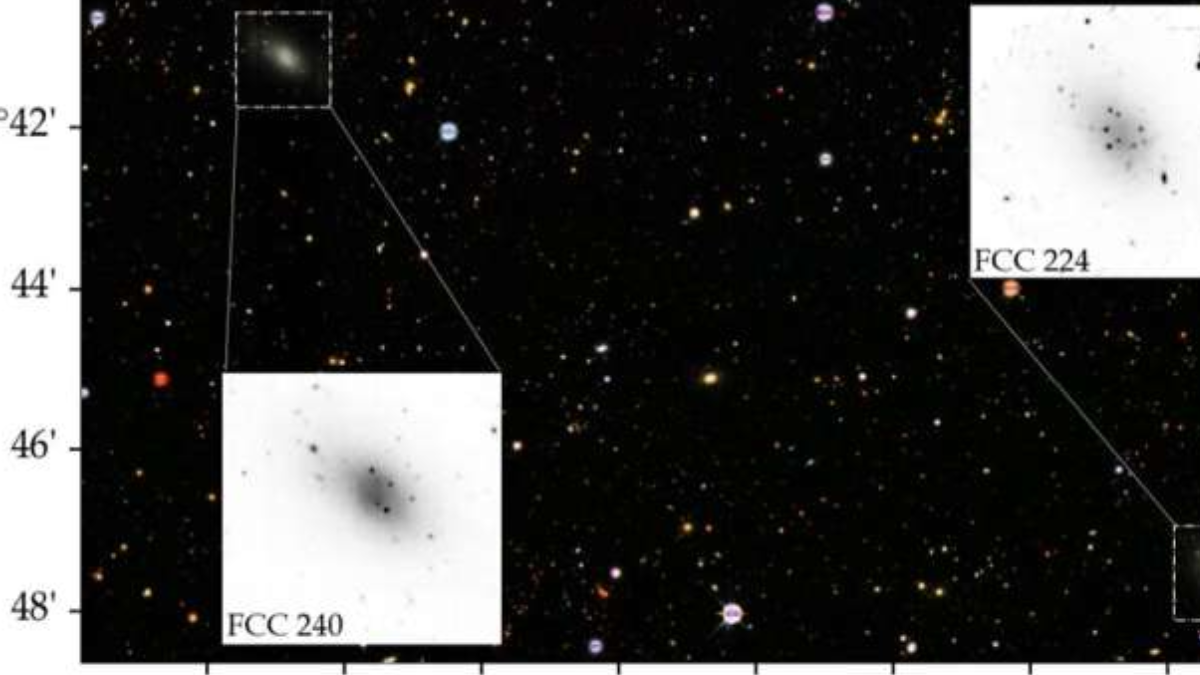
Photo Credit: Maria Luisa Buzzo
Local environment and MUSE coverage of the FCC 224/FCC 240 system.
Click Here to Add Gadgets360 As A Trusted Source


Advertisement
Galaxies are supposed to be kept together by dark matter, that invisible gravitational scaffold cosmologists say is essential for how they take shape and keep going. Yet, a fresh study points to two ghostlike galaxies on the outskirts of the Fornax Cluster, roughly 60 million light-years away, that appear to have almost none of it. This duo, FCC 224 and FCC 240, might end up being the universe's second known case of twin galaxies that are low on dark matter.
Galaxies Born From Chaos
In research led by Yale University's Maria Luísa Buzzo using the MUSE device attached to the ESO Very Large Telescope, the two galaxies were examined, with the findings uploaded to arXiv in May of 2026. This study investigates the validity of the so-called "bullet-dwarf" hypothesis, whereby high-velocity collisions involving dwarf galaxies deplete their stars of dark matter. Both FCC 224 and FCC 240 exhibit very low velocity dispersion rates – a clear indication of lacking dark matter – and highly luminous globular clusters, as predicted.
A Widening Crack in Cosmology
So far, they only really knew about one dark-matter-deficient galaxy pair—NGC 1052-DF2, along with NGC 1052-DF4, two ultra-diffuse galaxies sitting in the NGC 1052 group. These ultra-diffuse galaxies are kind of Milky Way- sized, but they host way fewer stars; most are thought to be dark-matter-rich “failed galaxies” that got shut off really early. Now, spotting a second candidate pair in another cluster makes it look like these weird cosmic underachievers could be more ordinary than we first thought. It also adds new stress to the usual cosmology scripts, because current models can't yet explain how a galaxy might shed so much of its dark matter.
Comments
Get your daily dose of tech news, reviews, and insights, in under 80 characters on Gadgets 360 Turbo. Connect with fellow tech lovers on our Forum. Follow us on X, Facebook, WhatsApp, Threads and Google News for instant updates. Catch all the action on our YouTube channel.
Further reading:
Dark Matter, Galaxy Formation, Fornax Cluster, FCC 224, FCC 240, Astronomy, Astrophysics, Cosmology, Yale University, ESO, Very Large Telescope, MUSE, Dwarf Galaxies, Galaxy Evolution, Space Science
Related Stories




Advertisement
Follow Us




-
01:15
[Sponsored] Galaxy Tab S10 Lite for Students: Notes, Solve Math and More -
04:17
[Sponsored] LG NANO 4K UHD AI TV NU885: Gemini Search, Dolby Atmos & 5 Years of Updates -
00:57
[Sponsored] Samsung Galaxy Z Fold8 My Fan Cam in Action: Find the Moment, Then Share It -
01:41
[Sponsored] What Do You Need To Know Before Your Next Run? | Samsung Galaxy Watch Ultra2 -
01:32
[Sponsored] Big Day Tomorrow? Prep Today | Samsung Galaxy Watch Ultra2
-
NVIDIA के सीईओ ने पेश किए माइक्रोडक रोबोट, AI से चलते हैं, क्या काम आएंगे
-
iPhone Duo को बीच से खोला, फोल्डेबल डिस्प्ले से हटाया कवर, फिर क्या दिखा?
-
1 जनवरी से फोन में बिना सिम नहीं चलेगा WhatsApp, सिम बाइडिंग हुआ अनिवार्य
-
Oppo Reno 17 सीरीज के लॉन्च की तैयारी, NBTC पर हुई लिस्टिंग
-
Oppo Find X10 vs Google Pixel 11 Pro XL vs Samsung Galaxy S26 Ultra: किस फोन में हैं ज्यादा दमदार फीचर्स
Advertisement
Popular on Gadgets
- Samsung Galaxy S26 Ultra
- Motorola Razr Fold
- ChatGPT
- OPPO Find N6
- Mobiles Under Rs. 40,000
- Vivo X300 Ultra
- Asus Zenbook S14
- iQOO 15
- Vivo X300 Pro
- Lenovo Yoga Slim 7i Aura Edition
- iQOO 15R
- Vivo X Fold 5
- Sony PlayStation 5
- HP OmniPad 12
- OnePlus Nord CE 6 Lite
- OnePlus Pad 4
- OPPO F33 Pro 5G
- Cryptocurrency
- HP OmniBook Ultra 14 (2026)
- iPhone 17
- Eureka Forbes AP 355 Room Air Purifier
- Latest Mobile Phones
- Compare Phones
Latest Gadgets
- HMD 2660 Flip Senior Edition
- Lava Aura Curve
- Poco X8s
- Samsung Galaxy F70 5G
- Tecno Spark 50S 5G
- Vivo Y600s Pro
- Vivo Y32 (2026)
- Infinix Smart 20 HD
- Lenovo Yoga 9n 2-in-1
- Lenovo Yoga Pro 9n
- Amazon Alexa Tablet 8
- Amazon Alexa Tablet 11
- Pebble Qore 2
- Amazfit T-Rex Dual Solar
- Toshiba 65-Inch 4K Ultra HD Smart Mini LED QLED TV (65Z670SP)
- Haier M70 Mini LED 65-inch
- Acer Predator Atlas 8
- Asus ROG Ally
- Blue Star 1.5 Ton 5 Star Inverter Split AC (IE518ZNURS)
- Blue Star 2 Ton 3 Star Inverter Window AC (WIE324L)

- About Us
- Sitemaps
- Feedback
- Archives
- Contact Us
- RSS
- Advertise
- Career
- Privacy Policy
- Ethics
- Editorial Policy
- Terms & Conditions
- Complaint Redressal
Download Our Apps
Available in Hindi
© Copyright Red Pixels Ventures Limited 2026. All rights reserved.