- Home
- Science
- Science News
- New Ionic Liquid Breaks Stability Barrier for Perovskite Solar Cells
New Ionic Liquid Breaks Stability Barrier for Perovskite Solar Cells
Scientists have developed a tailored ionic liquid that stabilises perovskite solar cells, allowing them to retain about 90% efficiency after 1,500 hours at 90°C under continuous light, overcoming a major hurdle to commercial adoption.
Written by Gadgets 360 Staff | Updated: 22 December 2025 21:50 IST
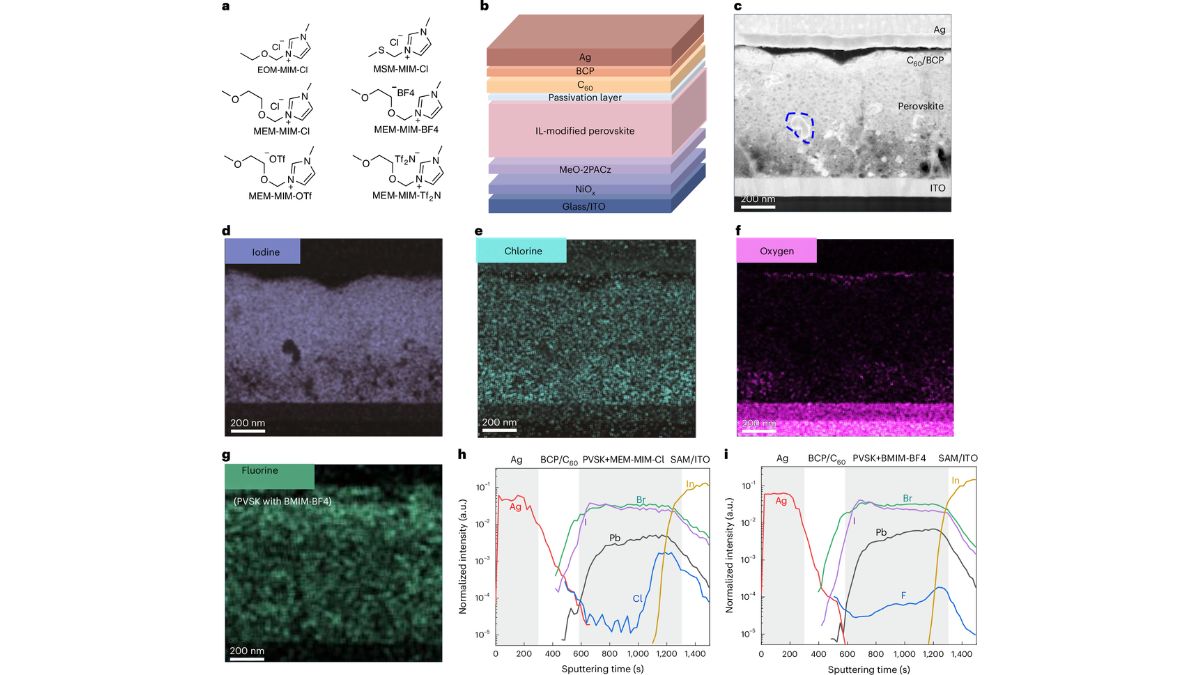
Photo Credit: Wikimedia Commons
Custom ionic liquid enhances perovskite stability, 90% efficiency 1,500 hours at 90°C
Click Here to Add Gadgets360 As A Trusted Source


Advertisement
Researchers from Purdue University and Emory University have announced an ionic liquid additive that significantly retards the breakdown of halide perovskite solar cells. Perovskite PV is a technology that has the promise of inexpensive but high-efficiency solar energy, although it generally fails quickly in high heat and light. This group demonstrated that cells in which the new additive was added retained approximately 90 percent of their activity at 90 °C after 1,500 hours of continuous light activity.
Tailored ionic-liquid additive
According to the paper, the researchers synthesised a custom ionic liquid, methoxyethoxymethyl-1-methylimidazole chloride (MEM-MIM-Cl), with an ethylene glycol ether side chain designed to “tune” perovskite crystal growth and stabilise buried interfaces (e.g., at the NiOx layer). When added to the perovskite precursor, MEM-MIM-Cl induces an intermediate crystalline phase by chelating undercoordinated lead ions. This dramatically lowers defect density and passivates trap sites. By curing up these defects, the additive slows the degradation pathways (from heat, light, or moisture) that normally shorten device lifetimes.
Record-breaking stability under heat
The best cells treated with MEM-MIM-Cl achieved 25.9% power conversion efficiency in laboratory tests, and after 1,500 hours at 90°C under one-sun illumination, they retained roughly 90% of that output. These outcomes significantly surpass earlier stability benchmarks. In contrast, a 2024 study discovered that a polymerised ionic-liquid additive allowed a perovskite cell to sustain approximately 87.6% of its efficiency following 1,500 hours of continuous light.
The Purdue team points out that MEM-MIM-Cl is compatible with large-scale manufacturing because it can be readily synthesised and applied using conventional solution processes (like blade coating).
Comments
Get your daily dose of tech news, reviews, and insights, in under 80 characters on Gadgets 360 Turbo. Connect with fellow tech lovers on our Forum. Follow us on X, Facebook, WhatsApp, Threads and Google News for instant updates. Catch all the action on our YouTube channel.
Further reading:
perovskite solar cells, ionic liquids, solar energy research, photovoltaic stability, clean energy materials, Purdue University, Emory University


Advertisement
Follow Us




-
03:41
[Sponsored] Samsung Galaxy Z Fold8: How It Fits Into an Actor’s Busy Day | Camera, Multitasking & More -
09:53
iPhone 18 Goes On Sale In India: Huge Crowds, Long Queues At Apple Stores -
06:32
Google Pixel 11 Pro XL Review: The Most Exciting Pixel Yet? | 120X Zoom + Tensor G6 -
05:20
Samsung Galaxy Watch Ultra 2 Review: Is This the Best Android Smartwatch? -
07:01
Samsung Galaxy Z Fold 8 Review: Is This the Best Foldable Phone?
-
Motorola Signature 27 हुआ लॉन्च; 200MP कैमरा के साथ मिलेगा पावरफुल चिप
-
Amazon Great Indian Festival Sale: ₹20 हजार तक सस्ता iPhone 16!
-
Ai+ Nova 2 Power 5G की आज से सेल शुरू, ₹16 हजार में 7000mAh बैटरी
-
Xiaomi 18 Pro Max हुआ लॉन्च, 2 डिस्प्ले के साथ मिलेगी 8500mAh की तगड़ी बैटरी और 200MP के 2 कैमरे
-
Redmi के 10000mAh बैटरी वाले Note 17 Pro Max 5G की सेल शुरू, ₹5,000 डिस्काउंट पर यहां से खरीदें
Advertisement
Popular on Gadgets
- Samsung Galaxy S26 Ultra
- Motorola Razr Fold
- ChatGPT
- OPPO Find N6
- Mobiles Under Rs. 40,000
- Vivo X300 Ultra
- Asus Zenbook S14
- iQOO 15
- Vivo X300 Pro
- Lenovo Yoga Slim 7i Aura Edition
- iQOO 15R
- Vivo X Fold 5
- Sony PlayStation 5
- HP OmniPad 12
- OnePlus Nord CE 6 Lite
- OnePlus Pad 4
- OPPO F33 Pro 5G
- Cryptocurrency
- HP OmniBook Ultra 14 (2026)
- iPhone 17
- Eureka Forbes AP 355 Room Air Purifier
- Latest Mobile Phones
- Compare Phones
Latest Gadgets
- Xiaomi 18 Pro Max
- Motorola Signature 27
- OPPO Find X10 E
- OnePlus N6 Lite 4G
- Ai+ Nova 2 Power 5G
- Lava Virat Curve 5G
- Lava Bold N4 Pro 5G
- Samsung Galaxy A08
- Lenovo LOQ 15AHP11
- Lenovo Legion 5a (2026)
- Xiaomi Pad 9 Pro
- Xiaomi Pad 9
- OPPO Watch S2
- Vivo Watch 6
- Haier M70 Mini LED 65-inch
- Xiaomi TV FX Mini LED 65
- Acer Predator Atlas 8
- Asus ROG Ally
- Blue Star 1.5 Ton 5 Star Inverter Split AC (IE518ZNURS)
- Blue Star 2 Ton 3 Star Inverter Window AC (WIE324L)

- About Us
- Sitemaps
- Feedback
- Archives
- Contact Us
- RSS
- Advertise
- Career
- Privacy Policy
- Ethics
- Editorial Policy
- Terms & Conditions
- Complaint Redressal
Download Our Apps
Available in Hindi
© Copyright Red Pixels Ventures Limited 2026. All rights reserved.