-
 JWST Reveals Salt Clouds in the Atmosphere of the ‘Pink Planet’ GJ 504b21 June 2026
 -
JWST Watches HD 80606 bExoplanet Heat Up by 1,100 Degrees in Hours19 June 2026
-
Scientists May Have Solved the Missing Sulfur Mystery in Star-Forming Clouds16 June 2026
-
Astronomers Discover Why Massive Galaxies Died Early in the Universe13 June 2026
-
JWST Reveals the True Identity of Mysterious Little Red Dots11 June 2026
- Home
- Science
- Science News
- James Webb Space Telescope Reveals Cosmic Buckyballs in Distant Nebula
James Webb Space Telescope Reveals Cosmic Buckyballs in Distant Nebula
Astronomers using the James Webb Space Telescope have captured detailed images of buckyballs—soccer ball-shaped carbon molecules—in a distant planetary nebula.
Written by Gadgets 360 Staff | Updated: 28 April 2026 20:29 IST
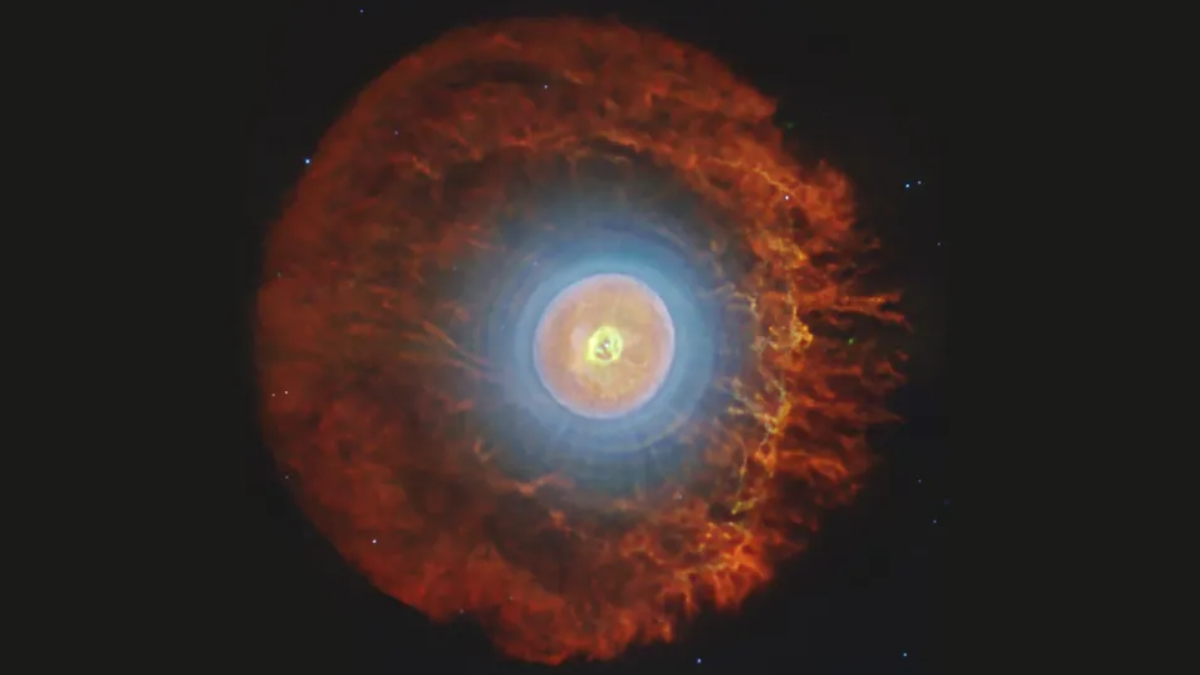
Photo Credit: NASA
An image shows planetary nebula Tc 1 as observed by the James Webb Space Telescope's.
Click Here to Add Gadgets360 As A Trusted Source


Advertisement
After a sun-like star has burnt through its nuclear fuel, it does not simply disappear but instead sheds its outer layers into space and emits glowing gas – a planetary nebula. The cosmos' most puzzling carbon molecules, buckyballs, were discovered in a nebula, 10000 light-years away in the constellation Ara. According to NASA scientists, the James Webb Space Telescope (JWST) took the most detailed pictures of its birthplace so far.
What Are Buckyballs?
The research work on planetary nebula Tc 1, led by Professor Jan Cami of Western University, used the Mid-Infrared Instrument (MIRI) of the JWST. Buckyballs, which refer to buckminsterfullerene, are carbon molecules that form a hollow ball arrangement similar to that of a soccer ball. The ball has 60 atoms that are geometrically arranged in pentagons and hexagons. Harry Kroto's team at the University of Sussex first synthesized fullerenes in 1985, which won the Nobel Prize in Chemistry, and have now been confirmed in space. Overall, they are a class of organic compounds that could be building blocks of life.
What JWST Revealed
The JWST's fine infrared vision has improved scientists' understanding of Tc 1. The images show a bright shell and its wispy filaments. It is also home to a puzzling upside-down question mark that they can't explain yet. Importantly, the buckyballs are not contextually dispersed randomly; they are instead arranged in a thin shell around the center of the white dwarf. PhD candidate Morgan Giese describes this as buckyballs that are arranged like one giant buckyball. Spectroscopic data have also captured infrared emissions that are unexpected and that current models can't explain. The team has acquired more telescope time to analyze two other nebulae.
Comments
Get your daily dose of tech news, reviews, and insights, in under 80 characters on Gadgets 360 Turbo. Connect with fellow tech lovers on our Forum. Follow us on X, Facebook, WhatsApp, Threads and Google News for instant updates. Catch all the action on our YouTube channel.
Further reading:
James Webb Space Telescope, JWST, buckyballs, fullerenes, planetary nebula, Tc 1, carbon molecules, astrophysics, space chemistry, astronomy
Related Stories


Advertisement
Follow Us




-
01:42
[Sponsored] Galaxy Watch9 for Everyday Health Insights | Smarter Wellness Choices -
01:15
[Sponsored] Galaxy Tab S10 Lite for Students: Notes, Solve Math and More -
04:17
[Sponsored] LG NANO 4K UHD AI TV NU885: Gemini Search, Dolby Atmos & 5 Years of Updates -
00:57
[Sponsored] Samsung Galaxy Z Fold8 My Fan Cam in Action: Find the Moment, Then Share It -
01:41
[Sponsored] What Do You Need To Know Before Your Next Run? | Samsung Galaxy Watch Ultra2
Advertisement
Popular on Gadgets
- Samsung Galaxy S26 Ultra
- Motorola Razr Fold
- ChatGPT
- OPPO Find N6
- Mobiles Under Rs. 40,000
- Vivo X300 Ultra
- Asus Zenbook S14
- iQOO 15
- Vivo X300 Pro
- Lenovo Yoga Slim 7i Aura Edition
- iQOO 15R
- Vivo X Fold 5
- Sony PlayStation 5
- HP OmniPad 12
- OnePlus Nord CE 6 Lite
- OnePlus Pad 4
- OPPO F33 Pro 5G
- Cryptocurrency
- HP OmniBook Ultra 14 (2026)
- iPhone 17
- Eureka Forbes AP 355 Room Air Purifier
- Latest Mobile Phones
- Compare Phones
Latest Gadgets
- Vivo Y600
- HMD 2660 Flip Senior Edition
- Lava Aura Curve
- Poco X8s
- Samsung Galaxy F70 5G
- Tecno Spark 50S 5G
- Vivo Y600s Pro
- Vivo Y32 (2026)
- Lenovo Yoga 9n 2-in-1
- Lenovo Yoga Pro 9n
- iPad mini (2026)
- Amazon Alexa Tablet 8
- Pebble Qore 2
- Amazfit T-Rex Dual Solar
- Toshiba 65-Inch 4K Ultra HD Smart Mini LED QLED TV (65Z670SP)
- Haier M70 Mini LED 65-inch
- Acer Predator Atlas 8
- Asus ROG Ally
- Blue Star 1.5 Ton 5 Star Inverter Split AC (IE518ZNURS)
- Blue Star 2 Ton 3 Star Inverter Window AC (WIE324L)

- About Us
- Sitemaps
- Feedback
- Archives
- Contact Us
- RSS
- Advertise
- Career
- Privacy Policy
- Ethics
- Editorial Policy
- Terms & Conditions
- Complaint Redressal
Download Our Apps
Available in Hindi
© Copyright Red Pixels Ventures Limited 2026. All rights reserved.