-
 Uranus’ Outer Rings May Reveal Hidden Moons, Scientists Say24 April 2026
 -
NASA’s Webb Telescope Confirms Asteroid 2024 YR4 Will Safely Pass the Moon in 20329 March 2026
-
NASA's James Webb Space Telescope Confirms Asteroid 2024 YR4 Will Not Strike the Moon6 March 2026
-
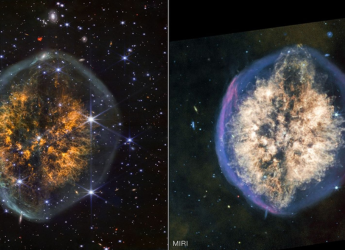
James Webb Telescope Captures Stunning Infrared View of Exposed Cranium Nebula26 February 2026
-
James Webb Telescope Maps Uranus in 3D for the First Time; Data Reveals Hidden Storms, Methane Clouds25 February 2026
- Home
- Science
- Science News
- James Webb Telescope Captures Rare Infrared Footprints of Io and Ganymede Inside Jupiter’s Auroras
James Webb Telescope Captures Rare Infrared Footprints of Io and Ganymede Inside Jupiter’s Auroras
The findings suggest that the gas giant's atmosphere reacts instantly to activity involving its orbiting moons.
Written by Gadgets 360 Staff | Updated: 11 March 2026 20:56 IST

Photo Credit: NASA
Recent research has given evidence that Jupiter was twice its current size in the past
Click Here to Add Gadgets360 As A Trusted Source


Advertisement
Jupiter produces the strongest auroras in the solar system. These features glow brightly around its poles as energetic particles crash into the giant planet's atmosphere. New observations have now revealed that Jupiter's moons can disturb this glowing display in unexpected ways. Scientists using the James Webb Space Telescope (JWST) have identified unusual "cold footprints" forming inside the auroras. This effect is caused by the interaction between the moons and Jupiter's immense magnetic field.
The findings suggest that the gas giant's atmosphere reacts instantly to activity involving its orbiting moons. Such interactions produce rapidly changing patterns of temperature and charged particle density.
Jupiter's Moons Drive Powerful Auroral Footprints Through Magnetic Interactions
According to researchers at Northumbria University, scientists evaluating data from the James Webb Space Telescope have observed that Jupiter's four largest moons, Io, Europa, Ganymede, and Callisto, significantly influence the planet's magnetic environment. As these moons interact with Jupiter's magnetic field, they funnel charged particles into the atmosphere, creating glowing auroral footprints directly linked to their orbital positions.
Io, the most volcanically active body in the solar system, emits vast quantities of charged particles that form the Io plasma torus around Jupiter. As the Galilean moons pass through this torus and the planet's magnetic field, ions are driven into the atmosphere, further strengthening the auroras.
Webb Observations Reveal Sudden Cold Spot and Rapid Particle Surges in Jupiter's Auroras
While analysing five images from September 2023, scientists spotted a cold region beneath Io's auroral footprint. Temperatures dropped to 509°F, while ion density surged, reaching nearly 45 times higher than nearby auroral regions.
Researchers found that the temperature and particle density within Io's auroral footprint changed within minutes. This indicates the presence of unstable, energetic electrons along Jupiter's magnetic field lines and demonstrates that the planet's atmosphere responds strongly to surrounding space activity.
While Earth's moon does not affect our auroras, Saturn's moon Enceladus likely does. Studying such interactions helps scientists understand the profound ways in which giant planets and their moons influence each other.
Comments
Get your daily dose of tech news, reviews, and insights, in under 80 characters on Gadgets 360 Turbo. Connect with fellow tech lovers on our Forum. Follow us on X, Facebook, WhatsApp, Threads and Google News for instant updates. Catch all the action on our YouTube channel.
Related Stories




James Webb Telescope Captures Rare Infrared Footprints of Io and Ganymede Inside Jupiter’s Auroras


Advertisement
Follow Us




-
04:49
Realme 16 Review: Air Design, 7000mAh, And More | Best Phone Under 35000 In 2026? -
05:05
Goboult Mustang Racer Smartwatch Review: Should You Get This Mustang Smartwatch? -
04:58
OnePlus Nord Buds 4 Pro Review: Specs, Sound Quality, ANC, and Battery Backup Tested -
02:29
[Sponsored] Samsung Galaxy S26 Ultra First Look: AI Smartphone for Creators, Gaming & Productivity -
04:25
Vivo X200T Review - Full Camera, Gaming & Battery Test | Worth Buying?
Advertisement
Popular on Gadgets
- Samsung Galaxy Unpacked 2026
- iPhone 17 Pro Max
- ChatGPT
- iOS 26
- Laptop Under 50000
- Smartwatch Under 10000
- Apple Vision Pro
- Oneplus 12
- OnePlus Nord CE 3 Lite 5G
- iPhone 13
- Xiaomi 14 Pro
- Oppo Find N3
- Tecno Spark Go (2023)
- Realme V30
- Best Phones Under 25000
- Samsung Galaxy S24 Series
- Cryptocurrency
- iQoo 12
- Samsung Galaxy S24 Ultra
- Giottus
- Samsung Galaxy Z Flip 5
- Apple 'Scary Fast'
- Housefull 5
- GoPro Hero 12 Black Review
- Invincible Season 2
- JioGlass
- HD Ready TV
- Latest Mobile Phones
- Compare Phones
Latest Gadgets
- Infinix GT 50 Pro
- Vivo Y6 5G
- Vivo Y05 5G
- Poco C81x
- Poco C81
- Honor 600
- Honor 600 Pro
- OPPO Find X9s
- Honor Win H9 Gaming Laptop
- Honor Win H7 Gaming Laptop
- Honor MagicPad 3 Pro 12.3
- Redmi K Pad 2
- NoiseFit Diva Araya
- OPPO Watch X3 Mini
- Xiaomi TV S Mini LED 2026 (75-inch)
- Xiaomi TV S Mini LED 2026 (65-inch)
- Asus ROG Ally
- Nintendo Switch Lite
- Haier 1.6 Ton 5 Star Inverter Split AC (HSU19G-MZAID5BN-INV)
- Haier 1.6 Ton 5 Star Inverter Split AC (HSU19G-MZAIM5BN-INV)

- About Us
- Sitemaps
- Feedback
- Archives
- Contact Us
- RSS
- Advertise
- Career
- Privacy Policy
- Ethics
- Editorial Policy
- Terms & Conditions
- Complaint Redressal
Download Our Apps
Available in Hindi
© Copyright Red Pixels Ventures Limited 2026. All rights reserved.