-
 JWST Reveals Salt Clouds in the Atmosphere of the ‘Pink Planet’ GJ 504b21 June 2026
 -
JWST Watches HD 80606 bExoplanet Heat Up by 1,100 Degrees in Hours19 June 2026
-
Scientists May Have Solved the Missing Sulfur Mystery in Star-Forming Clouds16 June 2026
-
Astronomers Discover Why Massive Galaxies Died Early in the Universe13 June 2026
-
JWST Reveals the True Identity of Mysterious Little Red Dots11 June 2026
- Home
- Science
- Science News
- NASA's James Webb Space Telescope Confirms Asteroid 2024 YR4 Will Not Strike the Moon
NASA's James Webb Space Telescope Confirms Asteroid 2024 YR4 Will Not Strike the Moon
New observations from the James Webb Space Telescope confirm asteroid 2024 YR4 will not strike the Moon in 2032. NASA scientists refined the object’s orbit using infrared data, showing it will pass about 21,200 km from the lunar surface.
Written by Gadgets 360 Staff | Updated: 6 March 2026 15:15 IST
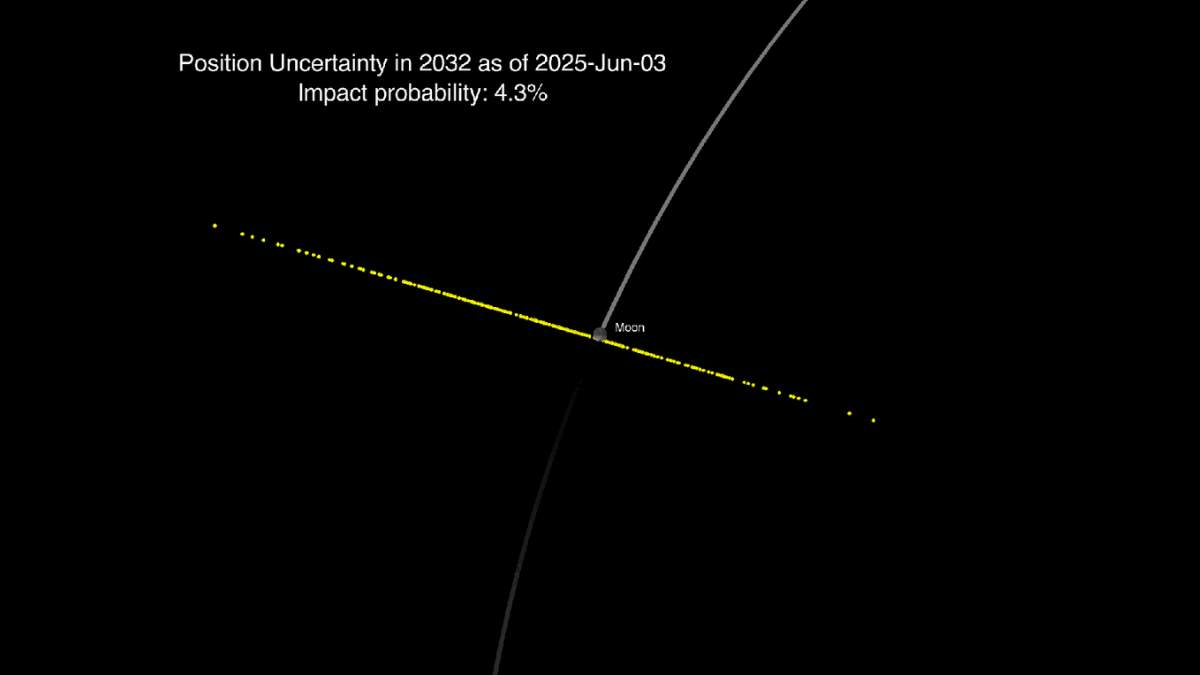
Photo Credit: NASA
Webb data refines asteroid 2024 YR4’s path, ruling out a lunar impact in 2032.
Click Here to Add Gadgets360 As A Trusted Source


Advertisement
NASA confirmed that new observations using the James Webb Space Telescope eliminated the possibility of asteroid 2024 YR4 impacting the Moon on 22 December 2032. Based on this new data, the asteroid is said to safely fly past the Moon at a distance of 21,200 km from the lunar surface. NASA's planetary defence experts note that this new information is based on improved precision in the asteroid's orbit, rather than a change in the asteroid's path, with the original 4.3 percent impact probability now being zero.
Webb observations refine asteroid's orbit
According to NASA, the Johns Hopkins APL team used the Webb Telescope on the 18th and 26th of February, 2026, to obtain two vital observations of the asteroid 2024 YR4. The asteroid has been too faint for other telescopes to detect, but the Webb Telescope's infrared technology detected the asteroid among the “faintest ever” observed for an asteroid. Using the data, NASA scientists were able to refine the asteroid's orbit.
The asteroid, 2024 YR4, was initially detected by the ATLAS survey in late 2024, with a “small, but notable” risk of impacting Earth, although global tracking has eliminated the threat of impact in 2032 or any other future time.
Asteroid threat assessment and planetary defence
To assess the threats, international collaboration is necessary, along with constant sharing of data. The data obtained from survey telescopes around the globe are used by NASA, with centres like JPL using CNEOS to calculate the probability of a potential impact. If a potential threat is identified, NASA's Planetary Defence Coordination Office (PDCO) notifies all international partners via the Asteroid Warning Network. Long-term measures to defend against asteroids involve surveys, such as the NEO Surveyor, and deflection tests, like DART. Nevertheless, the primary line of defence is detection.
Comments
Get your daily dose of tech news, reviews, and insights, in under 80 characters on Gadgets 360 Turbo. Connect with fellow tech lovers on our Forum. Follow us on X, Facebook, WhatsApp, Threads and Google News for instant updates. Catch all the action on our YouTube channel.
Related Stories


Advertisement
Follow Us




-
04:17
[Sponsored] LG NANO 4K UHD AI TV NU885: Gemini Search, Dolby Atmos & 5 Years of Updates -
00:57
[Sponsored] Samsung Galaxy Z Fold8 My Fan Cam in Action: Find the Moment, Then Share It -
01:41
[Sponsored] What Do You Need To Know Before Your Next Run? | Samsung Galaxy Watch Ultra2 -
01:32
[Sponsored] Big Day Tomorrow? Prep Today | Samsung Galaxy Watch Ultra2 -
04:37
[Sponsored]: CP PLUS CarKam CP-F89B: 4K Dashcam With Rear Camera, GPS & Emergency Recording
Advertisement
Popular on Gadgets
- Samsung Galaxy S26 Ultra
- Motorola Razr Fold
- ChatGPT
- OPPO Find N6
- Mobiles Under Rs. 40,000
- Vivo X300 Ultra
- Asus Zenbook S14
- iQOO 15
- Vivo X300 Pro
- Lenovo Yoga Slim 7i Aura Edition
- iQOO 15R
- Vivo X Fold 5
- Sony PlayStation 5
- HP OmniPad 12
- OnePlus Nord CE 6 Lite
- OnePlus Pad 4
- OPPO F33 Pro 5G
- Cryptocurrency
- HP OmniBook Ultra 14 (2026)
- iPhone 17
- Eureka Forbes AP 355 Room Air Purifier
- Latest Mobile Phones
- Compare Phones
Latest Gadgets
- Samsung Galaxy F70 5G
- Tecno Spark 50S 5G
- Vivo Y600s Pro
- Vivo Y32 (2026)
- Infinix Smart 20 HD
- Vivo V80
- Vivo S2 FE
- Vivo Y600K Turbo
- HP ZBook Ultra G3a
- Dell Pro Rugged 14
- Amazon Alexa Tablet 8
- Amazon Alexa Tablet 11
- Amazfit T-Rex Dual Solar
- OPPO Watch S2
- Toshiba 65-Inch 4K Ultra HD Smart Mini LED QLED TV (65Z670SP)
- Haier M70 Mini LED 65-inch
- Acer Predator Atlas 8
- Asus ROG Ally
- Blue Star 1.5 Ton 5 Star Inverter Split AC (IE518ZNURS)
- Blue Star 2 Ton 3 Star Inverter Window AC (WIE324L)

- About Us
- Sitemaps
- Feedback
- Archives
- Contact Us
- RSS
- Advertise
- Career
- Privacy Policy
- Ethics
- Editorial Policy
- Terms & Conditions
- Complaint Redressal
Download Our Apps
Available in Hindi
© Copyright Red Pixels Ventures Limited 2026. All rights reserved.