-
 JWST Reveals Salt Clouds in the Atmosphere of the ‘Pink Planet’ GJ 504b21 June 2026
 -
JWST Watches HD 80606 bExoplanet Heat Up by 1,100 Degrees in Hours19 June 2026
-
Scientists May Have Solved the Missing Sulfur Mystery in Star-Forming Clouds16 June 2026
-
Astronomers Discover Why Massive Galaxies Died Early in the Universe13 June 2026
-
JWST Reveals the True Identity of Mysterious Little Red Dots11 June 2026
- Home
- Science
- Science News
- James Webb Telescope Captures Stunning Infrared View of Exposed Cranium Nebula
James Webb Telescope Captures Stunning Infrared View of Exposed Cranium Nebula
The James Webb Space Telescope has captured detailed infrared images of PMR 1, nicknamed the “Exposed Cranium.” Located about 5,000 light-years away in Vela, the planetary nebula reveals a glowing inner core and outer hydrogen shell formed as a dying star sheds its material.
Written by Gadgets 360 Staff | Updated: 26 February 2026 21:56 IST
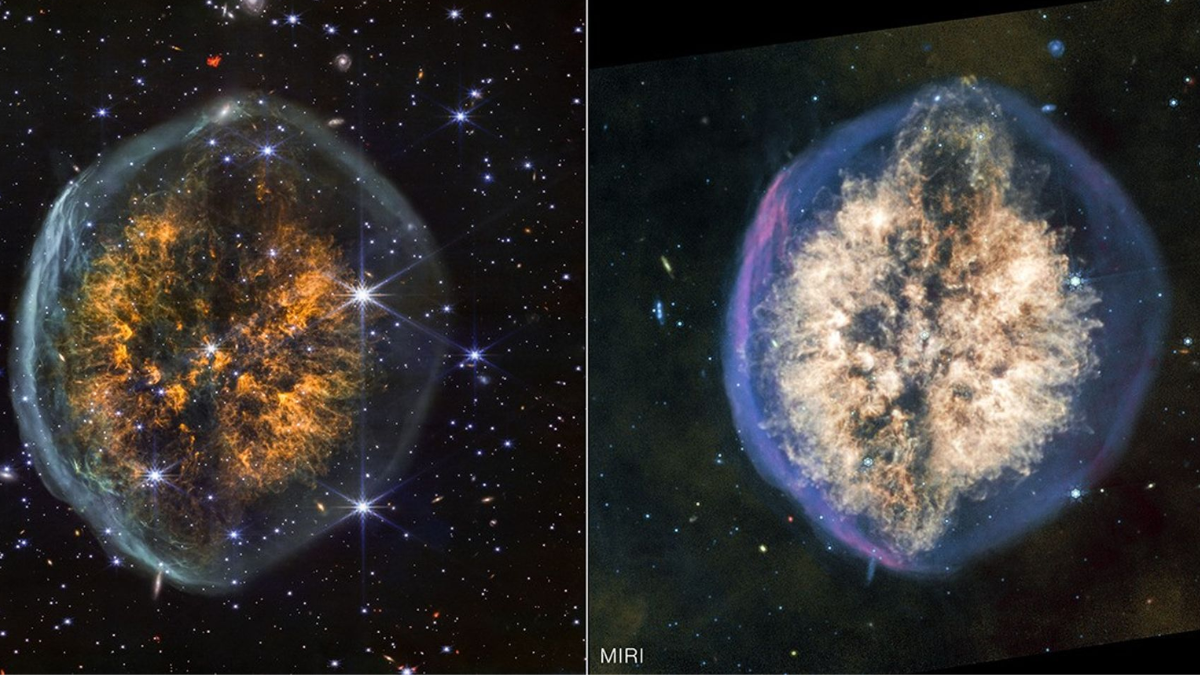
Photo Credit: NASA
Webb’s NIRCam reveals stars and galaxies, while MIRI highlights glowing dust in PMR 1.
Click Here to Add Gadgets360 As A Trusted Source


Advertisement
NASA's James Webb Space Telescope captured infrared images of a nebula called the “Exposed Cranium” (PMR 1), a cloud of gas and dust around an ageing star. Webb's cameras reveal an inner “brain” region and an outer shell of gas in striking detail. Astronomers first spotted PMR 1 more than a decade ago with the Spitzer Space Telescope, and Webb's new data provide much greater detail and resolution.
Webb's Revealing View
According to NASA, the PMR 1 nebula exists in the southern constellation Vela at a distance of approximately 5000 light-years from Earth. The nebula appears to Webb's near-infrared and mid-infrared images as a see-through skull which contains a luminous "brain" within. The telescope detects an external hydrogen gas bubble which surrounds an internal gas cloud that contains mixed gases. The dark lane divides the nebula into two hemispheres, while it probably marks the path of materials which a dying star has ejected. The scientists observed the nebula because its appearance resembles a human skull and they used the observations to investigate the star's last explosive emissions.
A Star's Final Breath
This is a planetary nebula, which occurs when a mid-sized star sheds its outer material. These nebulae have a very short lifespan of 20,000 years. The images taken by the Webb telescope record this brief moment in the life cycle of a star. The life of the central star, depending on its mass, will end in a supernova explosion if it is massive or in the formation of a white dwarf if it is like our sun. In either scenario, the Exposed Cranium Nebula provides a colourful look at the end of a star's life.
Comments
Get your daily dose of tech news, reviews, and insights, in under 80 characters on Gadgets 360 Turbo. Connect with fellow tech lovers on our Forum. Follow us on X, Facebook, WhatsApp, Threads and Google News for instant updates. Catch all the action on our YouTube channel.
Further reading:
James Webb Space Telescope, PMR 1, Exposed Cranium Nebula, planetary nebula, Vela Constellation
Related Stories



Advertisement
Follow Us




-
04:37
[Sponsored]: CP PLUS CarKam CP-F89B: 4K Dashcam With Rear Camera, GPS & Emergency Recording -
04:23
[Partner Content] Your Phone Can Do WAY More Than You Think | OPPO ColorOS 16 -
01:59
Samsung Galaxy Z Fold8 Ultra: Unfold the Ultra Night -
03:24
Apple Pay Launches In India: Supported Devices, Cards And Payments Explained -
00:21
[Sponsored] Samsung Galaxy Z Fold8, Fold8 Ultra
-
OnePlus 16 लॉन्च: 200 मेगापिक्सल कैमरा, 9000mAh की बैटरी से लैस, जानें
-
Vivo का लेटेस्ट फोन Amazon Great Indian Festival में मिल रहा ₹6,300 सस्ता
-
Amazon Great Indian Festival: ₹51000 सस्ता मिल रहा Samsung फोल्डेबल फोन
-
JBL के Wi-Fi स्पीकर Cove M1, Cove P1, Cove X1 नए ग्लोबल मार्केट्स में लॉन्च, जानें खास फीचर
-
Amazon की ग्रेट इंडियन फेस्टिवल सेल में प्रीमियम स्मार्टफोन्स पर भारी डिस्काउंट
Advertisement
Popular on Gadgets
- Samsung Galaxy S26 Ultra
- Motorola Razr Fold
- ChatGPT
- OPPO Find N6
- Mobiles Under Rs. 40,000
- Vivo X300 Ultra
- Asus Zenbook S14
- iQOO 15
- Vivo X300 Pro
- Lenovo Yoga Slim 7i Aura Edition
- iQOO 15R
- Vivo X Fold 5
- Sony PlayStation 5
- HP OmniPad 12
- OnePlus Nord CE 6 Lite
- OnePlus Pad 4
- OPPO F33 Pro 5G
- Cryptocurrency
- HP OmniBook Ultra 14 (2026)
- iPhone 17
- Eureka Forbes AP 355 Room Air Purifier
- Latest Mobile Phones
- Compare Phones
Latest Gadgets
- Vivo Y600s Pro
- Vivo Y32 (2026)
- Infinix Smart 20 HD
- Vivo V80
- Vivo S2 FE
- Vivo Y600K Turbo
- Realme P4s Lite
- Vivo S60t
- Dell Pro Rugged 14
- Dell Pro Rugged 13 Extreme
- Amazon Alexa Tablet 8
- Amazon Alexa Tablet 11
- Amazfit T-Rex Dual Solar
- OPPO Watch S2
- Toshiba 65-Inch 4K Ultra HD Smart Mini LED QLED TV (65Z670SP)
- Haier M70 Mini LED 65-inch
- Acer Predator Atlas 8
- Asus ROG Ally
- Blue Star 1.5 Ton 5 Star Inverter Split AC (IE518ZNURS)
- Blue Star 2 Ton 3 Star Inverter Window AC (WIE324L)

- About Us
- Sitemaps
- Feedback
- Archives
- Contact Us
- RSS
- Advertise
- Career
- Privacy Policy
- Ethics
- Editorial Policy
- Terms & Conditions
- Complaint Redressal
Download Our Apps
Available in Hindi
© Copyright Red Pixels Ventures Limited 2026. All rights reserved.