-
 Jurassic World: Bryce Dallas Howard Confirms Huge Pay Gap Compared to Co-Lead Chris Pratt16 August 2022
 -
Gap Launches Its First NFT Collection on Tezos Blockchain13 January 2022
-
Pixel 5 Gap Issue ‘Normal Part of Design’, Does Not Affect Water and Dust Resistance: Google4 November 2020
-
Google Pixel 5 Units Have Gap Between Display and Frame, Some Early Users Complain20 October 2020
-
Indian Women 28 Percent Less Likely Than Men to Own a Mobile Phone: GSMA20 February 2019
- Home
- Science
- Science News
- New Material to Increase Solar Cell Efficiency
New Material to Increase Solar Cell Efficiency
By Indo-Asian News Service | Updated: 20 July 2015 12:48 IST
Click Here to Add Gadgets360 As A Trusted Source

Advertisement
A team of researchers has come up with a solar cell that produces fuel rather than electricity. A material called gallium phosphide enables the solar cell to produce clean fuel hydrogen gas from liquid water.
To connect an existing silicon solar cell to a battery that splits the water may well be an efficient solution; but it is very expensive.
So, researchers were streamlining their search to a semi-conductor material that is able to both convert sunlight into an electrical charge and split water.
- Samsung Galaxy Z Fold8 camera vs Galaxy S26 Ultra: how big is the gap?
- Some TVs seem surprisingly expensive even with similar screen sizes. What usually causes the price gap?
- Gaming phones vs flagship phones gap narrowing
- Is paying extra for Sony worth it over Hisense?
- Is the new LG OLED worth the extra money?
The team found gallium phosphide (GaP), a compound of gallium and phosphide, useful in this respect.
GaP has good electrical properties but the drawback is that it cannot easily absorb light when it is a large flat surface as used in GaP solar cells, said the study that appeared in Nature Communications.
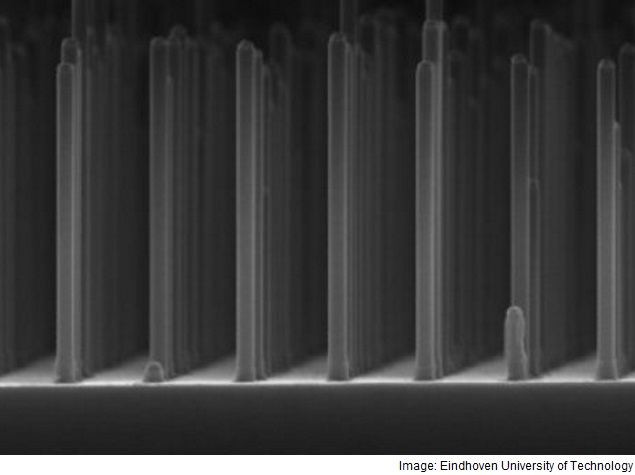
The researchers overcame this by making a grid of very small GaP nanowires, measuring five hundred nanometres (a millionth of a millimetre) long and ninety nanometres thick.
"That makes these kinds of cells potentially a great deal cheaper," said lead author Erik Bakkers from Eindhoven University of Technology, the Netherlands.
This immediately boosted the yield of hydrogen by a factor of ten to 2.9 percent.
"In short, for a solar fuel future, we cannot ignore gallium phosphide any longer," Bakkers added.
Comments
Get your daily dose of tech news, reviews, and insights, in under 80 characters on Gadgets 360 Turbo. Connect with fellow tech lovers on our Forum. Follow us on X, Facebook, WhatsApp, Threads and Google News for instant updates. Catch all the action on our YouTube channel.
Related Stories




Advertisement
Follow Us




-
![[Sponsored] LG NANO 4K UHD AI TV NU885: Gemini Search, Dolby Atmos & 5 Years of Updates](https://www.gadgets360.com/static/desktop/images/spacer.png)
04:17
[Sponsored] LG NANO 4K UHD AI TV NU885: Gemini Search, Dolby Atmos & 5 Years of Updates -
00:57
[Sponsored] Samsung Galaxy Z Fold8 My Fan Cam in Action: Find the Moment, Then Share It -
01:41
[Sponsored] What Do You Need To Know Before Your Next Run? | Samsung Galaxy Watch Ultra2 -
01:32
[Sponsored] Big Day Tomorrow? Prep Today | Samsung Galaxy Watch Ultra2 -
04:37
[Sponsored]: CP PLUS CarKam CP-F89B: 4K Dashcam With Rear Camera, GPS & Emergency Recording
-
iPhone 16 आज भी Amazon सेल में मिल रहा ₹15 हजार से ज्यादा सस्ता
-
OnePlus 15 को Amazon Great Indian Festival Sale में खरीदें सस्ता
-
₹2250 सस्ता मिल रहा Motorola का 7000mAh बैटरी वाला फोन! Flipkart पर ऑफर
-
₹18999 में मिल रहा Moto G Max फोन! 7000mAh बैटरी, Flipkart सेल में ऑफर
-
HMD Vibe 2 Max बजट फोन लॉन्च होगा 108MP कैमरा, 6,000mAh बैटरी फीचर के साथ!
Advertisement
Popular on Gadgets
- Samsung Galaxy S26 Ultra
- Motorola Razr Fold
- ChatGPT
- OPPO Find N6
- Mobiles Under Rs. 40,000
- Vivo X300 Ultra
- Asus Zenbook S14
- iQOO 15
- Vivo X300 Pro
- Lenovo Yoga Slim 7i Aura Edition
- iQOO 15R
- Vivo X Fold 5
- Sony PlayStation 5
- HP OmniPad 12
- OnePlus Nord CE 6 Lite
- OnePlus Pad 4
- OPPO F33 Pro 5G
- Cryptocurrency
- HP OmniBook Ultra 14 (2026)
- iPhone 17
- Eureka Forbes AP 355 Room Air Purifier
- Latest Mobile Phones
- Compare Phones
Latest Gadgets
- Samsung Galaxy F70 5G
- Tecno Spark 50S 5G
- Vivo Y600s Pro
- Vivo Y32 (2026)
- Infinix Smart 20 HD
- Vivo V80
- Vivo S2 FE
- Vivo Y600K Turbo
- HP ZBook Ultra G3a
- Dell Pro Rugged 14
- Amazon Alexa Tablet 8
- Amazon Alexa Tablet 11
- Amazfit T-Rex Dual Solar
- OPPO Watch S2
- Toshiba 65-Inch 4K Ultra HD Smart Mini LED QLED TV (65Z670SP)
- Haier M70 Mini LED 65-inch
- Acer Predator Atlas 8
- Asus ROG Ally
- Blue Star 1.5 Ton 5 Star Inverter Split AC (IE518ZNURS)
- Blue Star 2 Ton 3 Star Inverter Window AC (WIE324L)

- About Us
- Sitemaps
- Feedback
- Archives
- Contact Us
- RSS
- Advertise
- Career
- Privacy Policy
- Ethics
- Editorial Policy
- Terms & Conditions
- Complaint Redressal
Download Our Apps
Available in Hindi
© Copyright Red Pixels Ventures Limited 2026. All rights reserved.