-
 Carrington-Level Solar Storm Could Disrupt Satellites, GPS, and Power Grids, Scientists Warn14 April 2026
 -
Powerful X-Class Solar Flare Sends CME Toward Earth, Storms Possible22 January 2026
-
2026 Could Be the Best Year for Northern Lights; Why Post-Solar Maximum Storms Are Set to Surge4 January 2026
-
NOAA Issues G2 Solar Storm Watch; May Spark Auroras but Threaten Satellite Signals3 January 2026
-
Massive Sunspot Complex on the Sun Raises Risk of Strong Solar Storms9 December 2025
- Home
- Science
- Science News
- Scientists Trace Solar Storm Origins to Hidden Layer Deep Inside the Sun
Scientists Trace Solar Storm Origins to Hidden Layer Deep Inside the Sun
Scientists have traced the origin of solar storms to a thin layer deep inside the Sun called the tachocline. Using decades of data, researchers found magnetic activity begins far below the surface.
Written by Gadgets 360 Staff | Updated: 28 March 2026 17:00 IST
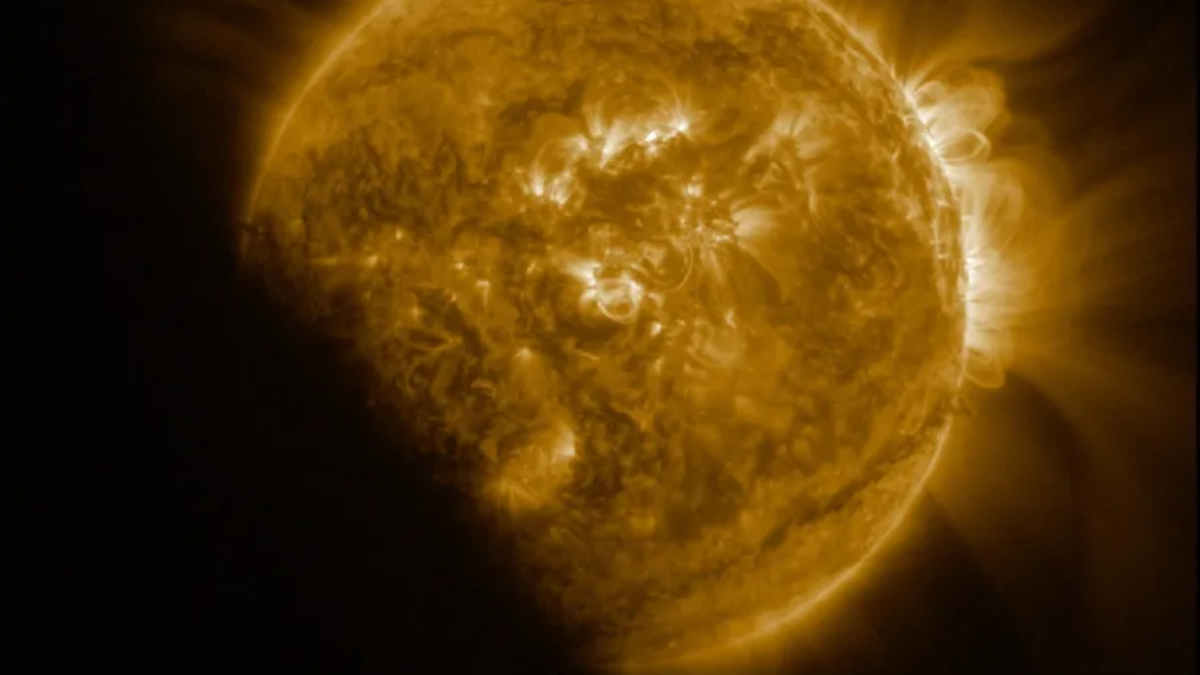
Photo Credit: NOAA
An image of the sun in space, with a dark shadow partially in front of it.
Click Here to Add Gadgets360 As A Trusted Source


Advertisement
The solar storms bring explosive releases of radiation and charged particles, which occur when solar activity reaches peak sunspot levels. The researchers need to find the source of the magnetic forces which create solar storms. Physicists at the New Jersey Institute of Technology have now identified the origin in a study published in Scientific Reports: a thin layer known as the tachocline, located about 200,000 kilometers or 16 widths of the Earth below the surface of the Sun.
Deep Shearing Motions Drive the Solar Cycle
According to the paper, the tachocline is a razor-thin transition zone between the turbulent outer convection zone and the stable radiative zone. The sudden changes in rotation trigger powerful shearing motions in the charged plasma. These are just right for boosting magnetic fields. Mandal and Kosovichev studied almost three decades' worth of acoustic data from NASA's SOHO satellite and the GONG network of telescopes on the ground. These can sense tiny ripples on the sun's surface caused by flows in the deep interior. The researchers found rotating bands of plasma in the tachocline take on a butterfly shape, echoing sunspot migration to the equator in each 11-year cycle.
Space Weather Forecasts
Solar flares and coronal mass ejections create operational problems for satellites and communications systems, and power grids which operate on Earth. Right now, many of the forecasting models only include near-surface solar processes. But the new research indicates that the whole convection zone, particularly the tachocline region, has to be taken into account. The sun's interior layer undergoes changes which require multiple years before they become visible on the surface. This development will enable scientists to detect upcoming dangerous solar events through precise early warning systems, which will provide them with early and accurate signals.
Comments
Get your daily dose of tech news, reviews, and insights, in under 80 characters on Gadgets 360 Turbo. Connect with fellow tech lovers on our Forum. Follow us on X, Facebook, WhatsApp, Threads and Google News for instant updates. Catch all the action on our YouTube channel.
Related Stories




Advertisement
Follow Us




-
14:16
[Partner Content] OPPO F33 Pro 5G Explained: Built for the Big Moments -
05:21
Poco X8 Pro Max Review | Is This the Ultimate Budget Beast? -
04:16
OnePlus Nord 6 Review | Full Honest Review, Camera Test, Performance & Battery -
05:17
Samsung Galaxy A57 Full Review: 50MP Triple Camera & 5000mAh Battery. Worth It? -
04:40
Google Pixel 10a | Don't Buy Before Watching This | Best Budget Phone or Overhyped?
Advertisement
Popular on Gadgets
- Samsung Galaxy Unpacked 2026
- iPhone 17 Pro Max
- ChatGPT
- iOS 26
- Laptop Under 50000
- Smartwatch Under 10000
- Apple Vision Pro
- Oneplus 12
- OnePlus Nord CE 3 Lite 5G
- iPhone 13
- Xiaomi 14 Pro
- Oppo Find N3
- Tecno Spark Go (2023)
- Realme V30
- Best Phones Under 25000
- Samsung Galaxy S24 Series
- Cryptocurrency
- iQoo 12
- Samsung Galaxy S24 Ultra
- Giottus
- Samsung Galaxy Z Flip 5
- Apple 'Scary Fast'
- Housefull 5
- GoPro Hero 12 Black Review
- Invincible Season 2
- JioGlass
- HD Ready TV
- Latest Mobile Phones
- Compare Phones
Latest Gadgets
- Itel Zeno 200
- OnePlus Nord CE 6 Lite
- OnePlus Nord CE 6
- Honor Play 70C
- Honor Play 80 Plus
- Moto G47
- Motorola Razr 2026
- Motorola Razr+ 2026
- HP OmniBook 5 (2026)
- HP OmniBook Ultra 14 (Snapdragon, 2026)
- HP OmniPad 12
- Acer Iconia iM11-22M5G
- NoiseFit Halo 3
- NoiseFit Diva Araya
- Lumio Vision 9 (2026)
- Lumio Vision 7 (2026)
- Asus ROG Ally
- Nintendo Switch Lite
- Blue Star 1.5 Ton 5 Star Inverter Split AC (IA518ZXUS)
- Blue Star 1.5 Ton 3 Star Inverter Split AC (IA318ZXU)

- About Us
- Sitemaps
- Feedback
- Archives
- Contact Us
- RSS
- Advertise
- Career
- Privacy Policy
- Ethics
- Editorial Policy
- Terms & Conditions
- Complaint Redressal
Download Our Apps
Available in Hindi
© Copyright Red Pixels Ventures Limited 2026. All rights reserved.