Anthropic Introduces Claude Opus 4.6 AI Model With Improved Agentic Performance
Anthropic’s Claude Opus 4.6 AI model brings improved coding, long-context handling, and agentic workflows.
Written by Akash Dutta, Edited by Rohan Pal | Updated: 6 February 2026 13:48 IST
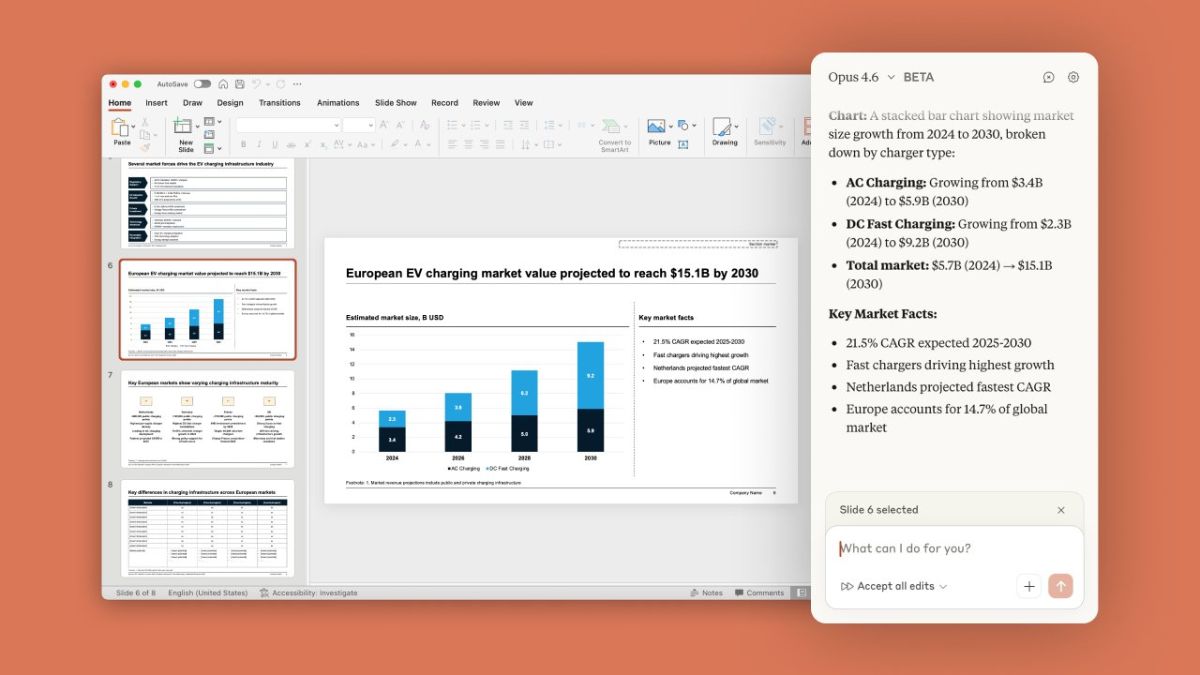
Photo Credit: Anthropic
Claude Opus 4.6 powers the new agent teams feature in Claude Code
Click Here to Add Gadgets360 As A Trusted Source

Advertisement
Anthropic released the Claude Opus 4.6 artificial intelligence (AI) model on Thursday, bringing a major update to its Opus 4 foundation model. The new model addresses key limitations in the predecessor by improving sustained performance across complex tasks, particularly in software engineering and knowledge-intensive domains. The Claude Opus 4.5 model was adept at handling advanced reasoning-based tasks, but often struggled with long-horizon contexts and edge cases in large databases. A beta version of Opus 4.6 fixes that with a context window of one million tokens.
Claude Opus 4.6 AI Model Is Here
In a newsroom post, Anthropic announced and detailed the latest frontier model. Marking a first for the Opus lineup, a beta version of the model now supports a context window of up to one million tokens, allowing it to process vast amounts of information while minimising performance degradation during long interactions. This is a step up from the 2,00,000 token limits in earlier Opus models.
Claude Opus 4.6 also comes with new features like context compaction that summarise and refresh older data during prolonged tasks. The architecture incorporates adaptive thinking, where the model assesses query complexity to allocate deeper reasoning as needed, and effort controls ranging from low to max for optimising speed, intelligence and cost.
On benchmarks, Claude Opus 4.6 sets new highs. Based on internal evaluations from the company, the post claims that the AI model leads frontier models on Terminal-Bench 2.0 for command-line proficiency, and Humanity's Last Exam for multidisciplinary reasoning. In agentic evaluations like GDPval-AA, it surpasses OpenAI's GPT-5.2 by about 144 Elo points and its own Opus 4.5 by 190 points, focusing on finance and legal tasks. SWE-bench Verified scores average 81.42 percent with optimised prompting, while CyberGym tests show strong no-thinking baseline performance.
Anthropic highlights that safeguards remain a core priority with the new model. It is said to match or exceed peers in safety audits, with low rates of deception or sycophancy and the lowest over-refusal tendencies among recent releases. The company said it added six new cybersecurity probes to detect potential misuse, accelerating defensive applications like vulnerability hunting in open-source code.
In coding, Opus 4.6 manages large repositories autonomously, conducts code reviews and debugs with high accuracy. It also assembles agent teams for parallel development via Claude Code's research preview. For business workflows, it runs financial analyses, generates documents and handles multi-step searches in tools like Claude in Excel, now upgraded for unstructured data and long-running tasks. A research preview for Claude in PowerPoint extends this to presentations. In domains like computational biology, it delivers nearly double the performance of Opus 4.5, aiding scientific discovery.
Claude Opus 4.6 is available now via the website, mobile and desktop apps, Anthropic's application programming interface (API), and major cloud providers. API pricing starts at $5 (roughly Rs. 453) per million input tokens and $25 (roughly Rs. 2,300) for output, with premiums for extended contexts.
Comments
Get your daily dose of tech news, reviews, and insights, in under 80 characters on Gadgets 360 Turbo. Connect with fellow tech lovers on our Forum. Follow us on X, Facebook, WhatsApp, Threads and Google News for instant updates. Catch all the action on our YouTube channel.


Advertisement
Follow Us




-

09:53
iPhone 18 Goes On Sale In India: Huge Crowds, Long Queues At Apple Stores -
06:32
Google Pixel 11 Pro XL Review: The Most Exciting Pixel Yet? | 120X Zoom + Tensor G6 -
05:20
Samsung Galaxy Watch Ultra 2 Review: Is This the Best Android Smartwatch? -
07:01
Samsung Galaxy Z Fold 8 Review: Is This the Best Foldable Phone? -
06:39
Samsung Galaxy Z Fold8 Ultra Review: Cameras, Battery, Performance Tested
-
10 मिनट में घर पहुंचेंगे iPhone 18 Pro, Pro Max: सेल हुई शुरू
-
Lava ने लॉन्च किया 6000mAh बैटरी वाला Bold N4 Pro 5G
-
itel Zeno 300 भारत में होगा लॉन्च, मिलेगी 6,000mAh बैटरी और डुअल कैमरा
-
Oppo A7 Pro Max 5G ग्लोबल मार्केट में लॉन्च, 50MP दो कैमरा, 10,000mAh बैटरी, IP69 रेटिंग!
-
Ai+ Nova 2 Power 5G भारत में हुआ लॉन्च, 48MP दो कैमरा, 7000mAh बैटरी के साथ, IP65 रेटिंग
Advertisement
Popular on Gadgets
- Samsung Galaxy S26 Ultra
- Motorola Razr Fold
- ChatGPT
- OPPO Find N6
- Mobiles Under Rs. 40,000
- Vivo X300 Ultra
- Asus Zenbook S14
- iQOO 15
- Vivo X300 Pro
- Lenovo Yoga Slim 7i Aura Edition
- iQOO 15R
- Vivo X Fold 5
- Sony PlayStation 5
- HP OmniPad 12
- OnePlus Nord CE 6 Lite
- OnePlus Pad 4
- OPPO F33 Pro 5G
- Cryptocurrency
- HP OmniBook Ultra 14 (2026)
- iPhone 17
- Eureka Forbes AP 355 Room Air Purifier
- Latest Mobile Phones
- Compare Phones
Latest Gadgets
- Lava Bold N4 Pro 5G
- Samsung Galaxy A08
- Itel Muzik 450L
- OPPO K14 Lite
- Samsung Galaxy A18 4G
- iPhone Duo
- OPPO A7 Pro
- Huawei Mate XT 2 Ultimate Design
- Asus Vivobook S14 (S5452MA)
- Acer Aspire G 3D 16
- Xiaomi Pad 9 Pro
- Xiaomi Pad 9
- Apple Watch Ultra 4
- Apple Watch Series 12
- Haier M70 Mini LED 65-inch
- Xiaomi TV FX Mini LED 65
- Acer Predator Atlas 8
- Asus ROG Ally
- Blue Star 1.5 Ton 5 Star Inverter Split AC (IE518ZNURS)
- Blue Star 2 Ton 3 Star Inverter Window AC (WIE324L)

- About Us
- Sitemaps
- Feedback
- Archives
- Contact Us
- RSS
- Advertise
- Career
- Privacy Policy
- Ethics
- Editorial Policy
- Terms & Conditions
- Complaint Redressal
Download Our Apps
Available in Hindi
© Copyright Red Pixels Ventures Limited 2026. All rights reserved.